- Plants
- ›Vascular Plants
- ›flowering plants
- ›Dicots
- ›pinks, cactuses, and allies
- ›Pussypaw Family
- ›Claytonia
- ›Limnia
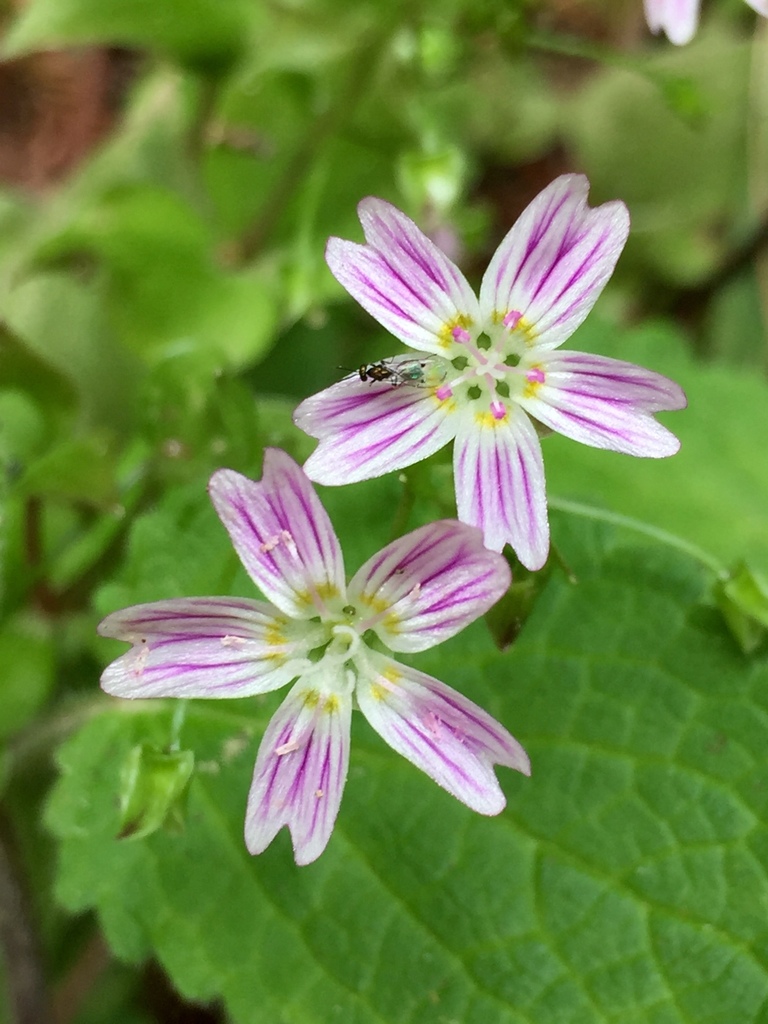
Candy Flower
Claytonia sibirica
Claytonia sibirica is a flowering plant in the family Montiaceae, commonly known as pink purslane, candy flower, Siberian spring beauty or Siberian miner's lettuce. A synonym is Montia sibirica. It is native to Aleutian Islands and western North America and has been introduced into parts of Europe and Scandinavia.
From the article Claytonia sibirica on Wikipedia (CC BY-SA), quoted section by section
Range & habitat
It is found in moist woods. It is long-lived perennial, biennial, or annual with hermaphroditic flowers which are protandrous and self-fertile. The numerous fleshy stems form a rosette and the leaves are linear, lanceolate, or deltate. The flowers are 8–20 mm diameter, with five white, candy-striped, or pink petals; flowering is typically between February and August, but some plants continue to bloom late into autumn.
Wikipedia: “Habitat and description”
At the table
Much like Claytonia perfoliata, the aboveground portion of the plant can be eaten raw or cooked. Some leaves have a poor taste or aftertaste.
Wikipedia: “Uses”
Where it lives
Recorded sightings
—
geo-referenced records in GBIF, from museums, herbaria and field observers.
Drag the globe to turn it. Dots are where records exist, not a range map; darker means more records.
In the stacks
Searching the stacks…
Every page naming Claytonia sibirica in the Biodiversity Heritage Library →
This page is assembled live from iNaturalist, GBIF, Wikipedia, the Source Library and the Internet Archive. It is not yet part of the hand-edited codex. iNaturalist taxon 55767.