- Plants
- ›Vascular Plants
- ›flowering plants
- ›Dicots
- ›Buttercups, Poppies, and Allies
- ›Poppy Family
- ›Poppy Subfamily
- ›Chelidonieae
- ›Chelidonium
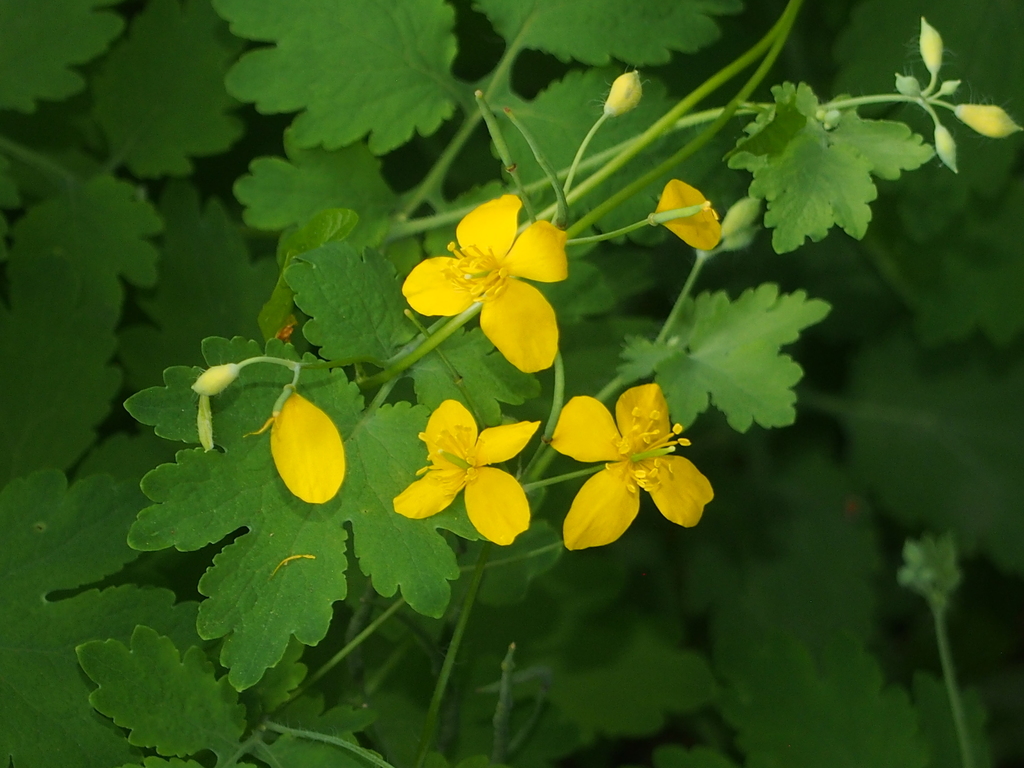
Greater celandine
Chelidonium majus
Chelidonium majus, the greater celandine, is a perennial herbaceous flowering plant in the poppy family Papaveraceae. One of two species in the genus Chelidonium, it is native to Europe and western Asia and introduced widely in North America.
The plant known as lesser celandine (Ficaria verna) is not closely related, as it belongs to the buttercup family Ranunculaceae.
From the article Chelidonium majus on Wikipedia (CC BY-SA), quoted section by section
Description
Greater celandine is a perennial herbaceous plant with an erect habit, and reaches 30–120 cm (12–47 in) high. The blue-green leaves are pinnate with lobed and wavy margins, up to 30 cm (12 in) long. When injured, the plant exudes a yellow to orange latex. The flowers consist of four yellow petals, each about 18 mm (0.71 in) long, with two sepals. A double-flowered variety occurs naturally. The flowers appear from late spring to summer, May to September (in the UK), in umbelliform cymes of about four flowers. The seeds are small and black, borne in a long, cylindrical capsule. Each has an elaiosome, which attracts ants to disperse the seeds (myrmecochory).
Range & habitat
Chelidonium majus is native to most regions of Europe. It is also found in North Africa in Macaronesia, Algeria and Morocco. In Western Asia it is found in the Caucasus, Armenia, Azerbaijan, Georgia, Kazakhstan, Mongolia, Siberia, Iran and Turkey. Its habitats include rocky slopes, woodlands, waste areas and roadsides.
Wikipedia: “Distribution and habitat”
What it does
It is considered an aggressive invasive plant in parts of North America and an invasive plant in other areas. In Wisconsin, for example, it is a restricted plant. Control is obtained mainly via pulling or spraying the plant before seed dispersal.
Wikipedia: “Ecology”
At the table
The yellow sap of plant is used in small quantities for a yellow-orange craft dye, and as an imitation gold paint.
Wikipedia: “Commercial uses”
In medicine
The whole plant is toxic in moderate doses as it contains a range of isoquinoline alkaloids; use in herbal medicine requires the correct dose. The main alkaloid present in the herb and root is coptisine. Other alkaloids present include methyl 2'-(7,8-dihydrosanguinarine-8-yl)acetate, allocryptopine, stylopine, protopine, cryptopine, hemochelidonine, homochelidonine, norchelidonine, berberine, chelidonine, sanguinarine, chelerythrine and 8-hydroxydihydrosanguinarine. Sanguinarine is particularly toxic with an LD50 of 18 mg per kg body weight (IP in rats). Caffeic acid derivatives, such as caffeoylmalic acid, are also present. The characteristic latex also contains proteolytic enzymes and the phytocystatin chelidostatin, a cysteine protease inhibitor. It is a traditional folk remedy against warts in France, German-speaking countries, Hungary, and the UK. It is used in the preparation of a range of off-the-shelf treatments for warts and skin conditions.
Chelidonium is used to make Ukrain, a drug that has been promoted for the treatment of cancer and viral infections but is not known to be effective. The fresh herb is no longer used officially. No dose-finding studies exist and the reported clinical studies are characterised by a considerable heterogeneity. Except for homeopathic medicines, the drug is no longer used in most English-speaking countries. …
Wikipedia: “Constituents and pharmacology”
Where it lives
Recorded sightings
—
geo-referenced records in GBIF, from museums, herbaria and field observers.
Drag the globe to turn it. Dots are where records exist, not a range map; darker means more records.
In the old herbals & bestiaries

Living Images of Plants
Otto Brunfels · 1532 · p.246

Commentaries on the Six Books of Pedanius Dioscorides on Medical Matter
Pietro Andrea Mattioli · 1565 · p.800

On the Virtues of Herbs
Macer Floridus · 1150 · p.238

Latin Herbal
1484 · p.99

Herbarius latinus (with Dutch synonyms)
1486 · p.97

Herbarius latinus (with French synonyms)
1486 · p.101

Living Images of Plants
Otto Brunfels · 1532 · p.243

The Great Herbary with all the figures of the herbs
1532 · p.91

Notable Commentaries on the History of Plants
Leonhart Fuchs · 1542 · p.899

Book of Herbs
Hieronymus Bock (Tragus) · 1546 · p.117

Notable Commentaries on the History of Plants
Leonhart Fuchs · 1549 · p.897

On Medical Materials in Six Books
Dioscorides · 1550 · p.343
In the stacks
Searching the stacks…
Every page naming Chelidonium majus in the Biodiversity Heritage Library →
This page is assembled live from iNaturalist, GBIF, Wikipedia, the Source Library and the Internet Archive. It is not yet part of the hand-edited codex. iNaturalist taxon 55757.