- Plants
- ›Vascular Plants
- ›flowering plants
- ›Dicots
- ›pinks, cactuses, and allies
- ›pink family
- ›Sagineae
- ›Sagina
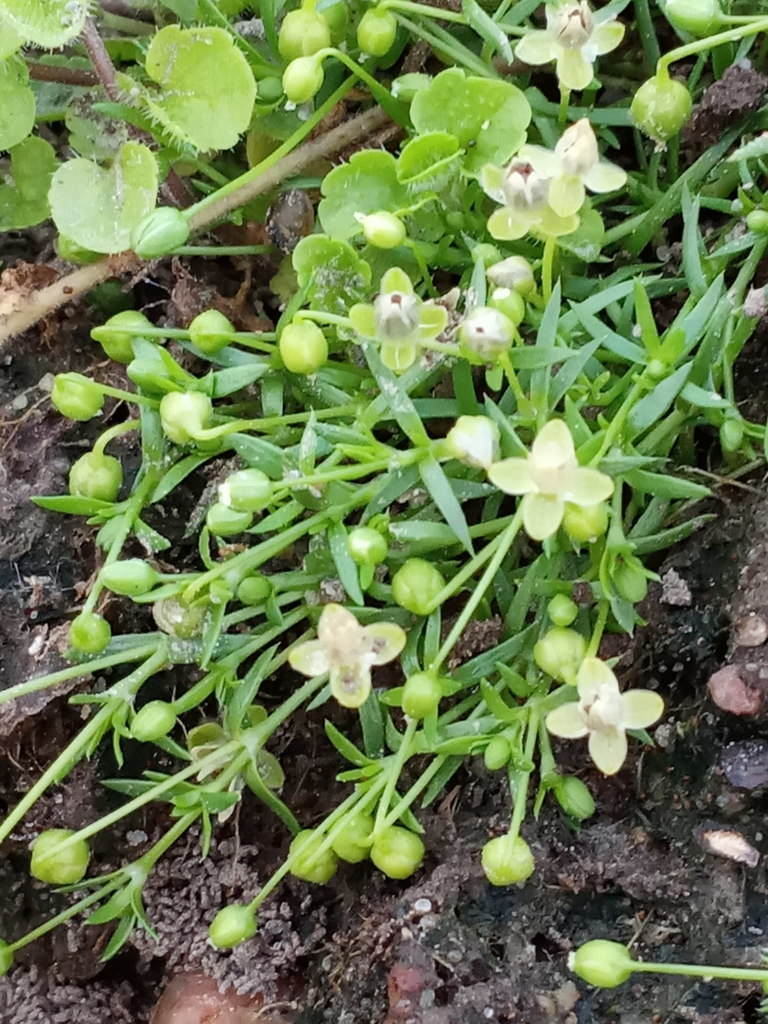
Procumbent Pearlwort
Sagina procumbens
Sagina procumbens (procumbent pearlwort) is a species of flowering plant in the family Caryophyllaceae, native throughout Europe, most of western and central Asia, and northwest Africa. It is a common weed in many environments, and can be found in wild and disturbed habitat, especially moist areas. It can frequently be seen growing in lawns or in cracks in pavements, particularly in block paving, where it resists human trampling well, and is also common in flower pots.
From the article Sagina procumbens on Wikipedia (CC BY-SA), quoted section by section
Description
It is a perennial ground-hugging herb forming clumps or mats of hairless green herbage, sometimes vaguely resembling a patch of moss. The stems root readily at the stem nodes, enabling it to spread widely by vegetative reproduction. The leaves are linear, and up to 1–2 cm long. The inflorescence is a solitary, minute flower with four or five sepals and four or five small white petals, but the petals are sometimes absent; they have 4 free stigmas. The fruit is a small capsule which releases black seeds.
In human culture
Sagina means 'fodder'; the genus was named after a fodder plant, spurrey, which has since been moved into its own genus, Spergula. The species name procumbens means 'procumbent', 'lying flat on the ground' The English name 'pearlwort' is first known from John Ray's 1660 Catalogus plantarum: 151; he did not explain its origin or derivation. Other recorded names include "birdeye pearlwort" and "matted pearlwort".
Wikipedia: “Etymology”
Where it lives
Recorded sightings
—
geo-referenced records in GBIF, from museums, herbaria and field observers.
Drag the globe to turn it. Dots are where records exist, not a range map; darker means more records.
In the stacks
Searching the stacks…
Every page naming Sagina procumbens in the Biodiversity Heritage Library →
This page is assembled live from iNaturalist, GBIF, Wikipedia, the Source Library and the Internet Archive. It is not yet part of the hand-edited codex. iNaturalist taxon 55667.