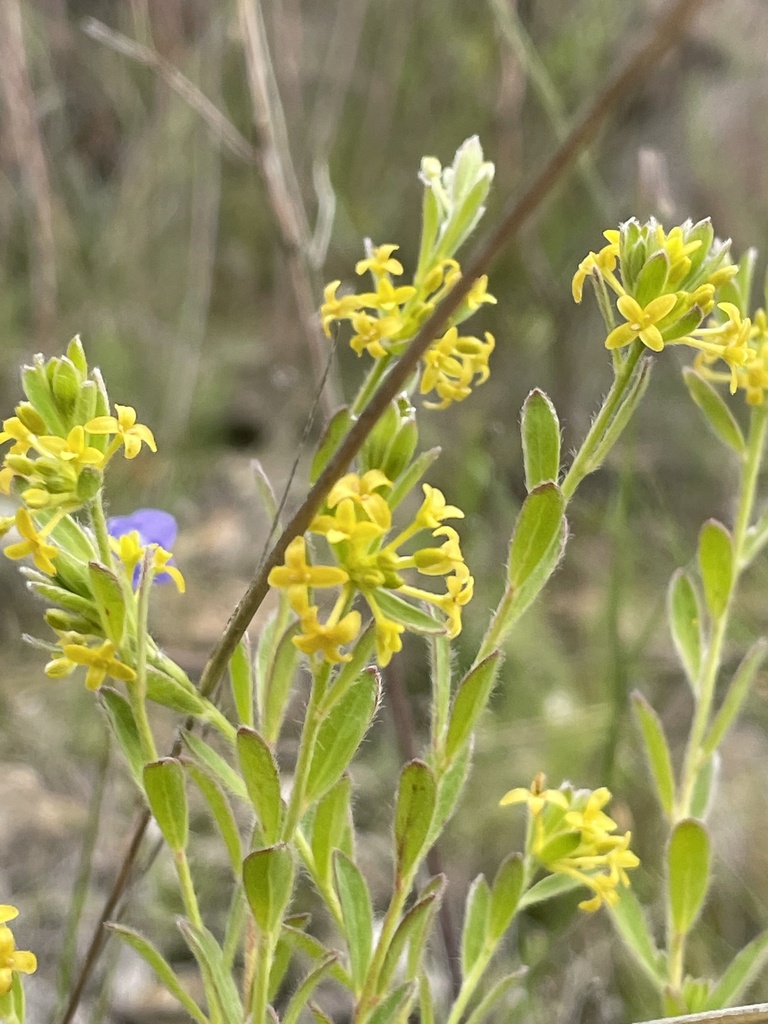
curved rice-flower
Pimelea curviflora
Pimelea curviflora, also known as curved rice-flower, is a shrub in the family Thymelaeaceae and is endemic to Australia. It is a small, hairy shrub with greenish-yellow or red tubular flowers.
From the article Pimelea curviflora on Wikipedia (CC BY-SA), quoted section by section
Description
Pimelea curviflora is a small understory woody shrub 20–150 cm (7.9–59.1 in) high with soft hairy stems. The yellowish-green leaves are elliptic, lance or egg-shaped 5–20 mm (0.20–0.79 in) long, 2–8 mm (0.079–0.315 in) wide and hairy on both sides. The leaves are arranged in opposite pairs or alternately, on a short petiole and end in a pointed tip. The upper leaf hairs are spreading or flattened then becoming silky, short and somewhat less twisted, upper leaf surface smooth or with shorter hairs. The leaves may be uniformly coloured or vary on the upperside or underneath. The 6-20 compact, green-yellow or sometimes reddish, female or bi-sexual flowers have a floral tube 5–12 mm (0.20–0.47 in) long and flaring at the tips, usually hairy and arranged in heads at the end of branches or in leaf axils. The flower bracts may be absent or not conspicuous, the style 2–5 mm (0.079–0.197 in) long, sometimes shorter in female flowers and the pedicels hairy. The dry, green fruit are 2–4 mm (0.079–0.157 in) long. Flowering occurs from late spring to early summer.
Range & habitat
Curved rice-flower is a variable widespread species found growing in New South Wales, south-eastern South Australia, south-eastern Queensland on or near the Great Dividing Range and coastal areas from Brisbane to Adelaide. It grows in forests, grassland and woodlands amongst acacia, eucalypt, callitris, usually on clay and shale soils. Also in rainforest amongst vine thickets. A common, widespread species in Victoria including montane woodland also found in Tasmania. Variety acuta grows in forest and woodland at altitudes between 750 and 1,500 m (2,460 and 4,920 ft) from near Mount Kosciuszko to the Budawang Range in New South Wales and the Australian Capital Territory. Variety curviflora is restricted to coastal areas around Sydney where it grows on sandstone. Variety divergens is widespread on the coast, ranges and western slopes from the Boyne River in Queensland to the Sydney region. Variety gracilis usually grows in forest, sometimes in rocky sites, and is widespread from the extreme south-east of Queensland, through eastern New South Wales and southern Victoria to south-eastern South Australia and northern Tasmania. Variety sericea grows in sandy soil in open forest from the extreme south-east of Queensland, in eastern New South Wales and Victoria, where it is widespread, to south-eastern South Australia and islands of the Furneaux Group in Tasmania. …
Wikipedia: “Distribution and habitat”
Where it lives
Recorded sightings
—
geo-referenced records in GBIF, from museums, herbaria and field observers.
Drag the globe to turn it. Dots are where records exist, not a range map; darker means more records.
In the stacks
Searching the stacks…
Every page naming Pimelea curviflora in the Biodiversity Heritage Library →
This page is assembled live from iNaturalist, GBIF, Wikipedia, the Source Library and the Internet Archive. It is not yet part of the hand-edited codex. iNaturalist taxon 556568.