- Plants
- ›Vascular Plants
- ›flowering plants
- ›Dicots
- ›Sunflowers, Bellflowers, Fanflowers, and Allies
- ›fanflower family
- ›Scaevola
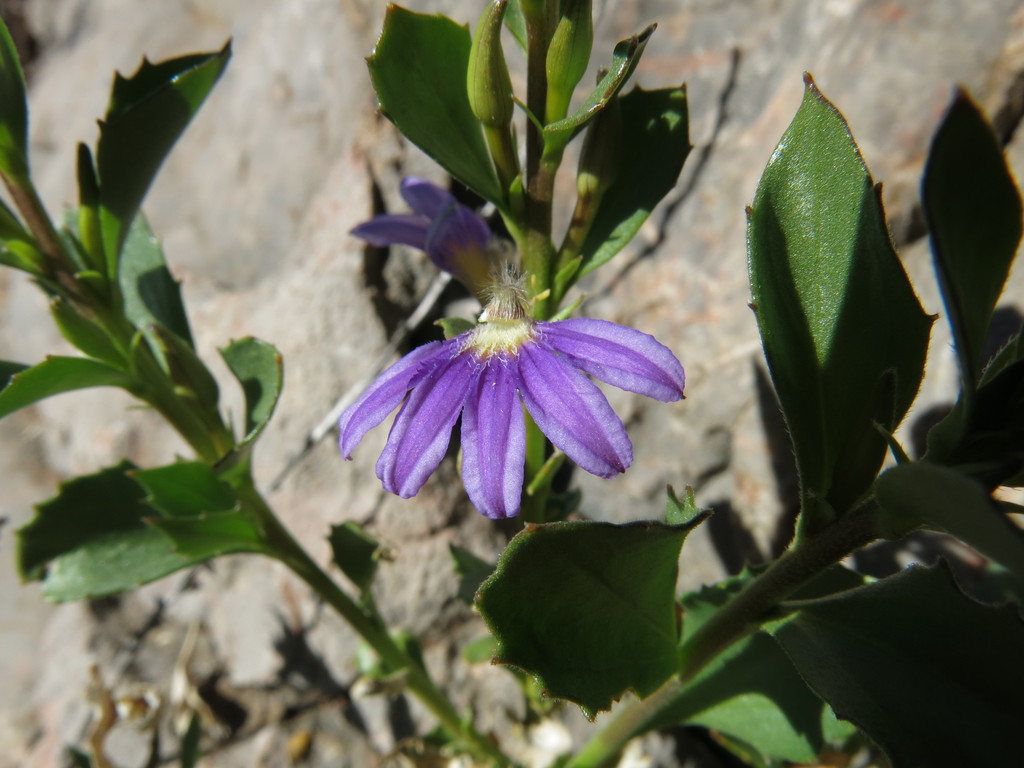
Scaevola glabrata
Scaevola glabrata is a species of flowering plant in the family Goodeniaceae. It is a small, spreading shrub with fan-shaped blue flowers and elliptic to egg-shaped leaves.
From the article Scaevola glabrata on Wikipedia (CC BY-SA), quoted section by section
Description
Scaevola glabrata is a spreading understorey shrub up to 70 cm (28 in) tall with upright needle-shaped stems that are glabrous or with occasional scattered hairs. The leaves are sessile or with a very short petiole, occasionally almost stem-clasping, egg-shaped, toothed, 21–68 mm (0.83–2.68 in) long and 6–26 mm (0.24–1.02 in) wide. The flowers are borne on spikes up to 12 cm (4.7 in) long, bracts elliptic-oval shaped and up to 15 mm (0.59 in) long. The blue corolla is 14–24 mm (0.55–0.94 in) long, hairy on the outside, bearded inside and the wings up to 10 mm (0.39 in) wide. Flowering occurs February to September and the fruit is cylinder-shaped, 4–6 mm (0.16–0.24 in) long, wrinkled and covered in soft hairs.
Range & habitat
This scaevola grows mostly in rocky locations, sometimes in sand, extending from the Northern Territory, not including Arnhem Land, south to the northern parts of South Australia and just over the border into Queensland.
== References ==
Wikipedia: “Distribution and habitat”
Where it lives
Recorded sightings
—
geo-referenced records in GBIF, from museums, herbaria and field observers.
Drag the globe to turn it. Dots are where records exist, not a range map; darker means more records.
In the stacks
Searching the stacks…
Every page naming Scaevola glabrata in the Biodiversity Heritage Library →
This page is assembled live from iNaturalist, GBIF, Wikipedia, the Source Library and the Internet Archive. It is not yet part of the hand-edited codex. iNaturalist taxon 554296.