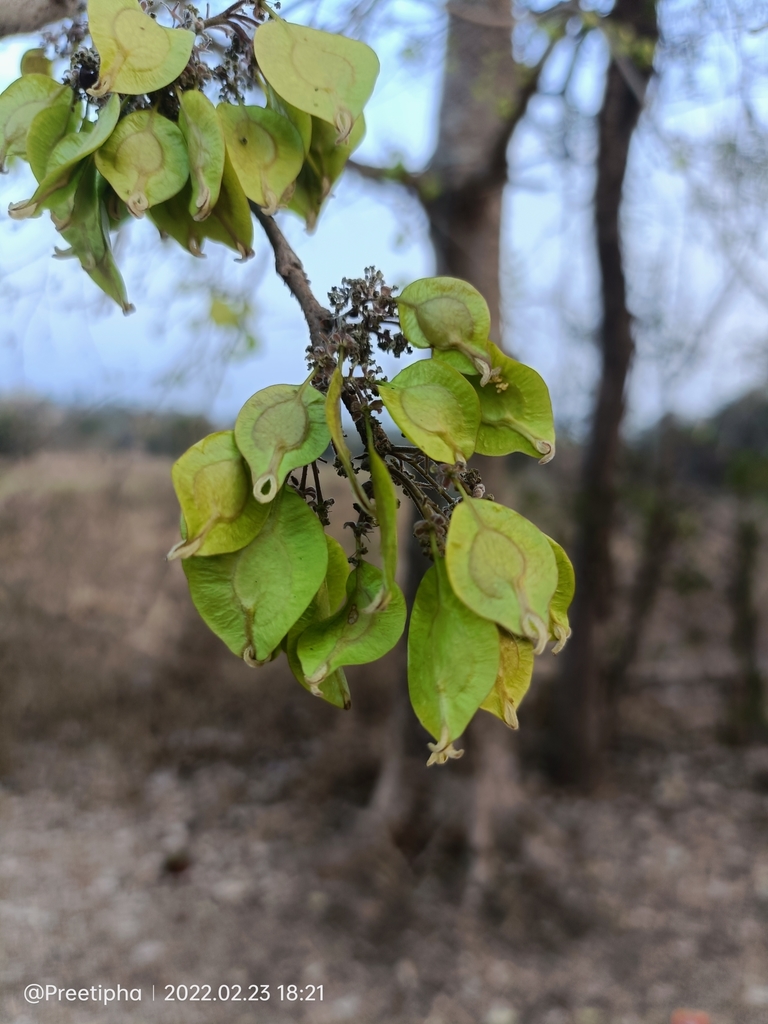
Indian elm
Holoptelea integrifolia
Holoptelea integrifolia, the Indian elm or jungle cork tree, is a species of tree in the family Ulmaceae, and a close relative to the true elms (Ulmus). It is native to most of Indian subcontinent, Indo-China and Myanmar. It is found mostly on plains but also in mountains on elevations up to 1100 m.
From the article Holoptelea integrifolia on Wikipedia (CC BY-SA), quoted section by section
Description
The Indian elm is a large deciduous tree, about 20–25 m tall (rarely over 30 m), with a broad crown featuring several ascending branches. Bark is grey in colour, covered with blisters, peeling in corky scales on old trees. Leaves are alternately arranged, elliptic-ovate in shape, 8–13 cm long and 3–6.5 cm wide, smooth, with entire margins (occasionally toothed), and a pointed tip. Leaf base is rounded or heart-shaped. Stipules are lance-shaped. Crushed leaves emit an unpleasant odour. Flowers are small, greenish-yellow to brownish, pubescent, borne in short racemes or fascicles at the scars of fallen leaves. Sepals are velvety, often 4. Fruit is a circular samara, 2.5 cm in diameter, with membranous, net-veined wings, and flat seed.
At the table
Holoptelea integrifolia is used for timber which makes cheap furniture and also used as firewood in rural parts. It is also used in ecological forestry for its heat and drought tolerance and regenerative abilities. Its flowers, leaves and bark have medicinal uses against several diseases.
Wikipedia: “Cultivation and uses”
How it is grown
Propagation of this tree is easy. The seeds are just flying around. These seeds can be planted in moist soil in a nursery bag or directly at the permanent location using direct seed plantation method. Sticks of bamboo can be used for marking and support. Germination takes place after about 10 days. The tree is quite fast growing. These trees can be planted at 6 × 15 feet. They act as good carbon sink due to fast growth.
Wikipedia: “Propagation”
Where it lives
Recorded sightings
—
geo-referenced records in GBIF, from museums, herbaria and field observers.
Drag the globe to turn it. Dots are where records exist, not a range map; darker means more records.
In the stacks
Searching the stacks…
Every page naming Holoptelea integrifolia in the Biodiversity Heritage Library →
This page is assembled live from iNaturalist, GBIF, Wikipedia, the Source Library and the Internet Archive. It is not yet part of the hand-edited codex. iNaturalist taxon 553635.