- Plants
- ›Vascular Plants
- ›flowering plants
- ›Dicots
- ›proteas, lotuses, planes, and allies
- ›plane family
- ›Platanus
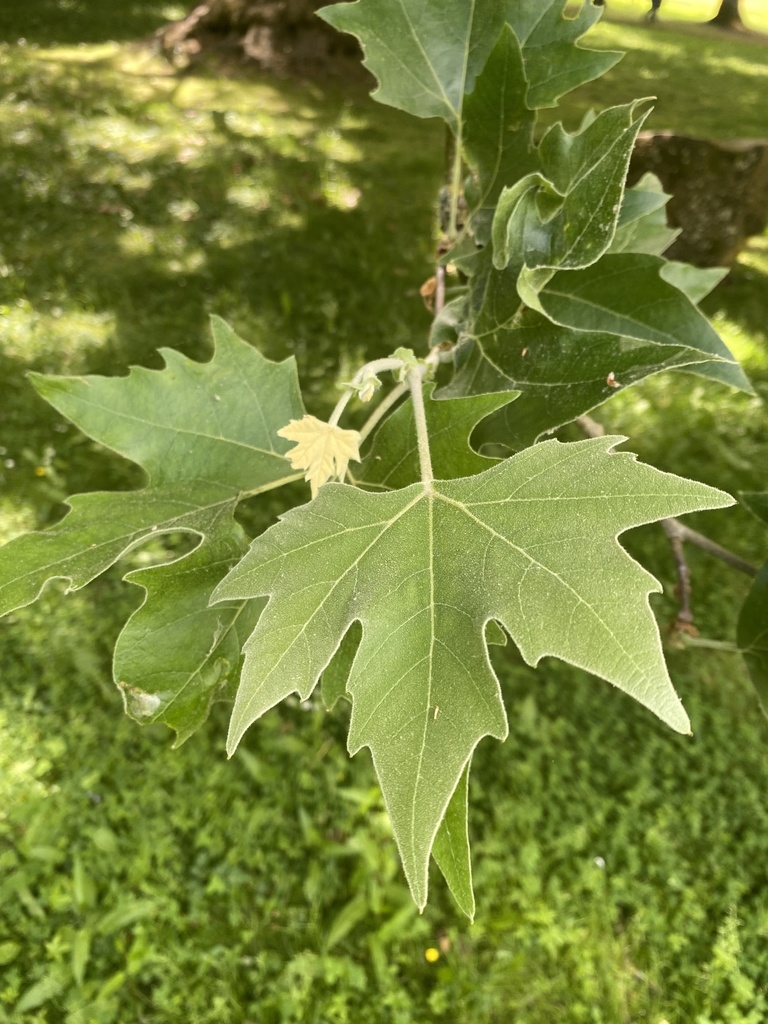
London Plane
Platanus × hispanica
Platanus × acerifolia, the London plane, London planetree, or hybrid plane, is a tree in the genus Platanus. It is usually thought to be a hybrid of Platanus orientalis (oriental plane) and Platanus occidentalis (American sycamore). Some authorities think that it may be a cultivar of P. orientalis.
From the article London plane on Wikipedia (CC BY-SA), quoted section by section
Description
The London plane is a large deciduous tree growing 20–40 m (65–130 ft), exceptionally to 50 m (160 ft) tall, with a trunk up to 10 m (33 ft) in circumference. The bark is usually pale grey-green, smooth and exfoliating, or buff-brown and not exfoliating. The leaves are thick and stiff-textured, broad, palmately lobed, superficially maple-like, the leaf blade 10–20 cm (4–8 in) long and 12–25 cm (5–10 in) broad, with a petiole 3–10 cm (1–4 in) long. The young leaves in spring are coated with minute, fine, stiff hairs at first, but these wear off and by late summer the leaves are hairless or nearly so. The flowers are borne in one to three (most often two) dense spherical inflorescences on a pendulous stem, with male and female flowers on separate stems (monoecy). The fruit matures in about 6 months, to 2–3 centimetres (0.8–1.2 in) diameter, and comprises a dense spherical cluster of achenes with numerous stiff hairs which aid wind dispersal; the cluster breaks up slowly over the winter to release the numerous 2–3 mm (0.08–0.12 in) seeds. …
At the table
The London plane is very tolerant of atmospheric pollution and root compaction, and for this reason it is a popular urban roadside tree. It was planted extensively in Victorian times to weather the pollution of London. It is now extensively cultivated in most temperate latitudes as an ornamental and parkland tree, and is a commonly planted tree in cities throughout the temperate regions of the world, in London and many other cities. It has a greater degree of winter cold tolerance than P. orientalis, and is less susceptible to anthracnose disease than P. occidentalis. The tree has gained the Royal Horticultural Society of Great Britain's Award of Garden Merit. Two of 50 "Great British Trees" that the Tree Council selected in 2002 in honour of Queen Elizabeth II's Golden Jubilee are London planes. The list specifically mentions Britain's first London plane being in the city of Ely, Cambridgeshire. The tree is fairly wind-resistant. However, it has a number of problems in urban use, most notably the short, stiff hairs shed by the young leaves and the dispersing seeds; these are an irritant if breathed in, and can exacerbate breathing difficulties for people with asthma. The vigorous roots can also cause problems with paving in cities, making uneven surfaces with tripping hazards. …
Wikipedia: “Cultivation and uses”
Where it lives
Recorded sightings
—
geo-referenced records in GBIF, from museums, herbaria and field observers.
Drag the globe to turn it. Dots are where records exist, not a range map; darker means more records.
In the stacks
Searching the stacks…
Every page naming Platanus × hispanica in the Biodiversity Heritage Library →
This page is assembled live from iNaturalist, GBIF, Wikipedia, the Source Library and the Internet Archive. It is not yet part of the hand-edited codex. iNaturalist taxon 552449.