- Plants
- ›Vascular Plants
- ›flowering plants
- ›Dicots
- ›pepper plants, birthworts, and allies
- ›birthwort family
- ›Aristolochioideae
- ›Aristolochia
- ›Siphisia
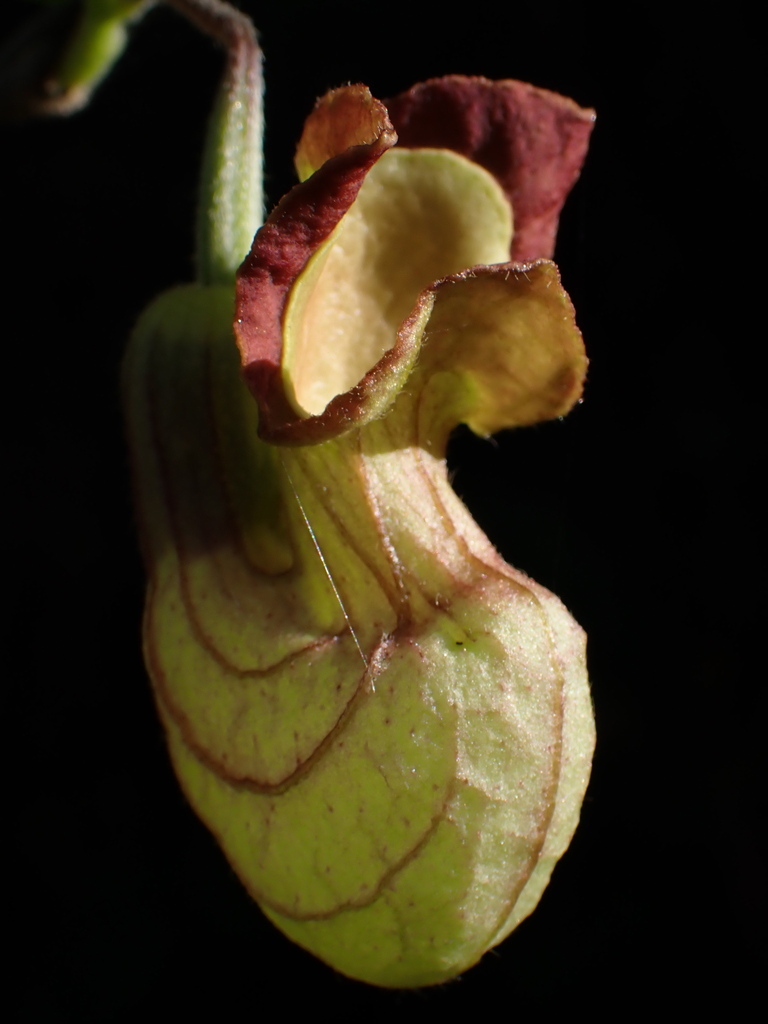
California Dutchman's Pipe
Aristolochia californica
Aristolochia californica, the California pipevine, California Dutchman's-pipe, or California snakeroot is a perennial woody vine of western North America.
From the article Aristolochia californica on Wikipedia (CC BY-SA), quoted section by section
Description
Aristolochia californica is a deciduous vine. It grows from rhizomes, to a length usually around 5 feet (1.5 m), but can reach over 20 feet (6.1 m). The twining trunk can become quite thick in circumference at maturity. It sends out new green heart-shaped leaves after it blooms. The bloom period is January through April. The plant produces large, green-to-pale-brown, curving pipe-shaped flowers, with purple veins and a yellow-to-red lining. The U-shaped flowers produce winged capsular green fruits.
Pollination. The California pipevine's flowers have a musty unpleasant odor which is attractive to tiny carrion-feeding insects. The insects crawl into the convoluted flowers and often become stuck and disoriented for some time, picking up pollen as they wander. Most eventually escape. The plant is not insectivorous, as was formerly thought. Fungus gnats (Mycetophilidae) may prove to be the effective pollinators. G.L. Stebbins suggested that pollination by deceit is presumed.
Range & habitat
The vine is endemic to northern California. It is native to the Sacramento Valley, northern Sierra Nevada foothills, San Francisco Bay Area, Northern Inner California Coast Ranges, southeastern Klamath Mountains. The plant grows along riparian streambank areas, in chaparral, oak woodland, and mixed evergreen forest habitats. It is found below 700 metres (2,300 ft) in elevation.
Wikipedia: “Distribution and habitat”
Where it lives
Recorded sightings
—
geo-referenced records in GBIF, from museums, herbaria and field observers.
Drag the globe to turn it. Dots are where records exist, not a range map; darker means more records.
In the stacks
Searching the stacks…
Every page naming Aristolochia californica in the Biodiversity Heritage Library →
This page is assembled live from iNaturalist, GBIF, Wikipedia, the Source Library and the Internet Archive. It is not yet part of the hand-edited codex. iNaturalist taxon 55190.