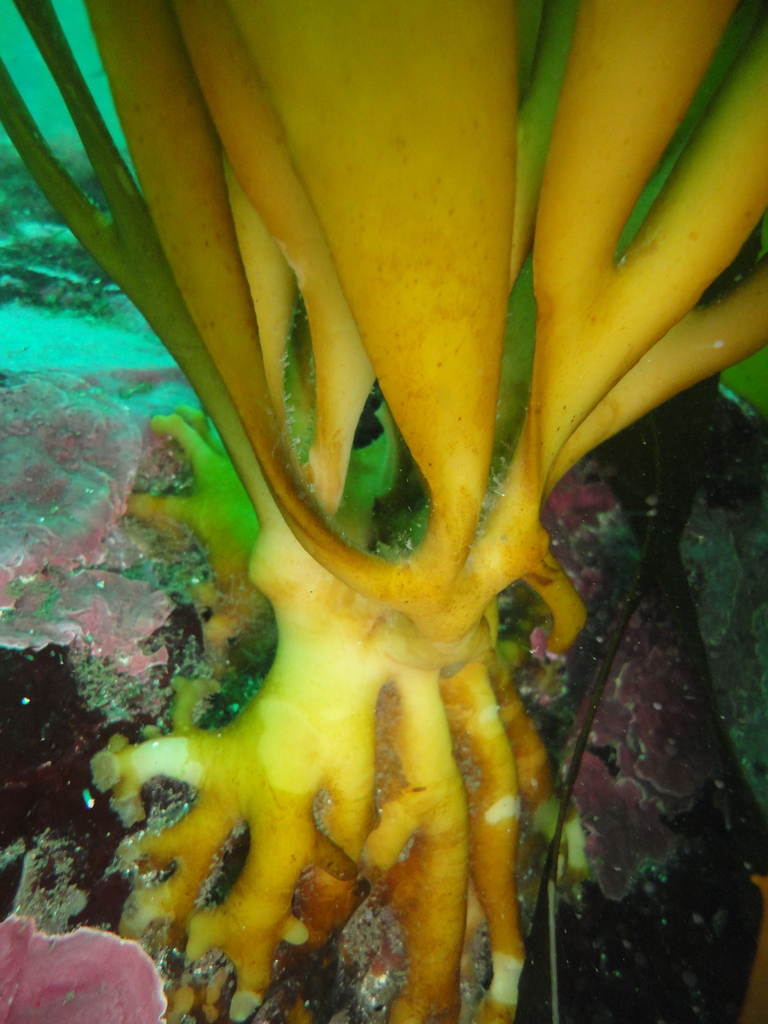
Lessonia trabeculata
Lessonia trabeculata is a species of kelp, a brown alga in the genus Lessonia. It grows subtidally off the coasts of Peru and northern and central Chile, with the closely related Lessonia nigrescens tending to form a separate zone intertidally. Lessonia trabeculata kelp have gained a great economic importance for alginate production, and its harvest has greatly intensified along the Chilean coast during past two decades
From the article Lessonia trabeculata on Wikipedia (CC BY-SA), quoted section by section
Description
This kelp can grow to a length of 2.5 m (8 ft). It is distinguished from all other members of the genus by the presence of trabeculae (cross struts) in the hollow centres of the blades and stipes (stems), and by the massive and irregular holdfast by which the kelp is attached to the rocks.
Range & habitat
Lessonia trabeculata occurs in the southeastern Pacific Ocean, in the subtidal zone off the coasts of Peru and northern and central Chile. Its range extends from Antofagasta to Puerto Montt and its depth range is between 0.5 and 20 m (2 and 66 ft). It forms substantial stands, being found in rocky areas exposed or partially exposed to strong wave action. This species is replaced in the intertidal rocky areas by Lessonia nigrescens, and these two kelps dominate the habitat forming kelp forests. Further south in Chile, Durvillaea antarctica becomes the dominant species of kelp.
Wikipedia: “Distribution and habitat”
What it does
Lessonia trabeculata grows in areas with strong surges, however it can be torn off the rocks during storms such as those associated with El Niño. It seems to have an annual cycle of growth, with the blade elongating fast during the summer, but growth slowing down in the autumn. It is possible to grow this species in the laboratory, and it may be suitable for aquaculture, with the aim of using it to repair damaged stands of kelp.
Wikipedia: “Ecology”
Where it lives
Recorded sightings
—
geo-referenced records in GBIF, from museums, herbaria and field observers.
Drag the globe to turn it. Dots are where records exist, not a range map; darker means more records.
In the stacks
Searching the stacks…
Every page naming Lessonia trabeculata in the Biodiversity Heritage Library →
This page is assembled live from iNaturalist, GBIF, Wikipedia, the Source Library and the Internet Archive. It is not yet part of the hand-edited codex. iNaturalist taxon 550845.