- Plants
- ›Vascular Plants
- ›flowering plants
- ›Dicots
- ›proteas, lotuses, planes, and allies
- ›Protea family
- ›Paired Proteas
- ›Embothrieae
- ›Hakeinae
- ›Hakea
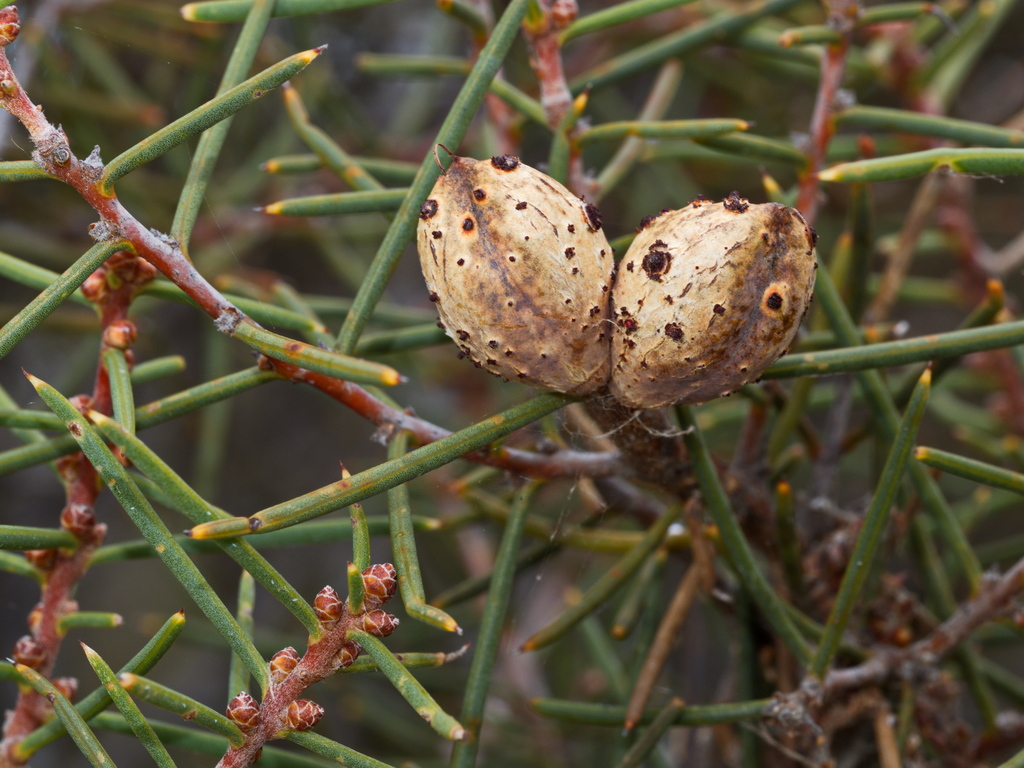
desert Hakea
Hakea mitchellii
Hakea mitchellii, commonly known as desert hakea, is a shrub species in the family Proteaceae.
From the article Hakea mitchellii on Wikipedia (CC BY-SA), quoted section by section
Description
Hakea mitchellii is a dense rounded medium to large shrub between 1–4 m (3–10 ft) high and wide and does not form a lignotuber. Leaves vary from terete, linear to ovate are 3.5–10 cm (1–4 in) long and 1–10 cm (0.4–4 in) wide. Profuse showy white or cream flowers appear in racemes in the leaf axils between October and January in the species' native range. Ellipsoidal to ovoid shaped fruit 1–2 cm (0.4–0.8 in) long by 0.5–1.5 cm (0.2–0.6 in) wide tapering to a small beak.
Range & habitat
Desert hakea grows in mallee-heath vegetation on calcareous sandy soil. Mainly a South Australian species occurring on Eyre, Yorke and Fleurieu Peninsulas, Kangaroo Island and south of the Murray River to Naracoorte, extending into western Victoria.
== References ==
Wikipedia: “Distribution and habitat”
Where it lives
Recorded sightings
—
geo-referenced records in GBIF, from museums, herbaria and field observers.
Drag the globe to turn it. Dots are where records exist, not a range map; darker means more records.
In the stacks
Searching the stacks…
Every page naming Hakea mitchellii in the Biodiversity Heritage Library →
This page is assembled live from iNaturalist, GBIF, Wikipedia, the Source Library and the Internet Archive. It is not yet part of the hand-edited codex. iNaturalist taxon 550583.