- Plants
- ›Vascular Plants
- ›flowering plants
- ›Dicots
- ›proteas, lotuses, planes, and allies
- ›Protea family
- ›Singlet Proteas
- ›Nutseed Proteoid Clade
- ›Adenanthinae
- ›Adenanthos
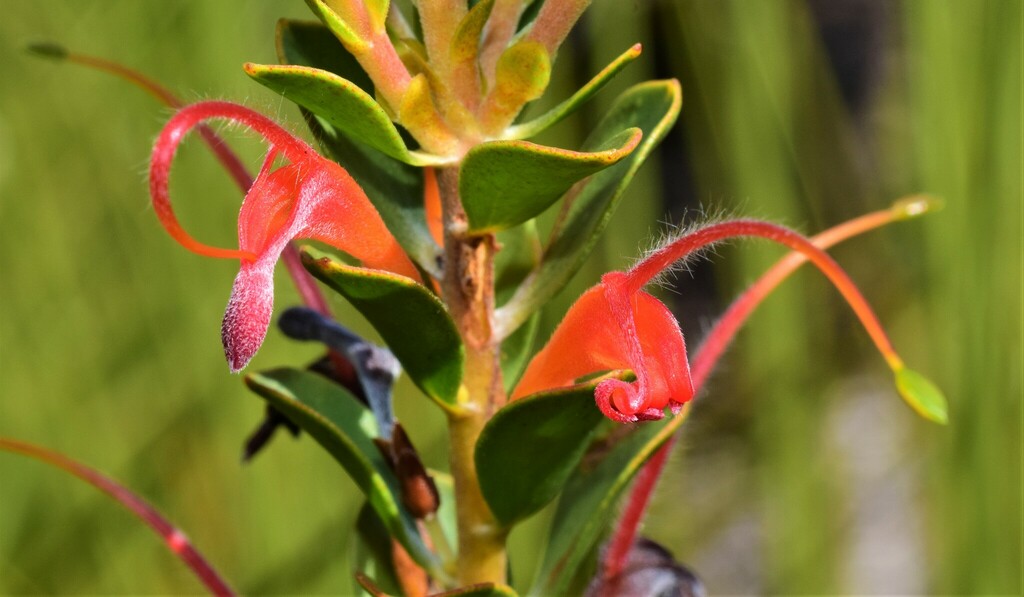
jugflower
Adenanthos obovatus
Adenanthos obovatus, commonly known as basket flower (which usually refers to Centaurea, though), or, jugflower, is a shrub of the plant family Proteaceae endemic to Southwest Australia. Described by French naturalist Jacques Labillardière in 1805, it had first been collected by Archibald Menzies in 1791. Within the genus Adenanthos, it lies in the section Eurylaema and is most closely related to A. barbiger. A. obovatus has hybridized with A. detmoldii to produce the hybrid A. × pamela. Several common names allude to the prominent red flowers of the species. It grows as a many-stemmed spreading bush up to 1 m (3.3 ft) high, and about 1.5 m (4.9 ft) across, with fine bright green foliage. Made up of single red flowers, the inflorescences appear from April to December, and peak in spring (August to October).
The shrub grows on sandy soils in seasonally wet lowland areas as well as hills and dunes. It regenerates after bushfire by resprouting from its underground lignotuber. Pollinators include honeyeaters, particularly the western spinebill, which can access the nectar with its long curved bill, and the silvereye, which punctures the flower tube. The most commonly cultivated Adenanthos species in Australia, it has a long flowering period and attracts honeyeaters to the garden. It is harvested for the cut flower industry.
From the article Adenanthos obovatus on Wikipedia (CC BY-SA), quoted section by section
Description
The growth habit of Adenanthos obovatus is that of a lignotuberous shrub, with many stems arising from a single underground lignotuber. It typically reaches about 1 m (3.3 ft) in height, and about 1.5 m (4.9 ft) in width, but plants occasionally reach a height of 2 m (6.6 ft). The leaves of this species are bright green, oval in shape, up to 20 mm (0.79 in) long and 15 mm (0.59 in) wide, sessile, and arranged in a spiral pattern on the branches. The flowers appear steadily between April and December, and are most frequent between August and October. They are red or orange, and emerge from the leaf axils. They are usually solitary, but occasionally an axil will carry two flowers. As with other Proteaceae species, each flower consists of a perianth of four united tepals, and a single style. In A. obovatus, the perianth is around 25 mm (0.98 in) long, and the style around 40 mm (1.6 in). Although the flowering period is lengthy (six months), there are generally only a few flowers at any one time, and a seven-year study at Harry Waring Marsupial Reserve south of Perth revealed fairly constant flowering from year to year, even when shrubs were cut back to ground level to simulate a bushfire. The species is very similar to A. barbiger. There are obvious differences in typical leaf shape, with leaves of most populations of A. …
Range & habitat
Abundant and widespread, A. obovatus occurs on a wide range of soils, favouring soils in the acidic pH range 3.9–5.4. Like most Adenanthos species it is common on deeply leached siliceous sandplain sand. It also occurs on gravelly quartz sand derived from rock outcrops, such as on the rocky hillslopes of the Stirling Range. It is rarely found on gravelly lateritic soils. It is also one of the few Adenanthos species to grow well in moist environments; it will not tolerate seasonal waterlogging—that niche is filled by A. detmoldii—but thrives in damp soils not subject to waterlogging. Consistent with these edaphic preferences, A. obovatus is widespread and common in the scrub and heath commonly found on the sandplains of Southwest Australia, and is also common in the sedgelands that develop in moister areas of the region. It is uncommon in forest or woodland areas, because these are usually associated with lateritic soils; but it may be found in stands of jarrah or marri forest where these grow in laterite-free sand. The climate in its range is mediterranean, with annual rainfall from 625–1,250 mm (24.6–49.2 in). The species occurs in coastal regions of Southwest Australia, from Gingin and Muchea north of Perth south to Augusta and east along the south coast to Green Range, east of Albany. …
Wikipedia: “Distribution and habitat”
What it does
The western spinebill (Acanthorhynchus superciliosus) is the most frequent visitor to the flowers. A territorial species, the territories are smaller when they contain more Adenanthos obovatus bushes. Their long curved bills fit the tube-like flowers exactly, so that the pollen-presenter brushes against the spinebill's head while it is probing for nectar. The birds then carry pollen from plant to plant, fertilising other plants. A field study marking the pollen with fluorescent dye found that pollen could be deposited on flowers of plants up to 20 metres (66 feet) away from the original flower visited. The New Holland honeyeater (Phylidonyris novaehollandiae) and brown honeyeater (Lichmera indistincta) have also been recorded with pollen from A. obovatus. The silvereye (Zosterops lateralis) drinks nectar from the flowers, but punctures the tube with its short bill. Larger honeyeaters in one field study tended to avoid A. obovatus, possibly seeking sources of more abundant nectar elsewhere. These species are too heavy for the fine branches and their bills are too large for the tubes. Adenanthos obovatus has been recorded as a source of nectar for the honey possum (Tarsipes rostratus) in winter and spring (early June to September), from field studies in the Scott National Park, replaced by A. …
Wikipedia: “Ecology”
How it is grown
Described by Ken Newbey as "an outstanding ornamental species with average foliage and very attractive in flower", A. obovatus was first grown in Great Britain in 1824, and is the most commonly cultivated Adenanthos species in Australia. It flowers for most of the year, is an excellent attractor of honeyeaters, and grows in a range of climates. Propagation is by cuttings of the current season's growth, from which it strikes readily, and subsequently makes fairly quick growth. Despite its natural occurrence in damp locations, in cultivation it grows best in a light, well-drained soil. It prefers a sunny aspect. Regular hard pruning is recommended to maintain an attractive form. Wildflowers of this species are harvested by licensed pickers in the cut flower industry, for sale in both local and export markets. The long, curved stems with flowers in the leaf axils have been described as "excellent for picking".
Wikipedia: “Cultivation”
Where it lives
Recorded sightings
—
geo-referenced records in GBIF, from museums, herbaria and field observers.
Drag the globe to turn it. Dots are where records exist, not a range map; darker means more records.
In the stacks
Searching the stacks…
Every page naming Adenanthos obovatus in the Biodiversity Heritage Library →
This page is assembled live from iNaturalist, GBIF, Wikipedia, the Source Library and the Internet Archive. It is not yet part of the hand-edited codex. iNaturalist taxon 550363.