- Animals
- ›Molluscs
- ›Bivalves
- ›Autobranchia
- ›Pteriomorphia
- ›Scallops and Allies
- ›Jingle and Windowpane Shells
- ›Jingle Shells
- ›Anomia
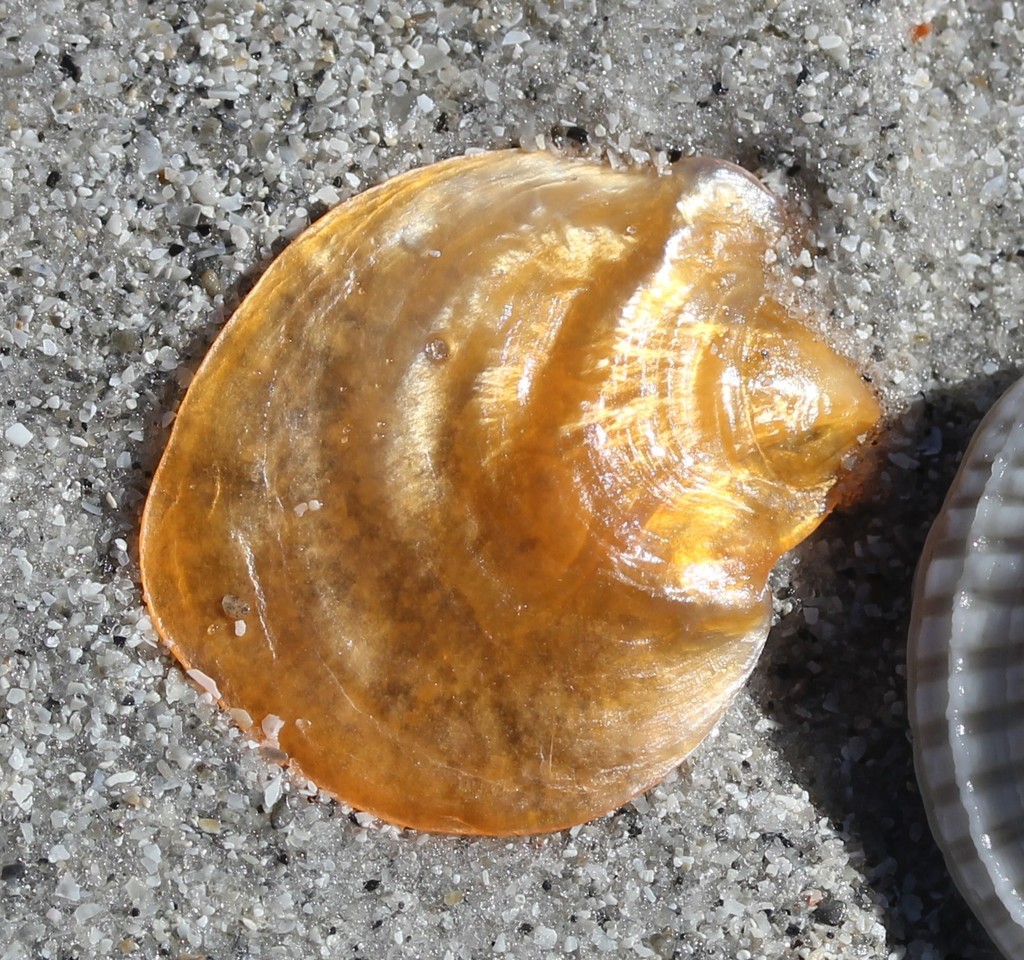
Common Jingle
Anomia simplex
Anomia simplex, the common jingle shell, is a typical species of bivalve mollusc in the family of Anomiidae, sharing attributes to blue mussels, American oysters, and bay scallops. Species related to the family of Anomiidae are often noted for their extremely thin, often translucent, paper-like shells. Anomia simplex can be found in shallow waters, typically estuaries, mainly along the Atlantic Coast of North America; however, they can range as far north as the coast of Nova Scotia, and as far south as the coast of Brazil.
From the article Anomia simplex on Wikipedia (CC BY-SA), quoted section by section
Description
Anomia simplex is a typical species of bivalve mollusk in the family of Anomiidae, similar to blue mussels, American oysters, and bay scallops. The family of Anomiidae ranges from saltwater clams to bivalve mollusks, which contains about 7 genera, including Anomia simplex. Anomiids are most closely recognized for their extremely thin, often translucent, paper-like shells, which can often be used to help manufacture glue, chalk, paints, and other materials. Despite the relatively thin and translucent shell, these shells are very strong and withstand many environmental pressures on hard substrates. Anomia simplex have often been referred to as “common jingle shells,” “gold shells,” and even “Mermaid’s Toenails.” The origin of the nickname “jingle shell” refers to the sound a collection or grouping of these shells will make when carried in a container and mixed around, producing a “jingle.” Also, when several shells are strung together on a coast, they can produce their characteristic chime effect through wave action. Their relative abundance across various coastal regions suggests they are a common shell to come across, and therefore suggests the name of “common jingle shell.” In terms of physical structure, Anomia simplex can reach up to 1-3 inches and are noted for the dissimilarity between the upper and lower valves of their bivalve conformation. …
Range & habitat
Anomia simplex is found throughout the year in shallow waters: typically estuaries, bays, or beaches, from the low tide water line all the way up to 30 feet deep. Common jingle shells are found coexisting in oyster beds and mollusk shells as far north as the coast of Nova Scotia, and as far south as the coast of Brazil. Overall, Anomia simplex is densely populated on the Atlantic Coast of North America. In terms of habitat, these bivalve mollusks attach themselves to hard objects in the water for structure, which can be other shells such as oyster beds and mollusk shells, or simply hard substrate such as a rock. The lower valve is responsible for anchoring the bivalve mollusk onto the substrate, in which it will spend the majority of its lifetime as a filter feeder. Therefore, it is imperative for the bivalve mollusk to anchor itself to a prosperous and nutrient-rich environment in order to ensure the longevity of life.
Wikipedia: “Distribution and habitat”
Where it lives
Recorded sightings
—
geo-referenced records in GBIF, from museums, herbaria and field observers.
Drag the globe to turn it. Dots are where records exist, not a range map; darker means more records.
In the stacks
Searching the stacks…
Every page naming Anomia simplex in the Biodiversity Heritage Library →
This page is assembled live from iNaturalist, GBIF, Wikipedia, the Source Library and the Internet Archive. It is not yet part of the hand-edited codex. iNaturalist taxon 55024.