- Plants
- ›Vascular Plants
- ›flowering plants
- ›Dicots
- ›Mustards, Capers, and Allies
- ›mustard family
- ›Brassicoideae
- ›Camelinodae
- ›Arabidopsideae
- ›Arabidopsis
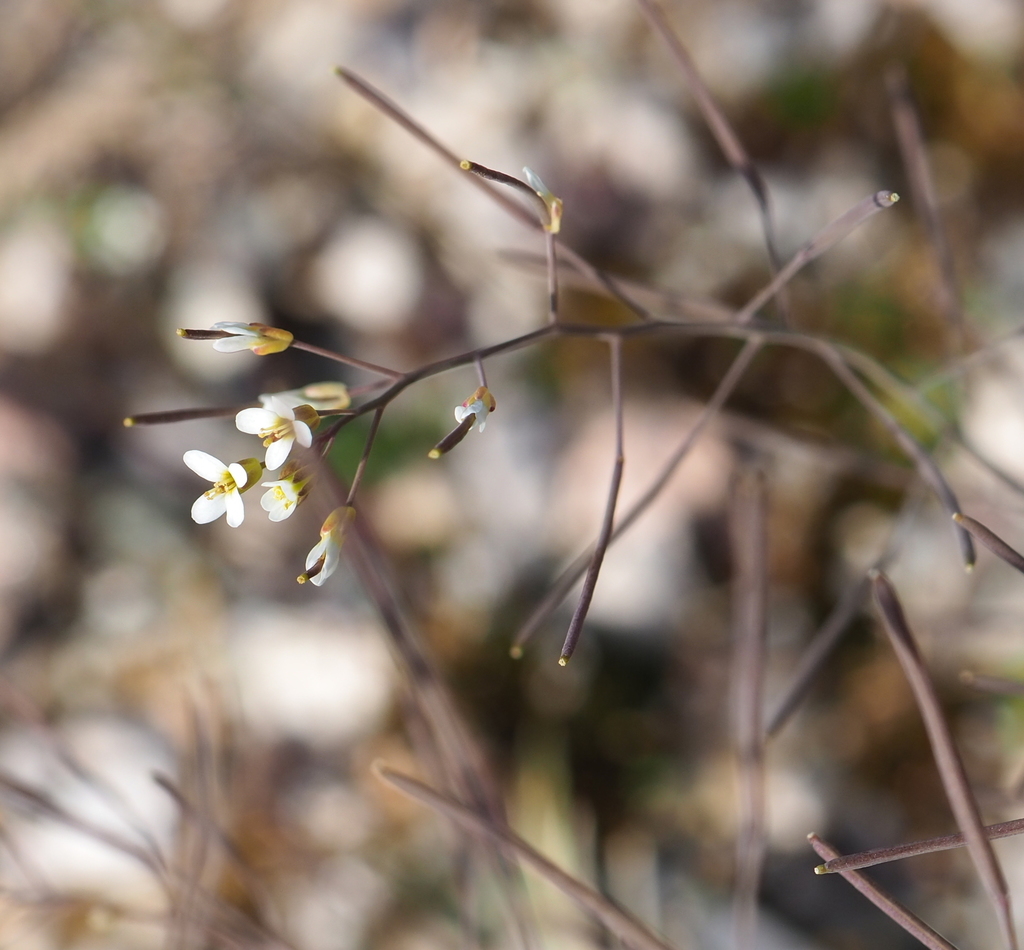
mouse-ear cress
Arabidopsis thaliana
Arabidopsis thaliana, the thale cress, mouse-ear cress or arabidopsis, is a small plant from the mustard family (Brassicaceae), native to Eurasia and Africa. Commonly found along the shoulders of roads and in disturbed land, it is generally considered a weed.
A winter annual with a relatively short lifecycle, A. thaliana is a popular model organism in plant biology and genetics. For a complex multicellular eukaryote, A. thaliana has a relatively small genome of around 135 megabase pairs. It was the first plant to have its genome sequenced, and is an important tool for understanding the molecular biology of many plant traits, including flower development and light sensing.
From the article Arabidopsis thaliana on Wikipedia (CC BY-SA), quoted section by section
Description
Arabidopsis thaliana is an annual (rarely biennial) plant, usually growing to 20–25 cm tall. The leaves form a rosette at the base of the plant, with a few leaves also on the flowering stem. The basal leaves are green to slightly purplish in color, 1.5–5 cm long, and 2–10 mm broad, with an entire to coarsely serrated margin; the stem leaves are smaller and unstalked, usually with an entire margin. Leaves are covered with small, unicellular hairs called trichomes. The flowers are 3 mm in diameter, arranged in a corymb; their structure is that of the typical Brassicaceae. The fruit is a silique 5–20 mm long, containing 20–30 seeds. Roots are simple in structure, with a single primary root that grows vertically downward, later producing smaller lateral roots. These roots form interactions with rhizosphere bacteria such as Bacillus megaterium.
A. thaliana can complete its entire lifecycle in six weeks. The central stem that produces flowers grows after about 3 weeks, and the flowers naturally self-pollinate. In the lab, A. thaliana may be grown in Petri plates, pots, or hydroponics, under fluorescent lights or in a greenhouse.
Range & habitat
A. thaliana is native to Europe, Asia, and Africa, and its geographic distribution is rather continuous from the Mediterranean to Scandinavia and Spain to Greece. It also appears to be native in tropical alpine ecosystems in Africa and perhaps South Africa. It has been introduced and naturalized worldwide, including in North America around the 17th century. A. thaliana readily grows and often pioneers rocky, sandy, and calcareous soils. It is generally considered a weed, due to its widespread distribution in agricultural fields, roadsides, railway lines, waste ground, and other disturbed habitats, but due to its limited competitive ability and small size, it is not categorized as a noxious weed. Like most Brassicaceae species, A. thaliana is edible by humans in a salad or cooked, but its use as a spring vegetable is not widespread.
Wikipedia: “Distribution and habitat”
What it does
Understanding how plants achieve resistance is important to protect the world's food production, and the agriculture industry. Many model systems have been developed to better understand interactions between plants and bacterial, fungal, oomycete, viral, and nematode pathogens. A. thaliana has been a powerful tool for the study of the subdiscipline of plant pathology, that is, the interaction between plants and disease-causing pathogens.
The use of A. thaliana has led to many breakthroughs in the advancement of knowledge of how plants manifest plant disease resistance. The reason most plants are resistant to most pathogens is through nonhost resistance - not all pathogens will infect all plants. An example where A. thaliana was used to determine the genes responsible for nonhost resistance is Blumeria graminis, the causal agent of powdery mildew of grasses. A. thaliana mutants were developed using the mutagen ethyl methanesulfonate and screened to identify mutants with increased infection by B. graminis. The mutants with higher infection rates are referred to as PEN mutants due to the ability of B. graminis to penetrate A. thaliana to begin the disease process. The PEN genes were later mapped to identify the genes responsible for nonhost resistance to B. …
Wikipedia: “Plant–pathogen interactions”
Where it lives
Recorded sightings
—
geo-referenced records in GBIF, from museums, herbaria and field observers.
Drag the globe to turn it. Dots are where records exist, not a range map; darker means more records.
In the stacks
Searching the stacks…
Every page naming Arabidopsis thaliana in the Biodiversity Heritage Library →
This page is assembled live from iNaturalist, GBIF, Wikipedia, the Source Library and the Internet Archive. It is not yet part of the hand-edited codex. iNaturalist taxon 55021.