- Plants
- ›Vascular Plants
- ›flowering plants
- ›Dicots
- ›begonias, gourds, and allies
- ›gourd family
- ›Benincaseae
- ›Cucumis
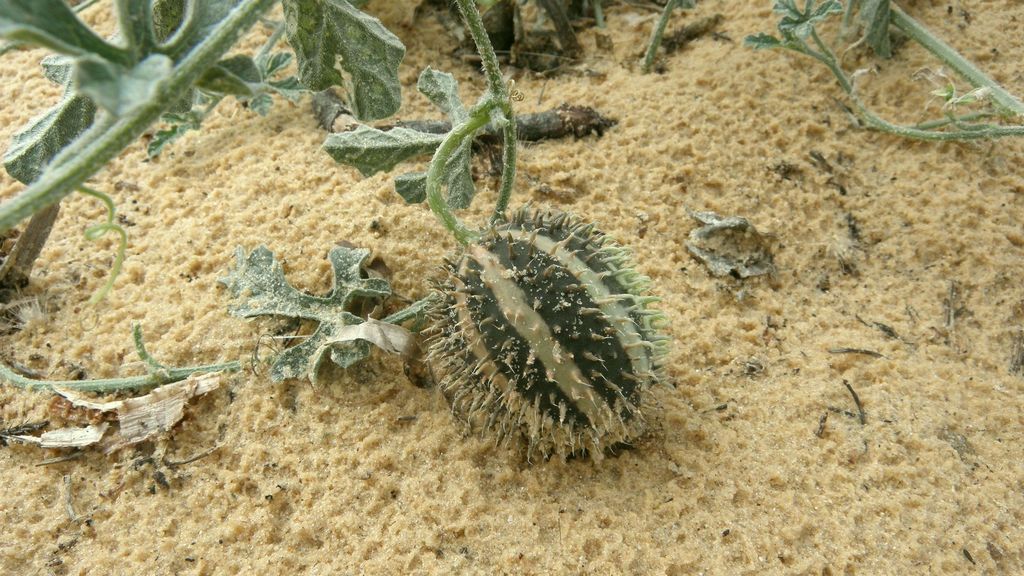
Cucumis ficifolius
Cucumis ficifolius is a dioecious flowering vine in the family Cucurbitaceae. The specific epithet (ficifolius) is derived from the Latin words ficus meaning "fig tree" and folium meaning "leaf".
From the article Cucumis ficifolius on Wikipedia (CC BY-SA), quoted section by section
Description
It is normally a prostrate plant with coarse, hairy stems and leaves. The leaf shape is ovate in outline and weakly cordate or subtruncate at the base and has 3–5 rounded lobes. The flowers occur solitarily and in males have yellow petals that measure 4–7 millimeters long each and in females measure 5–9 millimeters long each. The fruit is ovate and measures 23–50 millimeters (0.91–1.97 inches) in length and is green-yellow in color and is covered in small pustules that may look similar to spikes. The entire plant (stems, leaves, fruits, roots) is poisonous upon ingestion.
Range & habitat
Cucumis ficifolius is native to Africa and is found from Mauritania south to Ghana and Ivory Coast and east to the Horn of Africa and Tanzania and southwest to South Africa, as well as the Sinai Peninsula.
Wikipedia: “Distribution”
Where it lives
Recorded sightings
—
geo-referenced records in GBIF, from museums, herbaria and field observers.
Drag the globe to turn it. Dots are where records exist, not a range map; darker means more records.
In the stacks
Searching the stacks…
Every page naming Cucumis ficifolius in the Biodiversity Heritage Library →
This page is assembled live from iNaturalist, GBIF, Wikipedia, the Source Library and the Internet Archive. It is not yet part of the hand-edited codex. iNaturalist taxon 54918.