- Plants
- ›Vascular Plants
- ›flowering plants
- ›monocots
- ›lilies, supplejacks, and allies
- ›Peruvian Lily family
- ›Alstroemeria
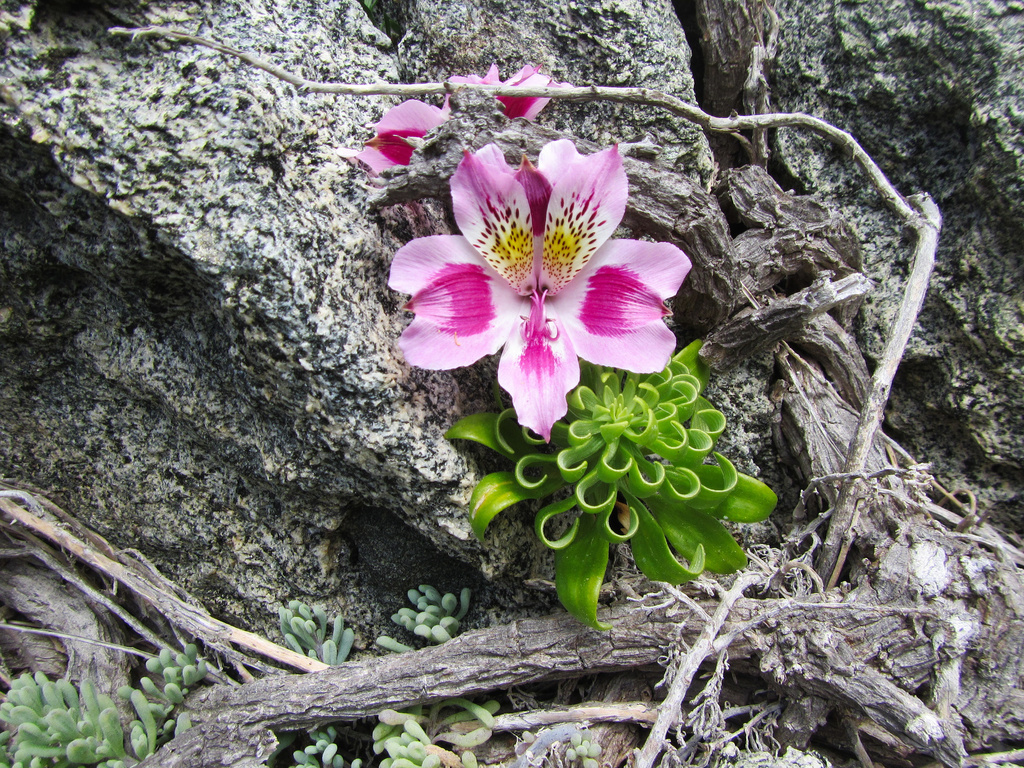
Alstroemeria pelegrina
Alstroemeria pelegrina, the Peruvian lily, is a species of flowering plant in the large genus Alstroemeria of the family Alstroemeriaceae (Inca-lilies), part of the monocot order Liliales. It is the type-species of that genus, originally described by Linnaeus in 1762 as one of three species of Alstroemeria. It is a herbaceous rhizomatous perennial endemic to Chile.
From the article Alstroemeria pelegrina on Wikipedia (CC BY-SA), quoted section by section
Description
The plant stems reach 20 to 60 cm in height, glabrous (smooth) in the upper part and scaly in the lower. The rhizomes are cylindrical, branched and elongated with roots that are long and thin. From the upper third of the stem arise leaves that are a vivid green in colour and arranged spirally and twisted so that their tips are on the side. The flowers are large and showy, the tepals being 4.5–5.5 cm in length, being an intense pink color with a purple centre. The stamens have purplish anthers. The ovary is glabrous, with 6 prominent ribs. The seeds are brow and spherical.
Range & habitat
Alstroemeria pelegrina is endemic to the Norte Chico and central regions of Chile, but it is also found in Peru. It is found between Los Vilos (Choapa Province, Coquimbo Region) and Punta Curaumilla (Valparaíso Province, Valparaíso Region) to the south, a Mediterranean littoral climate. A large population is found in the coastal region between Los Molles (Valparaíso) and Pichidangui, near Los Vilos, where it has the local name mariposa de Los Molles (Los Molles butterfly). The preferred habitat is in rocks and coastal cliffs at the level of high tide.
Wikipedia: “Distribution and habitat”
What it does
Alstroemeria pelegrina blooms annually between October and December, with fruit appearing after the end of October.
Wikipedia: “Ecology”
How it is grown
Alstroemeria pelegrina was the first species of Alstroemeria to be taken to Europe and cultivated there (1744). Hardy to USDA zones 10a–11. In the United States it is grown in California, Louisiana, Texas and Florida.
Wikipedia: “Cultivation”
Where it lives
Recorded sightings
—
geo-referenced records in GBIF, from museums, herbaria and field observers.
Drag the globe to turn it. Dots are where records exist, not a range map; darker means more records.
In the stacks
Searching the stacks…
Every page naming Alstroemeria pelegrina in the Biodiversity Heritage Library →
This page is assembled live from iNaturalist, GBIF, Wikipedia, the Source Library and the Internet Archive. It is not yet part of the hand-edited codex. iNaturalist taxon 549116.