- Plants
- ›Vascular Plants
- ›flowering plants
- ›Dicots
- ›Mallows, Rock Roses, and Allies
- ›Mallow and Hibiscus Family
- ›Linden subfamily
- ›Tilia
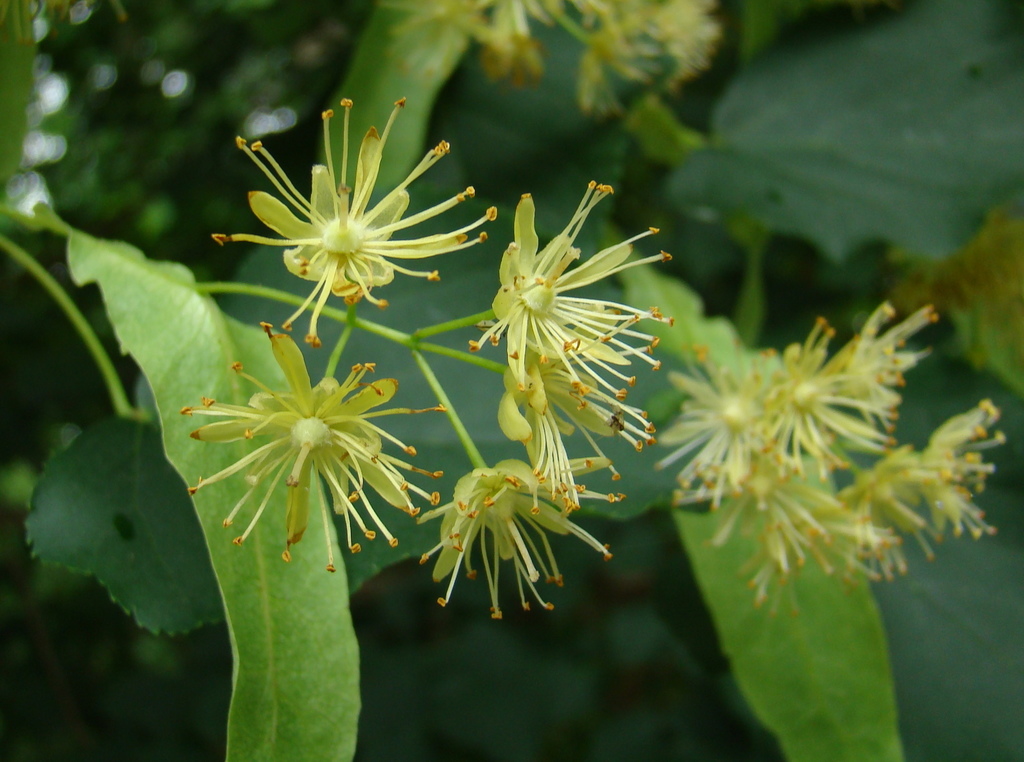
basswood
Tilia americana
Tilia americana is a species of tree in the family Malvaceae. It is native to eastern North America, from southeast Manitoba east to New Brunswick, southwest to northeast Oklahoma, southeast to South Carolina, and west along the Niobrara River to Cherry County, Nebraska. It is the sole representative of its genus in the Western Hemisphere, assuming T. caroliniana is treated as a subspecies or local ecotype of T. americana. Common names include American basswood and American linden.
From the article Tilia americana on Wikipedia (CC BY-SA), quoted section by section
Description
The American basswood is a medium-sized to large deciduous tree reaching a height of 18 to 37 m (60 to 120 ft) exceptionally 39 m (128 ft) with a trunk diameter of 1–1.5 m (3–5 ft) at maturity. It grows faster than many North American hardwoods, often twice the annual growth rate of American beech and many birch species. Life expectancy is around 200 years, with flowering and seeding generally occurring between 15 and 100 years, though occasionally seed production may start as early as eight years. The crown is domed, the branches spreading, often pendulous. The bark is gray to light brown, with narrow, well defined fissures. The roots are large, deep, and spreading. The twigs are smooth, reddish-green, becoming light gray in their second year, finally dark brown or brownish gray, marked with dark wart-like excrescences. The winter buds are stout, ovate-acute, smooth, deep red, with two bud scales visible. The leaves are simple, alternately arranged, ovate to cordate, asymmetrical, unequal at the base (the side nearer the branch the larger), 10–15 cm (4–6 in) (can grow up to 25 cm or 10 in) long and broad, with a long, slender petiole, a coarsely serrated margin and an acuminate apex. William Jackson Bean noted that occasionally, enormous leaves measuring 38 cm or 15 in long by 25 cm or 10 in wide appear on thick, succulent shoots. …
What it does
American basswood is dominant in the sugar maple–basswood forest association, which is most common in western Wisconsin and central Minnesota, but occurs as far east as New England and southern Quebec in places that have mesic soil with relatively high pH. It also has minor occurrence in many other forest cover types. Its flowers provide abundant nectar for insects. The seeds are eaten by chipmunks, mice, and squirrels. Rabbits and voles eat the bark, sometimes girdling young trees. The leaves serve as food for caterpillars of various Lepidoptera (see Lepidoptera which feed on Tilia). The ribbed cocoon maker species Bucculatrix improvisa has not been found on other plants. This species is particularly susceptible to adult Japanese beetles (an invasive species in North America) that feed on its leaves. The mushroom Pholiota squarrosoides is known to decay the logs of the tree.
Wikipedia: “Ecology”
At the table
T. americana mostly spreads by self-coppicing rather than seeds. Juvenile basswoods coppice readily, and even old trees may sprout from the stump if cut. T. americana seeds have a low viability rate of approximately 30%, and seeds develop an unusually hard seed coating after reaching maturity. This seed coating can delay germination for up to two years. It is possible to gather seeds in early autumn to sow before they dry out and form the harder coating. The American basswood is recommended as an ornamental tree when the mass of foliage or a deep shade is desired; no native tree surpasses it in this respect. It is often planted on the windward side of an orchard as a protection to young and delicate trees. It is cultivated at least as far north as Juneau, Alaska. The foliage and flowers are both edible, though the tender young leaves are more palatable. It is a beneficial species for attracting pollinators as well. Bees produce excellent honey with a mildly spicy flavor from its blossoms. The inner bark was used historically as a fiber source for making baskets, rope, and fishing nets. Basswood attracts many insect pests, including Japanese beetles, and skeletonized leaves are common. …
Wikipedia: “Cultivation and uses”
Where it lives
Recorded sightings
—
geo-referenced records in GBIF, from museums, herbaria and field observers.
Drag the globe to turn it. Dots are where records exist, not a range map; darker means more records.
In the stacks
Searching the stacks…
Every page naming Tilia americana in the Biodiversity Heritage Library →
This page is assembled live from iNaturalist, GBIF, Wikipedia, the Source Library and the Internet Archive. It is not yet part of the hand-edited codex. iNaturalist taxon 54854.