- Plants
- ›Vascular Plants
- ›flowering plants
- ›Dicots
- ›Soapberries, Cashews, Mahoganies, and Allies
- ›citrus family
- ›Zanthoxyloideae
- ›Zanthoxylum
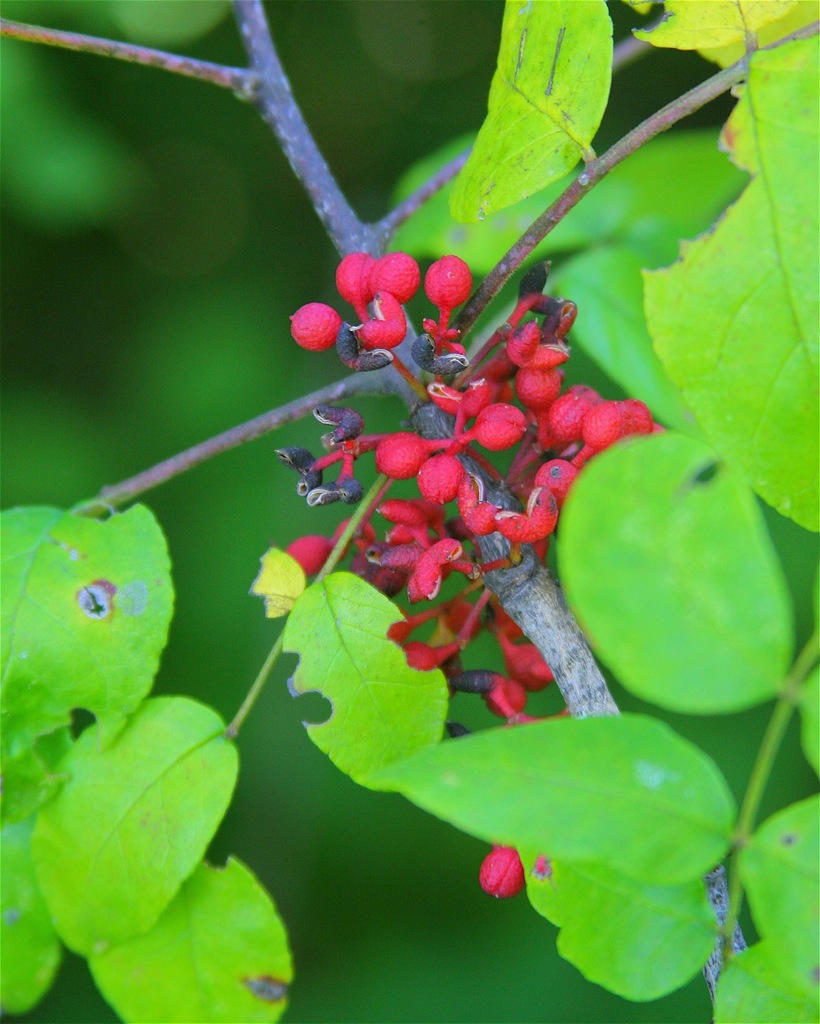
northern prickly ash
Zanthoxylum americanum
Zanthoxylum americanum, the common prickly-ash, common pricklyash, common prickly ash or northern prickly-ash (also sometimes called toothache tree, yellow wood, or suterberry), is an aromatic shrub or small tree native to central and eastern portions of the United States and Canada. It is the northernmost New World species in the citrus family, Rutaceae, and is the type species in its genus, which includes sichuan pepper. It can grow to 10 meters (33 ft) tall with a diameter at breast height (DBH) of 15 cm (5.9 in). It produces membranous leaflets and axillary flower clusters. The wood is not commercially valuable, but oil extracts from the bark have been used in traditional and alternative medicine and have been studied for antifungal and cytotoxic properties. The genus name is sometimes spelled Xanthoxylum.
From the article Zanthoxylum americanum on Wikipedia (CC BY-SA), quoted section by section
Description
The plant has pinnately compound leaves with 5–11 membranous leaflets. It has axillary flower and fruit clusters. The buds are hairy. The dark green leaves are bitter-aromatic, with crenate margins. The stalked follicles are green and then turn red through deep blue through black. Flowers are dioecious, with yellow-green petals. Flowers appear as umbrella-like clusters from 2–12 in small terminal to axillary umbellate clusters. They are imperfect with pedicels 2–4 m long; there are 4–5 petals, elliptic to ovate-oblong 1.6–1.9 mm long and have green with reddish hairs near the tips; stamens 5; ovary with 2–5 carpels. The fruit is a follicle, with 2 seeds per carpel.
Range & habitat
Rare in the South, it is more common in the northern United States. In the United States, it occurs in Alabama, Arkansas, Connecticut, Delaware, the District of Columbia, Florida, Georgia, Iowa, Illinois, Indiana, Kansas, Kentucky, Louisiana, Massachusetts, Maryland, Maine, Michigan, Minnesota, Missouri, North Carolina, North Dakota, Nebraska, New Hampshire, New Jersey, New York, Ohio, Oklahoma, Pennsylvania, Rhode Island, South Carolina, South Dakota, Tennessee, Virginia, Vermont, Wisconsin and West Virginia; the species also occurs in Ontario and Quebec in Canada. The species is listed as Endangered in Florida, Maryland, and New Hampshire; and as Special Concern in Tennessee. Butterflies that use Zanthoxylum americanum as a larval food source include the Thoas swallowtail (Papilio thoas), giant swallowtail (P. cresphontes), and spicebush swallowtail (P. troilus). This plant was known to the indigenous peoples of the region. It was first described to Europeans by John Bartram in his travels and plant collecting excursions.
Habitat. Underlies of maple-oak woodlands or dense growth of small trees like evergreen oak on rocky, often shallow, well-drained, tuff or other igneous rock, at elevations of 1,350–1,750 metres (4,430–5,740 ft). The understory is primarily native bunchgrasses with a mix of other cacti and herbaceous species. …
Wikipedia: “Distribution and conservation status”
At the table
There have been some modern studies of the oil's chemical constituents and their antifungal and cytotoxic effects. In 2012, a Pennsylvania distillery introduced a bitters called Bartram's Bitters that uses prickly ash bark as one of several botanical ingredients. The concoction was based on a recipe for "Bartram's Homestead Bitters" that was found in a book that belonged to the family of botanist John Bartram.
Wikipedia: “Modern studies and uses”
In medicine
An oil extracted from the bark and follicles of the prickly-ash (both this species and Zanthoxylum clava-herculis) has been used in herbal medicine. The extract may act as a stimulant, and historic medicinal use has included use "for chronic rheumatism, typhoid and skin diseases and impurity of the blood..." as well as for digestive ailments. Grieve states, "The berries are considered even more active than the bark, being carminative and antispasmodic, and are used as an aperient and for dyspepsia and indigestion; a fluid extract of the berries being given in doses of 10 to 30 drops." The bark has been chewed for toothaches, and a tea from the follicles has been used for sore throats and as a diuretic. As noted by Michael Dirr, in his Manual of Woody Landscape Plants, "Supposedly the stems and fruits were chewed by the Indians to alleviate toothache for the acrid juice has a numbing effect."
Wikipedia: “Traditional”
Where it lives
Recorded sightings
—
geo-referenced records in GBIF, from museums, herbaria and field observers.
Drag the globe to turn it. Dots are where records exist, not a range map; darker means more records.
In the stacks
Searching the stacks…
Every page naming Zanthoxylum americanum in the Biodiversity Heritage Library →
This page is assembled live from iNaturalist, GBIF, Wikipedia, the Source Library and the Internet Archive. It is not yet part of the hand-edited codex. iNaturalist taxon 54836.