- Plants
- ›Vascular Plants
- ›flowering plants
- ›Dicots
- ›beeches, oaks, walnuts, and allies
- ›walnut family
- ›Juglans
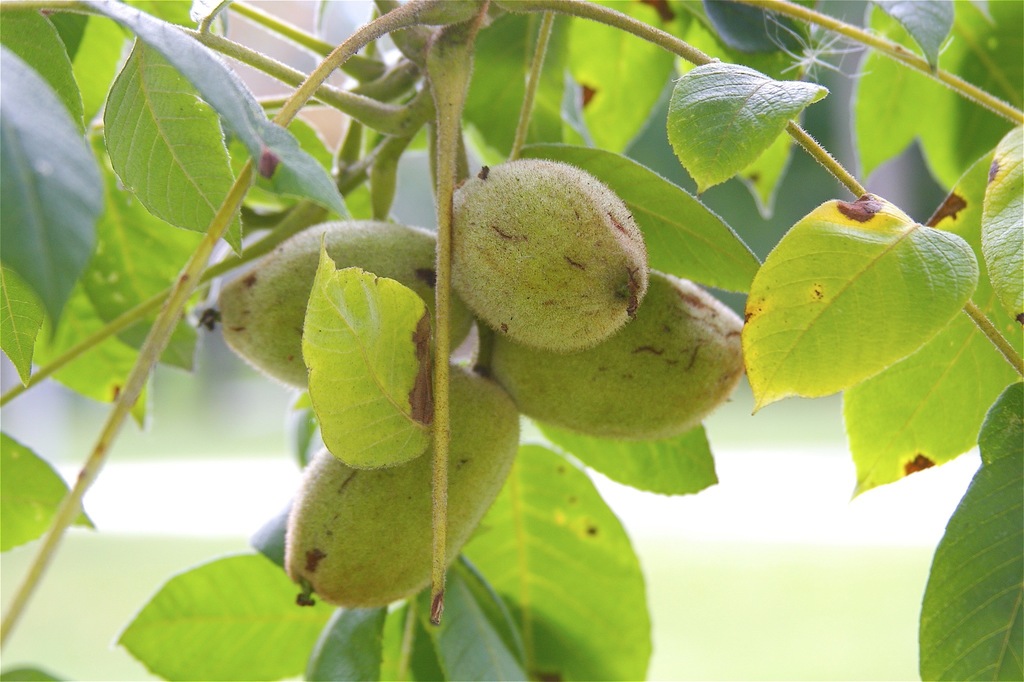
Butternut
Juglans cinerea
Juglans cinerea, commonly known as butternut or white walnut, is a species of walnut native to the eastern United States and southeast Canada.
From the article Juglans cinerea on Wikipedia (CC BY-SA), quoted section by section
Description
J. cinerea is a deciduous tree growing to 30 metres (98 ft) tall, rarely more. Butternut is a slow-growing species, and rarely lives longer than 75 years. It has a 40–80 cm (16–31 in) stem diameter, with light gray bark. The leaves are alternate and pinnate, 40–70 cm (16–28 in) long, with 11–17 leaflets, each leaflet 5–10 cm (2–4 in) long and 3–5 cm (1+1⁄4–2 in) broad. Leaves have a terminal leaflet at the end of the leafstalk and have an odd number of leaflets. The whole leaf is downy-pubescent, and a somewhat brighter, yellower green than many other tree leaves.
Flowering and fruiting. Like other members of the family Juglandaceae, butternut's leafout in spring is tied to photoperiod rather than air temperature and occurs when daylight length reaches 14 hours. This can vary by up to a month in the northern and southernmost extents of its range. Leaf drop in fall is early and is initiated when daylight drops to 11 hours. The species is monoecious. Male (staminate) flowers are inconspicuous, yellow-green slender catkins that develop from axillary buds and female (pistillate) flowers are short terminal spikes on current year's shoots. Each female flower has a light pink stigma. The flowers of both sexes typically do not mature at the same time on an individual tree. …
Range & habitat
The distribution range of J. cinerea extends east to New Brunswick, and from southern Quebec west to Minnesota, south to northern Alabama and southwest to northern Arkansas. It is absent from most of the Southern United States. The species also proliferates at middle elevations (about 610 m or 2,000 ft above sea level) in the Columbia River basin/Pacific Northwest, as an off-site species. Trees with 2.1 m or 7 ft (over mature) class range diameter at breast height were noted in the Imnaha River drainage as late as January 26, 2015. Butternut favors a cooler climate than black walnut and its range does not extend into the Deep South. Its northern range extends into Wisconsin and Minnesota where the growing season is too short for black walnut.
Wikipedia: “Distribution and habitat”
At the table
The butternuts are edible and were made into a butter-like oil by Native Americans for various purposes. The young green nuts, while still soft, can be pickled; survivalist Bradford Angier recommends this be done with a change of salt water every other day for a week, and a subsequent seasoning of at least two weeks. The sap can be used to make syrup.
Wikipedia: “Culinary uses”
Where it lives
Recorded sightings
—
geo-referenced records in GBIF, from museums, herbaria and field observers.
Drag the globe to turn it. Dots are where records exist, not a range map; darker means more records.
In the stacks
Searching the stacks…
Every page naming Juglans cinerea in the Biodiversity Heritage Library →
This page is assembled live from iNaturalist, GBIF, Wikipedia, the Source Library and the Internet Archive. It is not yet part of the hand-edited codex. iNaturalist taxon 54792.