- Plants
- ›Vascular Plants
- ›flowering plants
- ›Dicots
- ›beeches, oaks, walnuts, and allies
- ›beech family
- ›Quercus
- ›Quercus
- ›Quercus
- ›Albae
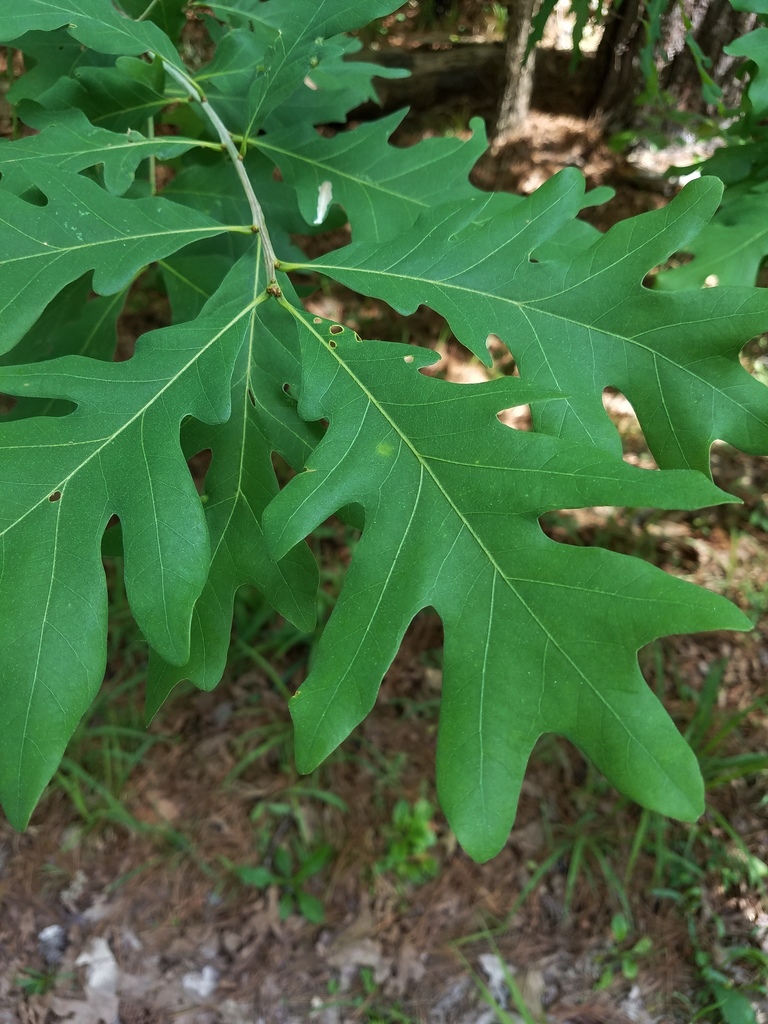
white oak
Quercus alba
Quercus alba, the white oak, is one of the preeminent hardwoods of eastern and central North America. It is a long-lived oak, native to eastern and central North America and found from Minnesota, Ontario, Quebec, and southern Maine south as far as northern Florida and eastern Texas. Specimens have been documented to be over 450 years old.
Although called a white oak, it is very unusual to find an individual specimen with white bark; the usual color is a light gray. The name comes from the colour of the undersides of the leaves. In the forest it can reach a magnificent height and in the open it develops into a massive broad-topped tree with large branches striking out at wide angles.
From the article Quercus alba on Wikipedia (CC BY-SA), quoted section by section
Description
Quercus alba typically reaches heights of 24 to 30 metres (80–100 feet) at maturity, and its canopy can become quite massive as its lower branches are apt to extend far out laterally, parallel to the ground. Trees growing in a forest will become much taller than ones in an open area which develop to be short and massive. The Mingo Oak was the tallest known white oak at over two hundred feet with a trunk height of 44.2 m (145 ft) before it was felled in 1938. It is not unusual for the crown spread of a white oak tree to be as wide as it is tall, but specimens growing at high altitudes may only become small shrubs. The bark is a light ash-gray and peels somewhat from the top, bottom and/or sides. According to Chris Bolgiano in The Appalachian Forest: A Search for Roots and Renewal, the largest tree ever cut in West Virginia was a white oak that measured 13 ft (4.0 m) thick at its base. White oak may live 200 to 300 years, with some even older specimens known. The Wye Oak in Wye Mills, Maryland was estimated to be over 450 years old when it finally fell in a thunderstorm in 2002. Another noted white oak was the Basking Ridge white oak in New Jersey, estimated to have been over 600 years old when it died in 2016. The tree measured 8 m (25 ft) in circumference at the base and 5 m (16 ft) in circumference 1.2 m (4 ft) above the ground. …
Range & habitat
Quercus alba is fairly tolerant of a variety of habitats, and may be found on ridges, in valleys, and in between, in dry and moist habitats, and in moderately acid and alkaline soils. It is mainly a lowland tree, but reaches altitudes of 1,600 m (5,249 ft) in the Appalachian Mountains. It is often a component of the forest canopy in an oak-heath forest. Frequent fires in the Central Plains region of the United States prevented oak forests, including Q. alba, from expanding into the Midwest. However, a decrease in the frequency of these natural fires after European settlement caused rapid expansion of oak forests into the Great Plains, negatively affecting the natural prairie vegetation.
Wikipedia: “Distribution”
At the table
The acorns are much less bitter than the acorns of red oaks. They can be eaten by humans but, if bitter, may need to have the tannins leached. They are also a valuable wildlife food, notably for turkeys, wood ducks, pheasants, grackles, jays, nuthatches, thrushes, woodpeckers, rabbits, squirrels, deer, and black bear. The white oak is the only known food plant of the Bucculatrix luteella and Bucculatrix ochrisuffusa caterpillars. The young shoots of many eastern oak species are readily eaten by deer. Dried oak leaves are also occasionally eaten by white-tailed deer in the fall or winter. Rabbits often browse twigs and can girdle stems.
Wikipedia: “Food”
How it is grown
Quercus alba is cultivated as an ornamental tree somewhat infrequently due to its slow growth and ultimately huge size. It is not tolerant of urban pollution and road salt; and due to its large taproot, it is unsuited for a street tree or parking strips/islands.
Wikipedia: “Cultivation”
In human culture
White oak has served as the official state tree of Illinois after selection by a vote of school children. There are two "official" white oaks serving as state trees, one located on the grounds of the governor's mansion, and the other in a schoolyard in the town of Rochelle. The white oak is also the state tree of Connecticut and Maryland. The Wye Oak, probably the oldest living white oak until it fell because of a thunderstorm on June 6, 2002, was the honorary state tree of Maryland. Being the subject of a legend as old as the colony itself, the Charter Oak of Hartford, Connecticut is one of the most famous white oaks in America. An image of the tree now adorns the reverse side of the Connecticut state quarter. The white oak from the movie The Shawshank Redemption, known as the "Shawshank tree" and the "Tree of Hope", was estimated to be more than 200 years old when it fell. The tree is seen during the last ten minutes of the movie. As the movie gained fame, the tree became popular as well, and used to attract tens of thousands of movie fans and tourists every year. A portion of the tree came down on July 29, 2011, when the tree was split by lightning during a storm. The remaining half of the tree fell during heavy winds just short of five years later, on July 22, 2016. The Bedford Oak is a 500-year-old white oak tree that sits in the town of Bedford in New York. …
Wikipedia: “Culture”
Where it lives
Recorded sightings
—
geo-referenced records in GBIF, from museums, herbaria and field observers.
Drag the globe to turn it. Dots are where records exist, not a range map; darker means more records.
In the stacks
Searching the stacks…
Every page naming Quercus alba in the Biodiversity Heritage Library →
This page is assembled live from iNaturalist, GBIF, Wikipedia, the Source Library and the Internet Archive. It is not yet part of the hand-edited codex. iNaturalist taxon 54779.