- Plants
- ›Vascular Plants
- ›flowering plants
- ›Dicots
- ›dogwoods, hydrangeas, and allies
- ›Dogwood family
- ›Cornus
- ›Mesomora
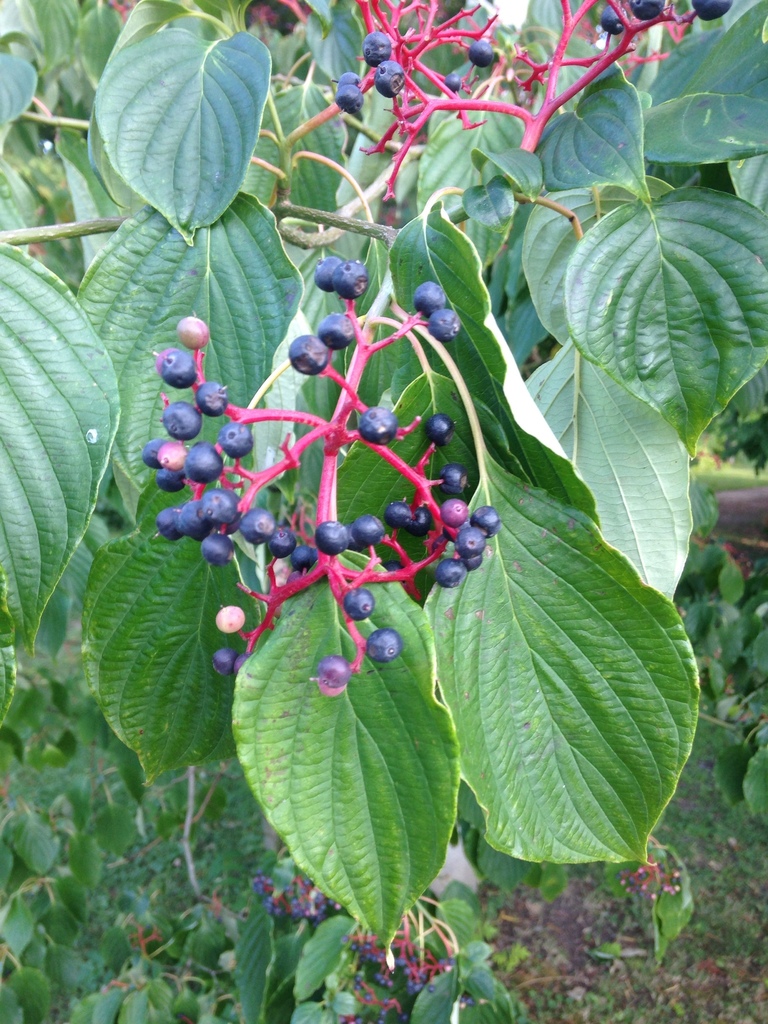
alternate-leaved dogwood
Cornus alternifolia
Cornus alternifolia is a species of flowering plant in the dogwood family Cornaceae, native to eastern North America, from Newfoundland west to southern Manitoba and Minnesota, and south to northern Florida and Mississippi. It is rare in the southern United States. It is commonly known as green osier, alternate-leaved dogwood, and pagoda dogwood.
From the article Cornus alternifolia on Wikipedia (CC BY-SA), quoted section by section
Description
It is a small deciduous shrub or tree growing to 25 feet (8 m) (rarely 30 feet (9 m)) tall and 20 feet (6 m) to 32 feet (10 m) wide, with a trunk up to 6 inches (152 mm) in diameter. The branches manifest in horizontal layers separated by gaps, with a flat-topped crown, said to resemble a pagoda. The alternate-leaf dogwood is a shrub or small tree that has horizontal branches that form tiers. The branches are parallel to the ground creating a layered tiered look with upturned branches like a pagoda. This plant may grow from 15 to 25 feet tall and 20 to 32 feet wide. Its leaves are elliptic to ovate and grow to 2–5 inches (5–13 cm) long and 1–2 inches (25–51 mm) broad, arranged alternately on the stems, not in opposite pairs typical of the majority of Cornus species. The leaves are most often arranged in crowded clusters around the ends of the twigs and appear almost whorled. The upper sides of the leaves are smooth and green, while the undersides are hairy and a bluish color. The bark is colored gray to brown, becoming ridged as it ages. Small cream colored flowers are produced, with four small petals. The flowers are grouped into cymes, with the inflorescences 2–5 inches (5–13 cm) across. It bears berries with a blackish blue color.
Bark: Dark reddish brown, with shallow ridges. …
Range & habitat
C. alternifolia is found under open deciduous trees, as well as along the margins of forests and swamps. These trees prefer moist, well drained soil. Seedlings are shade-tolerant and it is often found as an understory tree in mature forests, such as those dominated by Acer saccharum (sugar maple) or Populus (aspen). It is also common in younger forests.
Wikipedia: “Habitat”
What it does
The fruits provide food for at least eleven species of birds and the black bear. The leaves and bark are eaten by white-tailed deer, beaver, and cottontail rabbit. It additionally has been marked as a pollinator plant, supporting and attracting bees, flies, and butterflies. It is a host plant for butterflies, providing food during their larval stage.
Wikipedia: “Ecology”
Where it lives
Recorded sightings
—
geo-referenced records in GBIF, from museums, herbaria and field observers.
Drag the globe to turn it. Dots are where records exist, not a range map; darker means more records.
In the stacks
Searching the stacks…
Every page naming Cornus alternifolia in the Biodiversity Heritage Library →
This page is assembled live from iNaturalist, GBIF, Wikipedia, the Source Library and the Internet Archive. It is not yet part of the hand-edited codex. iNaturalist taxon 54775.