- Plants
- ›Vascular Plants
- ›flowering plants
- ›Dicots
- ›Soapberries, Cashews, Mahoganies, and Allies
- ›Cashew Family
- ›cashews, sumacs, and allies
- ›Rhus
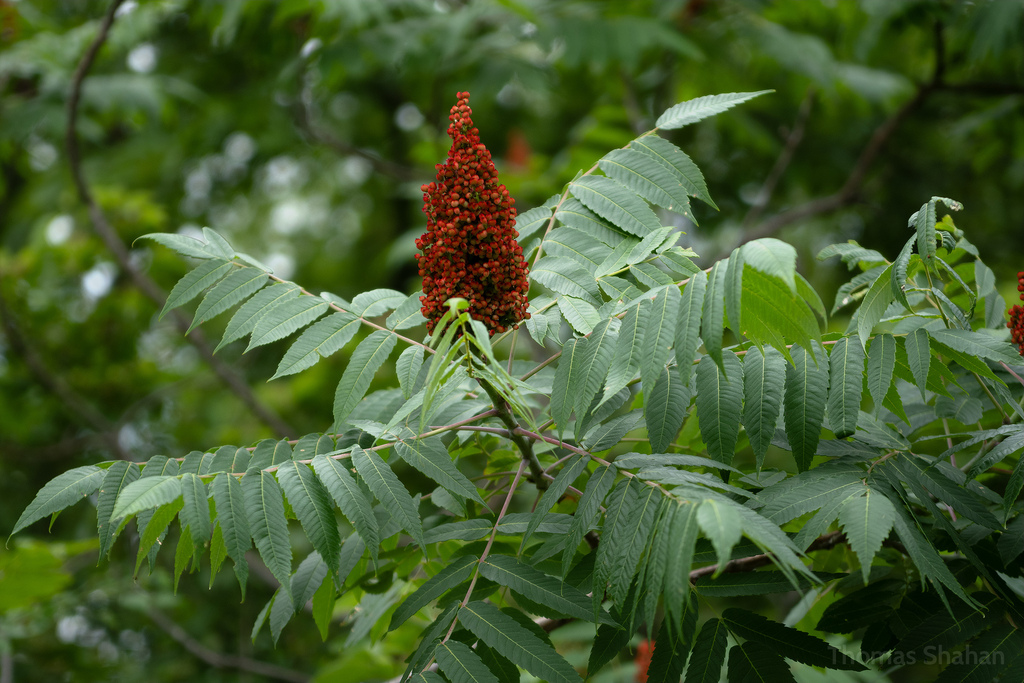
smooth sumac
Rhus glabra
Rhus glabra, the smooth sumac, (also known as white sumac, upland sumac, or scarlet sumac) is a species of sumac in the family Anacardiaceae, native to North America, from southern Quebec west to southern British Columbia in Canada, and south to northern Florida and Arizona in the United States and Tamaulipas in northeastern Mexico.
From the article Rhus glabra on Wikipedia (CC BY-SA), quoted section by section
Description
Smooth sumac has a spreading, open habit, growing up to 3 metres (10 ft) tall. The bark is smooth and gray to brown. The leaves are alternate, 30–50 centimetres (12–20 in) long, compound with 11–31 oppositely paired leaflets. Each leaflet is 5–13 cm (2–5 in) long, with a serrated margin. The leaves turn scarlet in the fall. The species is dioecious. The flowers are tiny, green, produced in dense erect panicles 10–25 cm (4–10 in) tall, in the spring, later followed by large panicles of edible crimson berries that remain throughout the winter. The buds are small, covered with brown hair and borne on fat, hairless twigs.
Range & habitat
It is native to North America, from southern Quebec west to southern British Columbia in Canada, and south to northern Florida and Arizona in the United States and Tamaulipas in northeastern Mexico. It can be found in a wide variety of habitats, from streambanks to dry and montane slopes.
Wikipedia: “Distribution and habitat”
What it does
In late summer it sometimes forms galls on the underside of leaves, caused by the parasitic sumac leaf gall aphid, Melaphis rhois. The galls are not harmful to the tree.
Wikipedia: “Ecology”
At the table
Native Americans ate the young sprouts as a salad. The fruit is sour and contains a large seed, but can be chewed (to alleviate thirst) and made into a lemonade-like drink. Deer forage the twigs and fruit. In 2020, archaeologists unearthed a pipe at a dig in Central Washington state, showing chemical evidence that a Native American tribe had smoked R. glabra either alone or in a blend with tobacco, perhaps "for its medicinal qualities and to improve the flavor of smoke".
Wikipedia: “Uses”
Where it lives
Recorded sightings
—
geo-referenced records in GBIF, from museums, herbaria and field observers.
Drag the globe to turn it. Dots are where records exist, not a range map; darker means more records.
In the stacks
Searching the stacks…
Every page naming Rhus glabra in the Biodiversity Heritage Library →
This page is assembled live from iNaturalist, GBIF, Wikipedia, the Source Library and the Internet Archive. It is not yet part of the hand-edited codex. iNaturalist taxon 54764.