- Plants
- ›Vascular Plants
- ›flowering plants
- ›Dicots
- ›Soapberries, Cashews, Mahoganies, and Allies
- ›soapberry family
- ›Acer
- ›Platanoidea
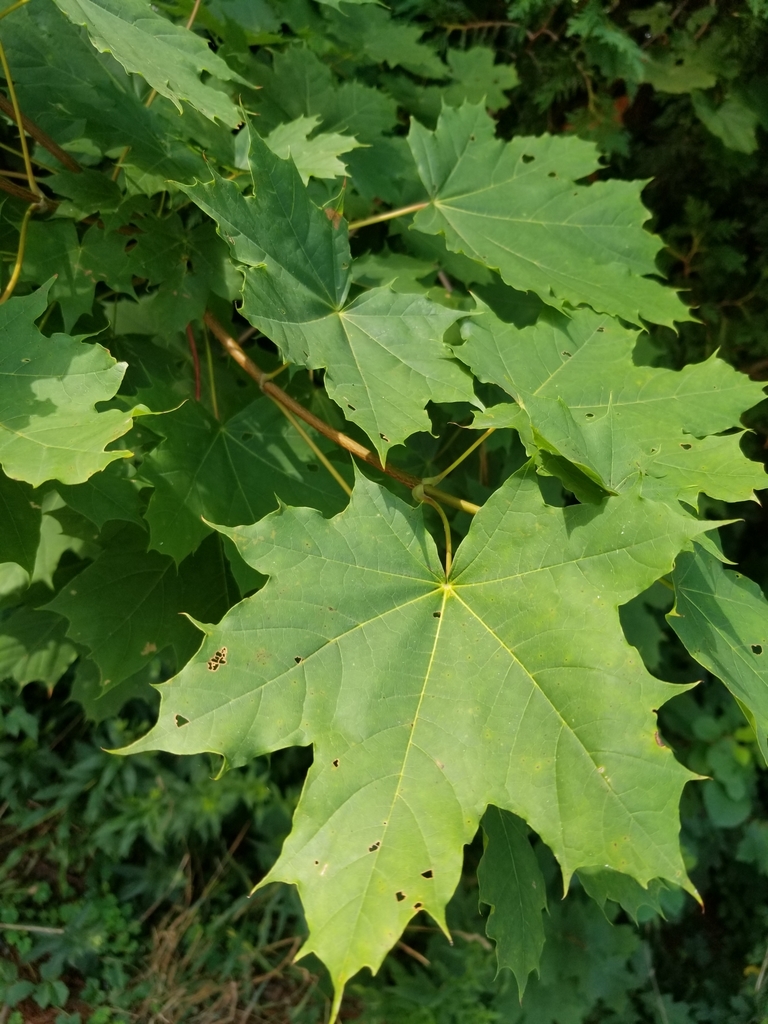
Norway maple
Acer platanoides
Acer platanoides, commonly known as the Norway maple, is a species of maple native to eastern and central Europe and western Asia, from Spain east to Russia, north to southern Scandinavia and southeast to northern Iran. It was introduced to North America in the mid-1700s as a shade tree. It is a member of the family Sapindaceae.
From the article Acer platanoides on Wikipedia (CC BY-SA), quoted section by section
Description
Acer platanoides is a deciduous tree, growing to 20–30 m (65–100 ft) tall with a trunk up to 1.5 m (5 ft) in diameter, and a broad, rounded crown. The bark is grey-brown and shallowly grooved. Unlike many other maples, mature trees do not tend to develop a shaggy bark. The shoots are green at first, soon becoming pale brown. The winter buds are shiny red-brown. The leaves are opposite, palmately lobed with five lobes, 7–14 cm (2+3⁄4–5+1⁄2 in) long and 8–25 cm (3+1⁄4–9+3⁄4 in) across; the lobes each bear one to three side teeth, and an otherwise smooth margin. The leaf petiole is 8–20 cm (3+1⁄4–7+3⁄4 in) long, and secretes a milky juice when broken. The autumn colour is usually yellow, occasionally orange-red.
The flowers are in corymbs of 15–30 together, yellow to yellow-green with five sepals and five petals 3–4 mm (1⁄8–3⁄16 in) long; flowering occurs in early spring before the new leaves emerge. The fruit is a double samara with two winged seeds. the seeds are disc-shaped, strongly flattened, 10–15 mm (3⁄8–5⁄8 in) across and 3 mm (1⁄8 in) thick. The wings are 3–5 cm (1+1⁄4–2 in) long, widely spread, approaching a 180° angle. It typically produces a large quantity of viable seeds. Under ideal conditions in its native range, Norway maple may live up to 250 years, but often has a much shorter life expectancy; in North America, for example, sometimes only 60 years. …
At the table
The wood is hard, yellowish-white to pale reddish, with the heartwood not distinct; it is used for furniture and woodturning. Norway maple sits ambiguously between hard and soft maple with a Janka hardness of 1,010 lbf or 4,500 N. The wood is rated as non-durable to perishable in regard to decay resistance. In Europe, it is used for furniture, flooring and musical instruments, especially for violins. Norway maple has been widely taken into cultivation in other areas, including western Europe northwest of its native range. It grows north of the Arctic Circle at Tromsø, Norway. In North America, it is planted as a street and shade tree as far north as Anchorage, Alaska. In Ontario, it is common in cultivation north to Sault Ste. Marie and Sudbury; although not considered reliably hardy northward, it has been established at Kapuskasing and Iroquois Falls, and even at Moose Factory. It is most recommended in USDA Hardiness Zones 4 to 7 but will grow in warmer zones (at least up to Zone 10) where summer heat is moderate, as along the Pacific coast south to the Los Angeles Basin. They tend to prefer wetter Oceanic climates. …
Wikipedia: “Cultivation and uses”
Where it lives
Recorded sightings
—
geo-referenced records in GBIF, from museums, herbaria and field observers.
Drag the globe to turn it. Dots are where records exist, not a range map; darker means more records.
In the old herbals & bestiaries

In the stacks
Searching the stacks…
Every page naming Acer platanoides in the Biodiversity Heritage Library →
This page is assembled live from iNaturalist, GBIF, Wikipedia, the Source Library and the Internet Archive. It is not yet part of the hand-edited codex. iNaturalist taxon 54763.