- Plants
- ›Vascular Plants
- ›flowering plants
- ›Dicots
- ›Roses, Elms, Figs, and Allies
- ›rose family
- ›Amygdaloideae
- ›Maleae
- ›Cotoneaster
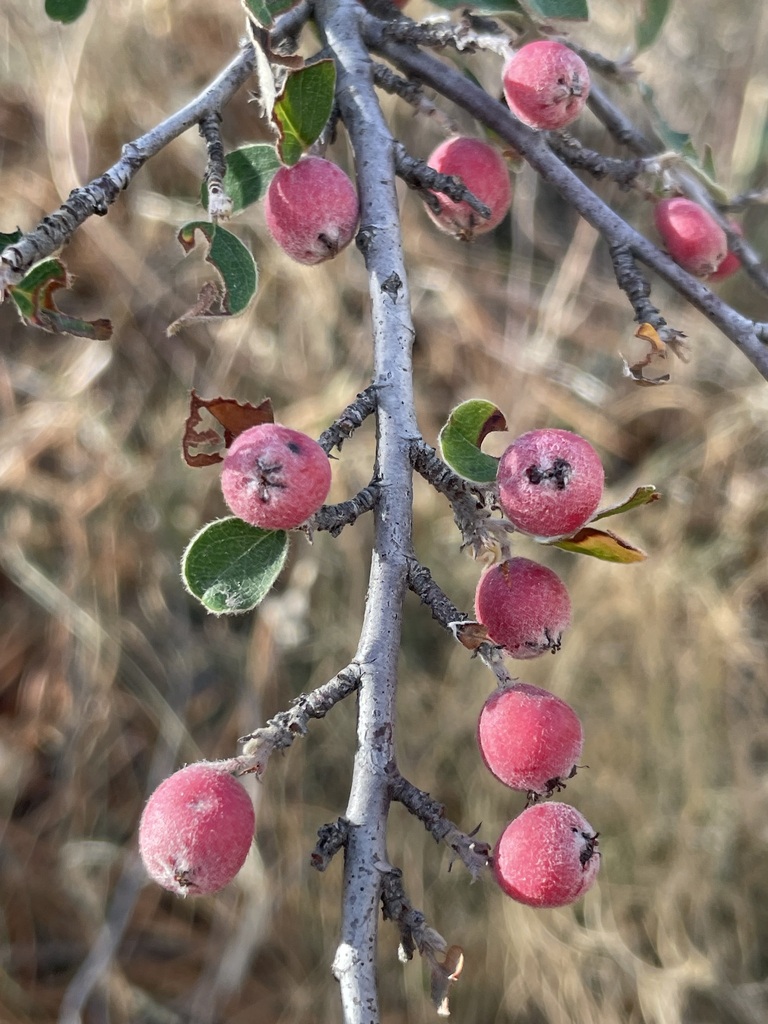
Asian Cotoneaster
Cotoneaster nummularius
Cotoneaster nummularius, the nummular or coinwort cotoneaster, is a deciduous shrub in the rose family. It is native to a wide geographical range spanning from Morocco and Greece eastward through the Middle East, Central Asia, and into parts of China and India. It typically grows at altitudes between 800 and 2,400 meters in semi-arid montane climates, forming dense, rounded thickets. Characterized by its small, alternate leaves with dark green upper surfaces and densely grey undersides, C. nummularius produces white to pinkish-white hermaphroditic flowers from April to June. These are followed by round or oval pomes that ripen from red to bluish-black or black-violet between August and October. The fruits contain cyanogenic glycosides, which contribute to their toxicity and aid in seed dispersal by birds. Beyond its ornamental value in landscaping, C. nummularius has a history of traditional medicinal use in various Asian cultures, where its fruits and other parts have been employed as an appetite stimulant, expectorant, and for treating conditions like malarial fever and rheumatic ailments. Modern pharmacological investigations have identified a complex phytochemical composition, including flavonoids and procyanidins, and have demonstrated antioxidant, anti-inflammatory, antimalarial, and anti-jaundice properties.
From the article Cotoneaster nummularius on Wikipedia (CC BY-SA), quoted section by section
Description
Cotoneaster nummularius is a mountainous winter deciduous woody shrub typically reaching 50 cm (1.6 ft) to 100 cm (3.3 ft) in height, characterized by its much-branched structure that forms dense, rounded thickets. The branches are stiff and erect to arching, with young shoots densely tomentose and greyish, transitioning to reddish-brown to dark grey on older wood. The leaves are alternate, rounded or oval-shaped to broadly elliptic, measuring 5 mm (0.20 in) to 35 mm (1.4 in) in length and 4 mm (0.16 in) to 25 mm (0.98 in) in width, with an obtuse apex. The upper surface is dark green and fuzzy or slightly pubescent, while the lower surface is densely grey-tomentose, with a fuzzy white-silvery appearance. Petioles are short, 1 mm (0.039 in) to 2 mm (0.079 in) long, and tomentose, with small caducous stipules. The flowers are hermaphroditic and white to pinkish-white, occurring solitary or in small corymbs of 2–5 (up 7 in some populations) per cluster, blooming from April to June. Each flower measures 7 mm (0.28 in) to 10 mm (0.39 in) in diameter, with a campanulate, densely hairy hypanthium; triangular, reflexed calyx lobes that are short and hairy; and orbicular petals that are rounded, rigid, and slightly overlapping, approximately 8 mm (0.31 in) across. Stamens are numerous, and styles number 2 to 3. …
Wikipedia: “Morphology”
Range & habitat
The species is found in Morocco, Greece, Crete, Lebanon, Syria, Palestine, Türkiye, Cyprus, Iraq, Yemen, Eritrea, Oman, Saudi Arabia, Caucasus, Iran, Turkmenistan, Afghanistan, Tajikistan, Uzbekistan, Azerbaijan, Armenia, Gruziya, Pakistan, Northwestern India, Xinjiang China, Inner Mongolia, Kazakhstan and Kyrgyzstan. Cotoneaster nummularius' distribution highlights its montane affinities, such as on Mount Lebanon, Anti-Lebanon, and the Caucasian highlands. In eastern Anatolia's young mountains within Turkey, the terrain facilitates seed-based reproduction and population expansion. The species thrives in the temperate biome of mountainous regions, typically at altitudes ranging from 800 metres (2,600 ft) to 2,400 metres (7,900 ft). In Lebanon, it occurs between 1,400 metres (4,600 ft) to 2,000 metres (6,600 ft), and higher elevations up to 2,719 meters in the Alborz Mountains of Iran. It prefers a semi-arid montane climate characterized by cool, dry summers, cold winters with significant snowfall, and a dry season lasting 4–5 months, with mean annual precipitation around 687 mm mostly as snow; Ellenberg indicator values suggest a preference for cool temperatures and moderately dry conditions. …
Wikipedia: “Distribution”
What it does
Cotoneaster nummularius is a perennial shrub that reproduces primarily sexually means via hermaphroditic flowers pollinated by insects. Flowering occurs from April to June, with white blooms clustered at the branch tips that attract pollinators. The pomes contain cyanogenic glycosides, such as prunasin, and lower concentrations of amygdalin, which contribute to their toxicity and may deter some herbivores while aiding in seed dispersal. Seed dispersal is achieved through seed dispersal by birds, which consume the attractive pomes and excrete the seeds intact over wide areas, facilitating the shrub's spread in mountainous habitats. In cultivation, Cotoneaster nummularius seeds require human intervention to break dormancy. Mature seeds are first decorticated without drying, sorted and soaked in water for 24 hours, then placed on moist paper under warm stratification at approximately 20 °C until radicle emergence; this treatment can take up to a year before the first germination occurs. The shrub can also propagate vegetatively through cuttings, though seed-based reproduction predominates in natural settings. Cotoneaster nummularius has a slow-growing habit. It forms dense, rounded thickets with arching branches in its native montane environments. In Iran, it thrives in mountain soils and is associated with plant communities growing on relatively mature, well-developed soils.
Wikipedia: “Growth and reproduction”
At the table
Cotoneaster nummularius is cultivated as an ornamental shrub, widely grown in landscape architecture due to diversity of their forms, glossy green leaves, abundant flowers, and attractive pomes. Cotoneaster nummularius has a history of traditional medicinal use, particularly in Asian medicine. Modern research has also investigated its phytochemical composition and various biological activities, often in the context of the broader Cotoneaster genus.
Traditional Uses. In Lebanon, Cotoneaster nummularis is used in folk medicine; decoctions made from the fruits is taken orally as an appetite stimulant, stomachic and expectorant. The genus Cotoneaster is widely recognized in traditional medicine across Iran, Turkey, Mongolia, and Tibet for its diuretic, astringent, expectorant, hepatoprotective, digestive, cardiotonic, antiviral, and spasmolytic properties. Traditional indications for the genus include inflammation of the eyes, wounds, bronchitis, fever, abdominal pain, pruritus, leucoderma, hemorrhoids, diabetes mellitus, and urinary calculi. Specifically, the ripe fruits of C. nummularius are traditionally used in Turkey as an expectorant. In Iran, the fruiting twigs of C. nummularius have been used as an antipyretic agent for malarial fever. The roots of C. nummularius are employed in the Caucasus to alleviate rheumatic ailments.
Phytochemical Composition. …
Wikipedia: “Uses”
Where it lives
Recorded sightings
—
geo-referenced records in GBIF, from museums, herbaria and field observers.
Drag the globe to turn it. Dots are where records exist, not a range map; darker means more records.
In the stacks
Searching the stacks…
Every page naming Cotoneaster nummularius in the Biodiversity Heritage Library →
This page is assembled live from iNaturalist, GBIF, Wikipedia, the Source Library and the Internet Archive. It is not yet part of the hand-edited codex. iNaturalist taxon 546610.