- Plants
- ›Vascular Plants
- ›flowering plants
- ›monocots
- ›Aroids, Water Plantains, Seagrass, and allies
- ›Arum Family
- ›duckweeds
- ›Lemna
- ›Lemna
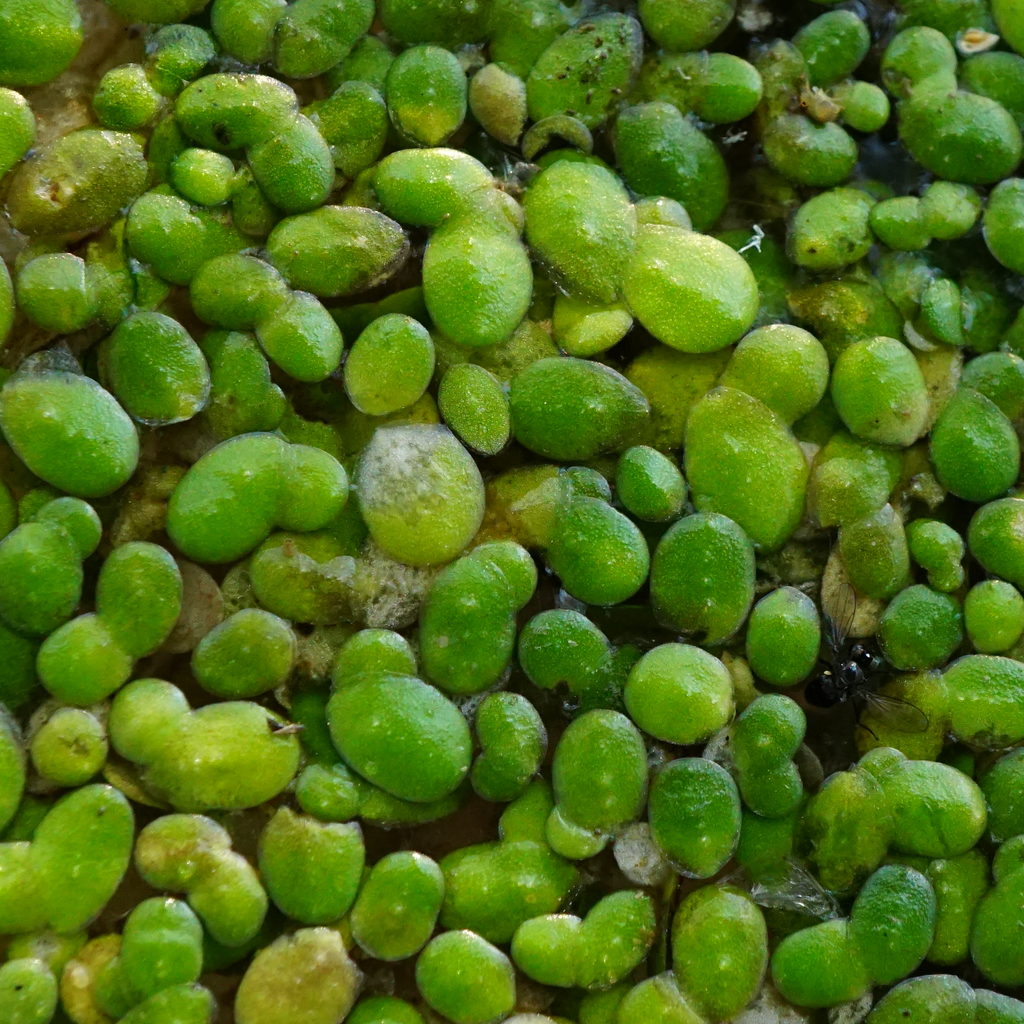
Common Duckweed
Lemna minor
Lemna minor, the common duckweed or lesser duckweed, is an aquatic freshwater plant of the genus Lemna. They belong to the family of Lemnaceae, which is monophyletic to the Araceae family. L. minor is used as animal fodder, bioremediator, for wastewater nutrient recovery and other applications.
From the article Lemna minor on Wikipedia (CC BY-SA), quoted section by section
Description
Lemna minor is a floating freshwater aquatic plant, with one, two, three or four leaves each having a single root hanging in the water. As more leaves grow, the plants divide and become separate individuals. The root is 1–2 cm long. Leaves are oval, 1–8 mm long and 0.6–5 mm broad, light green, with three (rarely five) veins and small air spaces that assist flotation. It reproduces mainly vegetatively by division. Flowers are rarely produced and measure about 1 mm in diameter, with a cup-shaped membranous scale containing a single ovule and two stamens. The seed is 1 mm long, ribbed with 8–15 ribs. Birds are important in dispersing L. minor to new sites. The sticky root enables the plant to adhere to the plumage or feet of birds and can thereby colonize new ponds.
Range & habitat
Lemna minor has a subcosmopolitan distribution and is native throughout most of Africa, Asia, Europe and North America. It is present wherever freshwater ponds and slow-moving streams occur, except for arctic and subarctic climates. It is not reported as native in Australasia or South America, though it is naturalised there.
Wikipedia: “Distribution”
Toxicity
Lemna minor is commonly used for the ecotoxicity assessment of organic and inorganic micropollutants as well as for evaluating the toxicity of wastewater and landfill leachates. Information for the applied methodology are provided in the relevant OECD protocol.
== References ==
Wikipedia: “Ecotoxicity experiments”
How it is grown
For optimal growth conditions pH values between 6.5 and 8 are required. L. minor can grow at temperatures between 6 and 33 °C (43 and 91 °F). Growth of colonies is rapid, and the plants form a carpet covering still pools when conditions are suitable. In temperate regions, when temperatures drop below 6 to 7 °C (43 to 45 °F), small, dense, starch-filled organs called 'turions' are produced. The plants then become dormant and sink to the ground for overwintering. The following spring, they restart growing again and float back to the surface. Duckweeds in general need some management effort to be cultivated. The small free floating plants are susceptible to being blown into heaps which results in open water surface allowing algal growth. For this reason, long narrow ponds running perpendicular to the prevailing wind are recommended. The equal distribution of added nutrients in the ponds can be achieved by several inlets. To maintain a dense cover of plants on the water surface and prevent a too thick layer for growth, coordinated harvesting and replenishment of nutrients are required. The fertilizer requirements for growing duckweed depend on the water source and the geographic isolate of L. minor that is used. L. minor grown in ponds that are filled with rainwater, need an additional application of nitrogen, phosphorus and potassium. …
Wikipedia: “Cultivation”
Where it lives
Recorded sightings
—
geo-referenced records in GBIF, from museums, herbaria and field observers.
Drag the globe to turn it. Dots are where records exist, not a range map; darker means more records.
In the stacks
Searching the stacks…
Every page naming Lemna minor in the Biodiversity Heritage Library →
This page is assembled live from iNaturalist, GBIF, Wikipedia, the Source Library and the Internet Archive. It is not yet part of the hand-edited codex. iNaturalist taxon 54518.