- Plants
- ›Vascular Plants
- ›flowering plants
- ›Dicots
- ›proteas, lotuses, planes, and allies
- ›Protea family
- ›Paired Proteas
- ›Banksieae
- ›Banksiinae
- ›Banksia
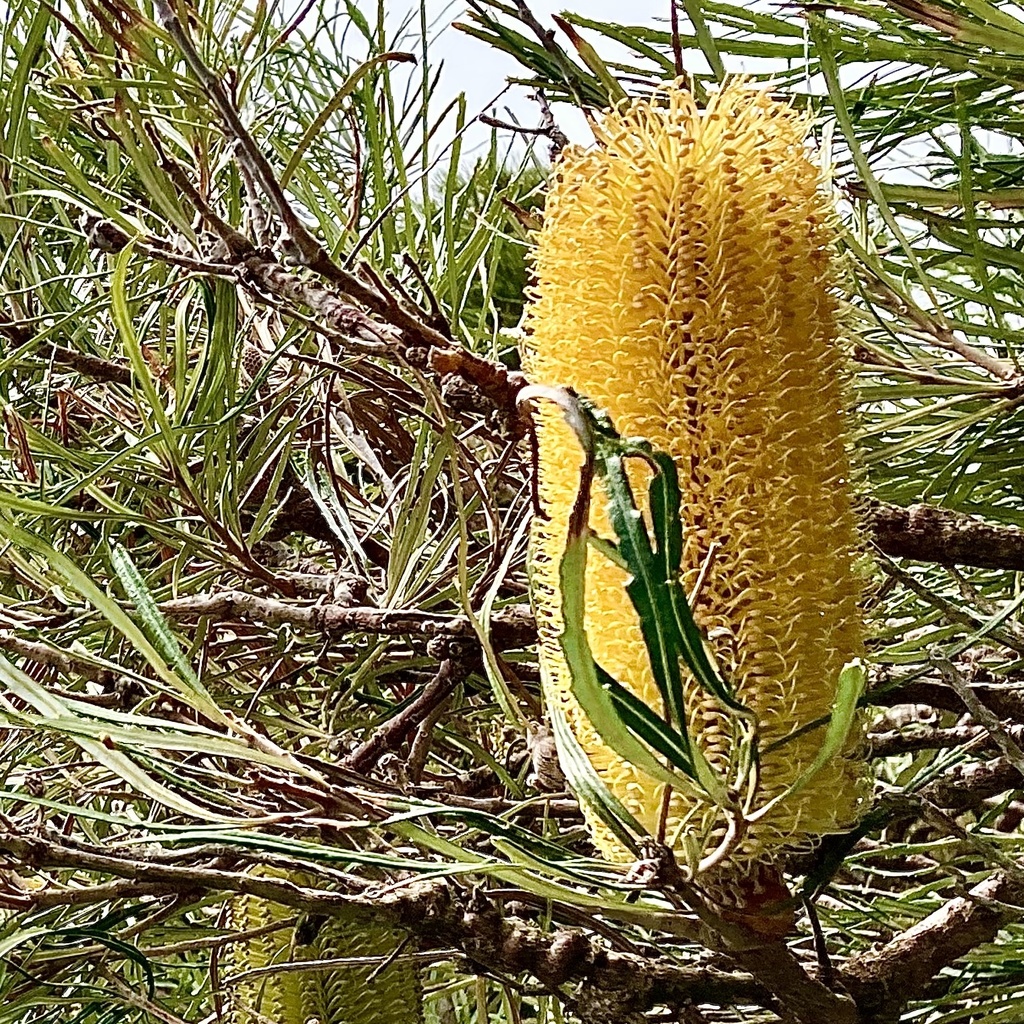
Swamp Banksia
Banksia littoralis
Banksia littoralis, commonly known as the swamp banksia, swamp oak, river banksia or seaside banksia and the western swamp banksia, is a species of tree that is endemic to the south-west of Western Australia. The Noongar peoples know the plant as pungura, boongura or gwangia. It has rough, crumbly bark, linear, more or less serrated leaves arranged in whorls, yellow flowers and up to two hundred follicles in each head.
From the article Banksia littoralis on Wikipedia (CC BY-SA), quoted section by section
Description
Banksia littoralis is a tree that typically grows up to around 1.5 to 12 m (4 ft 11 in to 39 ft 4 in), sometimes to 25 m (82 ft), with rough, crumbly bark and woolly-hairy stems. The leaves are arranged in whorls and are linear in shape, usually serrated in the upper half, 70–230 mm (2.8–9.1 in) long and 4–18 mm (0.16–0.71 in) wide on a petiole 5–10 mm (0.2–0.4 in) long. The flowers are arranged on a cylindrical head 70–200 mm (2.8–7.9 in) long and 60–70 mm (2.4–2.8 in) wide when the flowers open. The flowers are yellow with a perianth 25–27 mm (0.98–1.06 in) long and a hooked pistil 29–35 mm (1.1–1.4 in) long. Flowering occurs from March to July and the follicles are broadly linear to narrow elliptical, 11–22 mm (0.4–0.9 in) long, 2.5–8 mm (0.1–0.3 in) high and 4–8 mm (0.16–0.31 in) wide, the old flowers having fallen. There are sometimes up to two hundred follicles in each head.
Range & habitat
Swamp banksia is found in coastal areas of southwestern Western Australia, including the Wheatbelt, Peel, South West and Great Southern regions, where it is often situated along creeks and rivers, in low-lying, seasonally damp areas like swamps and depressions, where it grows well in high moisture peaty to sandy soils. It is often part of low woodland communities and often is associated with Melaleuca preissiana and also in Eucalyptus gomphocephala forest communities, but rarely is it found as a part of low coastal kwongan communities. The range extends from around Mount Lesueur in the north to around Cape Leeuwin in the southwest, extending east to around Two Peoples Bay and the Stirling Range.
Wikipedia: “Distribution and habitat”
How it is grown
Banksia littoralis is relatively easy to grow. It is possibly not as sensitive to dieback as other western banksias. Seeds do not require any treatment, and take 20 to 36 days to germinate.
Wikipedia: “Use in horticulture”
Where it lives
Recorded sightings
—
geo-referenced records in GBIF, from museums, herbaria and field observers.
Drag the globe to turn it. Dots are where records exist, not a range map; darker means more records.
In the stacks
Searching the stacks…
Every page naming Banksia littoralis in the Biodiversity Heritage Library →
This page is assembled live from iNaturalist, GBIF, Wikipedia, the Source Library and the Internet Archive. It is not yet part of the hand-edited codex. iNaturalist taxon 544919.