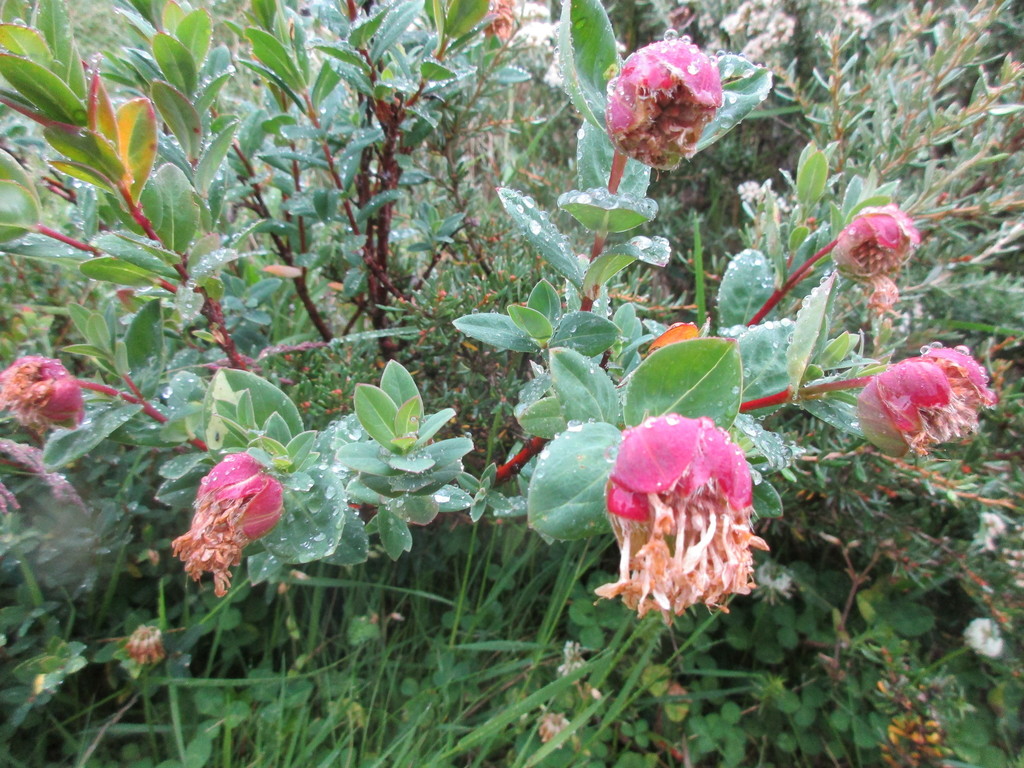
tall rice-flower
Pimelea ligustrina
Pimelea ligustrina is a species of flowering plant in the family Thymelaeaceae, and is endemic to south-eastern Australia. It is a shrub with lance-shaped or narrowly elliptic leaves arranged in opposite pairs, and clusters of creamy-white, white or pinkish flowers usually surrounded by 4 or 8, greenish to reddish brown involucral bracts.
From the article Pimelea ligustrina on Wikipedia (CC BY-SA), quoted section by section
Description
Pimelea ligustrina is a shrub that typically grows to a height of 0.2–3 m (7.9 in – 9 ft 10.1 in) and has glabrous stems. Its leaves are arranged in opposite pairs, lance-shaped with the narrower end towards the base or narrowly elliptic, mostly 15–90 mm (0.59–3.54 in) long and 7–20 mm (0.28–0.79 in) wide on a short petiole. The flowers are bisexual or female, creamy white or white, rarely pink, and arranged in large, erect clusters, surrounded by 4 or 8 lance-shaped to broadly elliptic involucral bracts 5–18 mm (0.20–0.71 in) long and 3–14 mm (0.12–0.55 in) wide. The floral tube is 5.5–13 mm (0.22–0.51 in) long, the sepals 1.5–5 mm (0.059–0.197 in) long and hairy on the outside. Flowering time varies with subspecies. The fruit is green and 3–5 mm (0.12–0.20 in) long.
Range & habitat
This pimelea occurs in the A.C.T. and all states of Australia, except Western Australia. Subspecies ciliata grows in forest, snow gum woodland and heath above 1,400 m (4,600 ft) south from the Brindabella Range in New South Wales, the A.C.T. and eastern Victoria. Subspecies hypericina grows on the margins of wet forest and rainforest, mainly between the Gibraltar Range and Mount Cambewarra in New South Wales. Subspecies ligustrina is widely distributed in forest below 1,400 m (4,600 ft) in south-east Queensland, eastern New South Wales, the A.C.T., southern Victoria, the far south-east of South Australia, and in Tasmania.
Wikipedia: “Distribution and habitat”
Where it lives
Recorded sightings
—
geo-referenced records in GBIF, from museums, herbaria and field observers.
Drag the globe to turn it. Dots are where records exist, not a range map; darker means more records.
In the stacks
Searching the stacks…
Every page naming Pimelea ligustrina in the Biodiversity Heritage Library →
This page is assembled live from iNaturalist, GBIF, Wikipedia, the Source Library and the Internet Archive. It is not yet part of the hand-edited codex. iNaturalist taxon 544835.