- Plants
- ›Vascular Plants
- ›Ferns
- ›Leptosporangiate Ferns
- ›Polypod Ferns
- ›eupolypods I
- ›shieldfern family
- ›Dryopteridoideae
- ›Polystichum
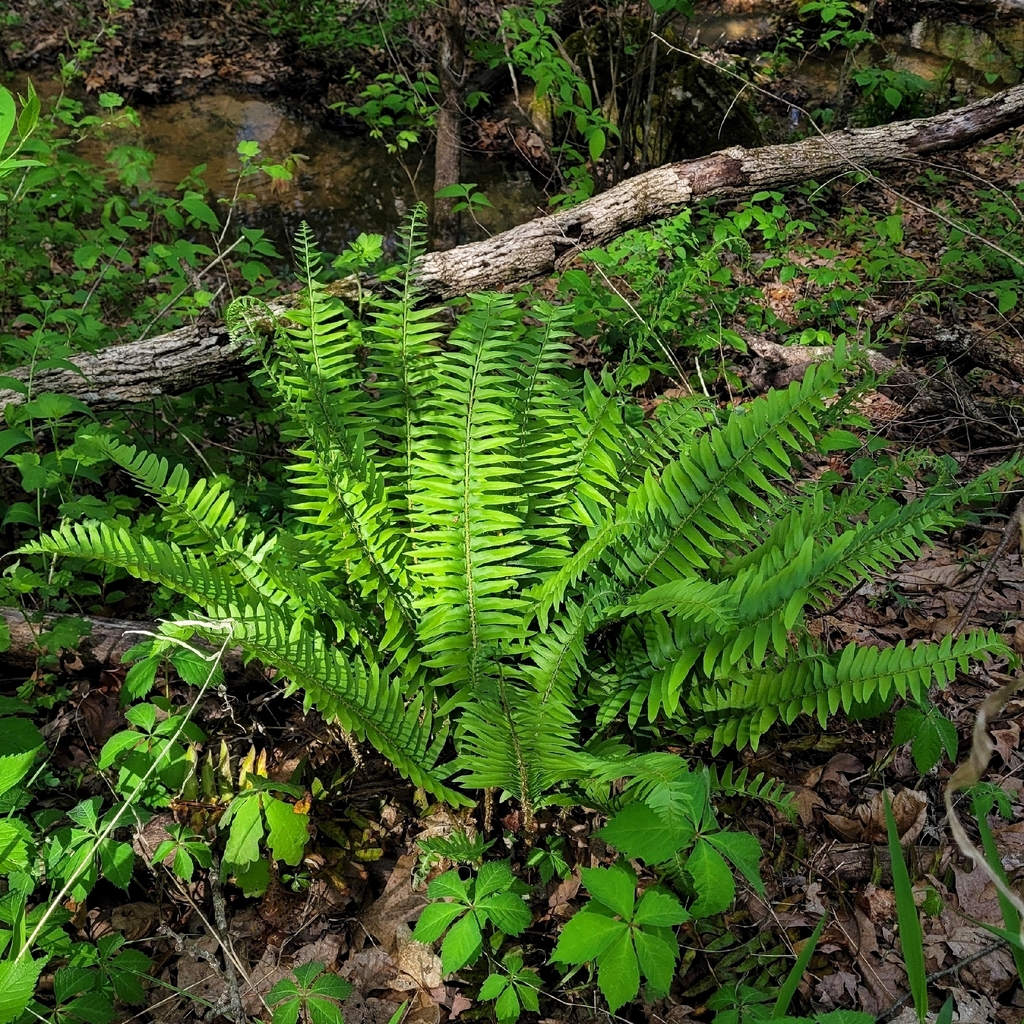
Christmas fern
Polystichum acrostichoides
Polystichum acrostichoides, commonly called Christmas fern, is a perennial, evergreen fern native to eastern North America, from Nova Scotia west to Minnesota and south to Florida and eastern Texas and naturalized in Europe. It is one of the most common ferns in eastern North America, being found within moist and shady areas in forests, rocky slopes, and stream banks. The common name of Christmas fern, derives from its evergreen fronds which are often still green at...
From the article Polystichum acrostichoides on Wikipedia (CC BY-SA), quoted section by section
Description
Christmas fern has a tufted, clumping habit, with its fronds arising from a central growth point. It can form colonies, but frequently grows singly or in twos or threes. In winter, the fertile fronds die; the sterile fronds remain through the winter, and are Reoriented towards the ground from tropism cues caused by low temperatures and presence of snow. This is done in an attempt to save the frond due to the fern being an evergreen species. The frond is supported by a dark brown- to black-colored stipe, or stem, which is typically a quarter to a third of the overall frond length. Coarse, light-brown-to-tan scales cover the stipe, and are typically about 5-millimetre-long (0.20 in) and translucent. The coiled, developing fronds ("crosiers") are scaly, greyish and prominent in early spring. Fronds are 30-to-80-centimetre-long (12 to 31 in) and 5-to-12-centimetre-broad (2.0 to 4.7 in), dark green and rather leathery in texture; their undersides may be covered in very sparse hairs. They have 20 to 35 pairs of pinnae. Each pinna is typically 4-centimetre-long (1.6 in) and has a finely serrulate or spiny edge, and is oblong to falcate in shape. The fine teeth or spines on the edge of the pinna are oriented towards its tip. Each pinna has a small, triangular, "thumblike" lobe at its base. …
What it does
P. acrostichoides is parasitized by the fungus Taphrina polystichi, which causes yellowish to whitish galls on the fronds. The moth Herpetogramma sphingealis has larvae that feed on Christmas ferns. This moth species is primarily found where Christmas ferns are abundant and was given a scientific description in 2011.
Wikipedia: “Ecology”
How it is grown
Christmas fern is popular in cultivation as an ornamental plant for gardens, including natural gardens, as it is easy to cultivate in a range of environments and soils. Being evergreen, it is sometimes used in winter-oriented garden design. This fern can conserve soil and allay erosion of steep slopes. The fronds are semi-erect until the first killing frost, after which they lie prostrate on the ground and effectively hold in place the duff layer of the forest floor, enabling the gradual decomposition of the duff into humus, which in turn builds the soil.
Wikipedia: “Cultivation”
Where it lives
Recorded sightings
—
geo-referenced records in GBIF, from museums, herbaria and field observers.
Drag the globe to turn it. Dots are where records exist, not a range map; darker means more records.
In the stacks
Searching the stacks…
Every page naming Polystichum acrostichoides in the Biodiversity Heritage Library →
This page is assembled live from iNaturalist, GBIF, Wikipedia, the Source Library and the Internet Archive. It is not yet part of the hand-edited codex. iNaturalist taxon 54412.