- Plants
- ›Vascular Plants
- ›flowering plants
- ›Dicots
- ›Roses, Elms, Figs, and Allies
- ›rose family
- ›Amygdaloideae
- ›Amygdaleae
- ›Prunus
- ›Prunus
- ›Amygdalus
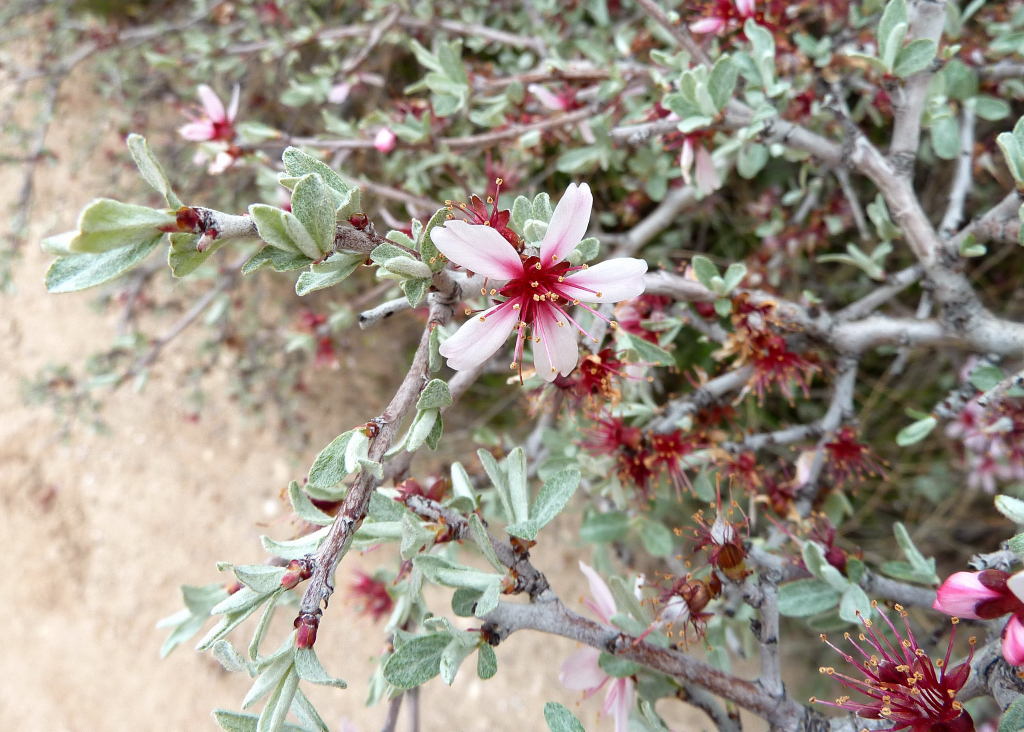
silver almond
Prunus argentea
Prunus argentea, sometimes called the silver almond, is a species of wild almond found in the Levant, Turkey, Iraq and western Iran. It is a thorny shrub 0.5 to 3 m (1.6 to 9.8 ft) tall, with rough gray or brown bark. Its leaves are silvery white due to a covering of pubescent hairs. The leaves have a 1–5 mm petiole and the leaf blades are 10–44 mm (0.4–1.7 in) long and 10–23 mm (0.4–0.9 in) wide. Its inflorescences have red hypanthia and sepals, and pale pink or pink petals. The flowers are borne on a pedicel about 1 to 3 mm long, which lengthens to 2 to 7 mm when the fruit is fully developed. It is found growing in a variety of habitats; open oak woodlands, rocky slopes, dry silted areas, and steep banks of streams, at 500–2,000 m (1,600–6,600 ft) above sea level. A genetic study showed that its closest relative is probably Prunus haussknechtii.
From the article Prunus argentea on Wikipedia (CC BY-SA), quoted section by section
At the table
In warmer areas of Europe it is occasionally cultivated as an ornamental garden plant for its fragrant rose-pink flowers and attractive foliage, but it must be planted in a protected spot for best results.
== References ==
Wikipedia: “Uses”
Where it lives
Recorded sightings
—
geo-referenced records in GBIF, from museums, herbaria and field observers.
Drag the globe to turn it. Dots are where records exist, not a range map; darker means more records.
In the stacks
Searching the stacks…
Every page naming Prunus argentea in the Biodiversity Heritage Library →
This page is assembled live from iNaturalist, GBIF, Wikipedia, the Source Library and the Internet Archive. It is not yet part of the hand-edited codex. iNaturalist taxon 543512.