- Plants
- ›Vascular Plants
- ›flowering plants
- ›Dicots
- ›Soapberries, Cashews, Mahoganies, and Allies
- ›citrus family
- ›Aurantioideae
- ›Citrus
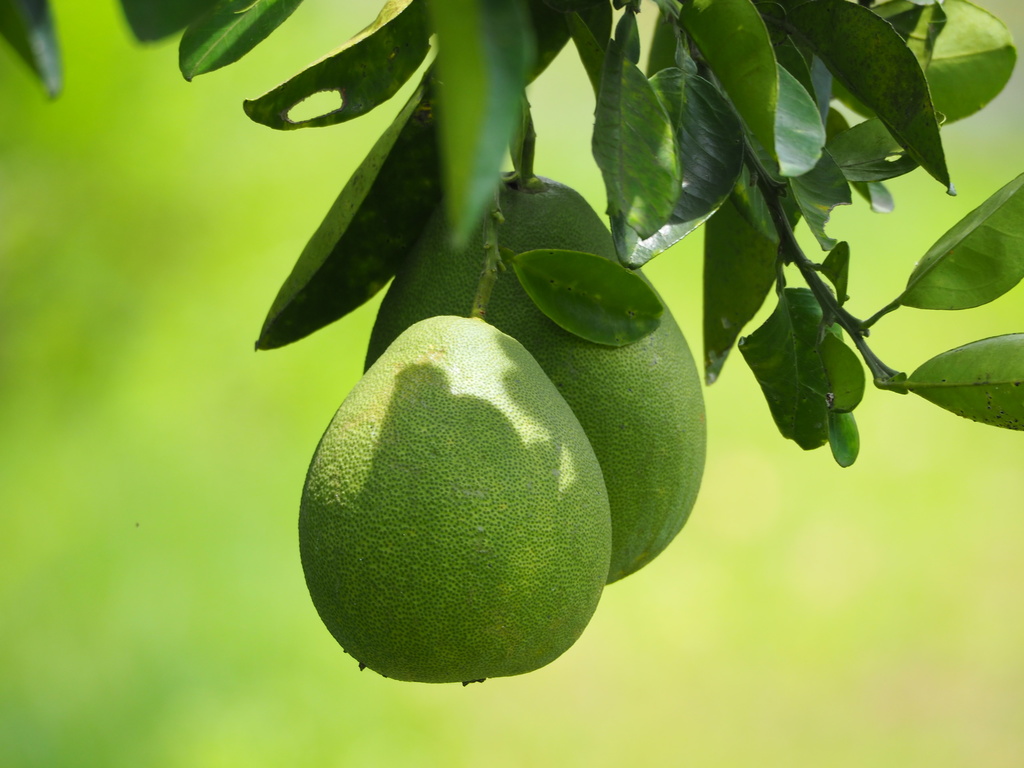
Pomelo
Citrus maxima
The pomelo ( POM-il-oh, PUM-; or pummelo, Citrus maxima), also known as a shaddock, is the largest citrus fruit. It is an ancestor of several cultivated citrus species, including the bitter orange and the grapefruit. It is a natural, non-hybrid citrus fruit, native to Southeast Asia. Similar in taste to a sweet grapefruit, the pomelo is commonly eaten and used for festive occasions throughout Southeast and East Asia. As with the grapefruit, phytochemicals in the pomelo have the potential for drug interactions.
From the article Pomelo on Wikipedia (CC BY-SA), quoted section by section
Description
The pomelo tree can be 5–15 metres (16–50 feet) tall, with a trunk, often rather crooked, that is 10–30 centimetres (4–12 inches) thick, and low-hanging, irregular branches. The petioles (leaf stalks) are distinctly winged. The leaves are alternate, ovate or elliptic in shape, and 5–20 cm (2–8 in) long; they are leathery and dull green above, hairy beneath. The flowers, produced singly or in clusters, are fragrant and yellow-white. The fruit is large, 10–30 cm (4–12 in) in diameter, round or somewhat pear-shaped. Its weight varies by cultivar from 0.26–1.95 kilograms (0.6–4.3 pounds). It has a thicker peel than a grapefruit, and is divided into 11 to 18 segments. The flesh is less acidic than that of the grapefruit. The pomelo has at least sixty cultivars. The fruit generally contains a few, relatively large seeds, but some cultivars have numerous seeds. The characteristics of pomelo vary widely across South Asia. The pomelo is native to Southeast Asia and all of Malaysia. The tree may have been introduced to China around 100 BCE, and is now heavily cultivated in Southern China. Seeds of the tree were first brought to the Americas in the late 1600s.
What it does
The pomelo, while not itself toxic, can cause adverse interactions similar to those caused by the grapefruit with a wide range of prescription drugs. These occur by the inhibition of cytochrome P450-mediated metabolism of prescription drugs including for example some anti-hypertensives, some anticoagulants, some anticancer agents, some anti-infective agents, some statins, and some immunosuppressants.
Wikipedia: “Drug interactions”
At the table
Raw pomelo flesh is 89% water, 10% carbohydrates, 1% protein, and contains negligible fat. A 100-gram reference amount provides 159 kilojoules (38 kilocalories) of food energy, and is rich in vitamin C (68% of the Daily Value), with no other micronutrients in significant content (table).
Wikipedia: “Nutrition”
How it is grown
The seeds of the pomelo are monoembryonic, producing seedlings with genes from both parents, so they do not breed true to type. However, they are usually fairly similar to the tree they grow from and therefore in Asia, pomelos are typically grown from seed. Seeds can be stored for 80 days at a temperature of 5 °C (41 °F) with moderate relative humidity. Pomelos can be propagated vegetatively by air-layering, by taking cuttings, by grafting, by shield budding, or by tissue culture.
Wikipedia: “Cultivation”
In human culture
According to the Oxford English Dictionary, the etymology of the word "pomelo" is uncertain. It may be derived from Dutch pompelmoes. The Dutch name in turn has uncertain etymology, but is possibly derived from Dutch pompel ("swollen") or pompoen ("pumpkin"), combined with limoes ("lemon, citrus fruit"), influenced by Portuguese limões with the same meaning. An alternative possibility is that the Dutch name derives from Portuguese pomos limões ("citrus fruit"). The specific name maxima is the feminine form of the Latin word meaning "biggest". One theory for the alternative English name "shaddock" is that it was adopted after the plant's introduction into Barbados by a "Captain Shaddock" of the East India Company (apparently Philip Chaddock, who visited the island in the late 1640s). From there the name spread to Jamaica in 1696.
Wikipedia: “Etymology”
Where it lives
Recorded sightings
—
geo-referenced records in GBIF, from museums, herbaria and field observers.
Drag the globe to turn it. Dots are where records exist, not a range map; darker means more records.
In the old herbals & bestiaries

Compendium of Materia Medica
李時珍 · 1596 · p.39

Rariorum Plantarum Historia (with Fungorum Historia)
Carolus Clusius · 1601 · p.25

Sancai Tuhui (Vol. 105)
王圻, 王思義 · 1609 · p.30

Illustrated Herbal Primer
Chen Jiamo (陳嘉謨) · 1628 · p.243

Illustrated Investigation of the Names and Realities of Plants
吳其濬 · 1848 · p.14

Berthe Hoola van Nooten — Fleurs, fruits et feuillages choisis de la flore et de la pomone de Java (1863)
Berthe Hoola van Nooten · 1863 · p.19
In the stacks
Searching the stacks…
Every page naming Citrus maxima in the Biodiversity Heritage Library →
This page is assembled live from iNaturalist, GBIF, Wikipedia, the Source Library and the Internet Archive. It is not yet part of the hand-edited codex. iNaturalist taxon 54299.