- Plants
- ›Vascular Plants
- ›flowering plants
- ›Dicots
- ›Roses, Elms, Figs, and Allies
- ›rose family
- ›Amygdaloideae
- ›Maleae
- ›Sorbus
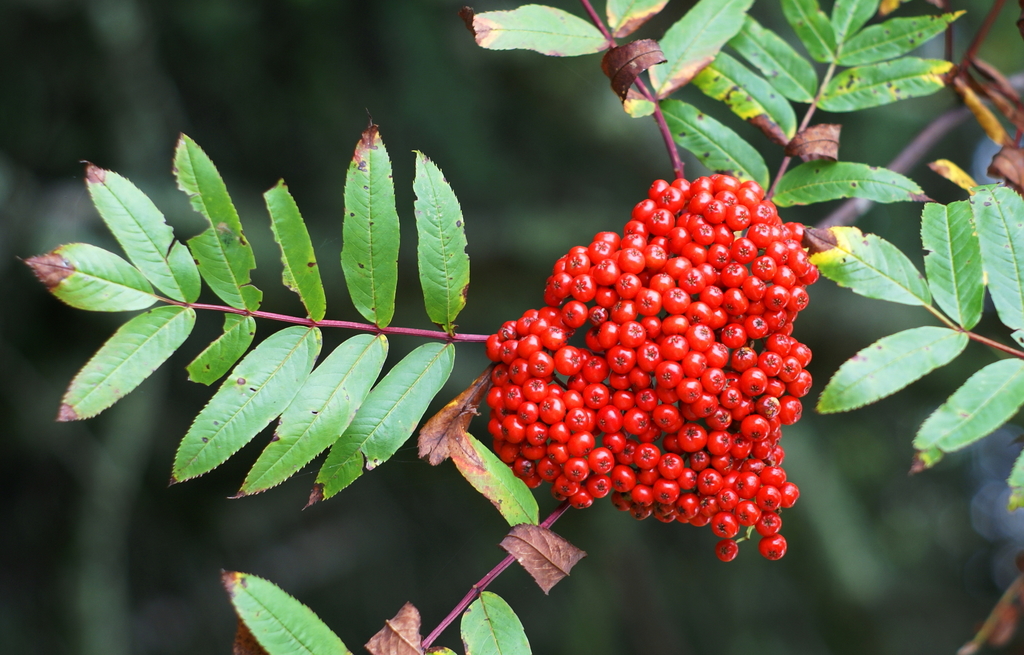
American mountain ash
Sorbus americana
The tree species Sorbus americana is commonly known as the American mountain-ash. It is a deciduous perennial tree, native to eastern North America.
The American mountain-ash and related species (most often the European mountain-ash, Sorbus aucuparia) are also referred to as rowan trees.
From the article Sorbus americana on Wikipedia (CC BY-SA), quoted section by section
Description
Sorbus americana is a relatively small tree, reaching 12 metres (40 ft) in height. The American mountain-ash attains its largest specimens on the northern shores of Lake Huron and Lake Superior. It resembles the European mountain-ash, Sorbus aucuparia.
Bark Light gray, smooth, surface scaly. Branchlets downy at first, later become smooth, brown tinged with red, lenticular, finally they become darker and the papery outer layer becomes easily separable. Wood Pale brown; light, soft, close-grained but weak. Specific gravity, 0.5451; weight of cu. ft., 33.97 lbs. Winter buds Dark red, acute, one-fourth to three-quarters of an inch long. Inner scales are very tomentose and enlarge with the growing shoot. Leaves Alternate, compound, odd-pinnate, 6 to 10 inches (15 to 25 cm) long, with slender, grooved, dark green or red petiole. Leaflets 13 to 17, lanceolate or long oval, two to three inches long, one-half to two-thirds broad, unequally wedge-shaped or rounded at base, serrate, acuminate, sessile, the terminal one sometimes borne on a stalk half an inch long, feather-veined, midrib prominent beneath, grooved above. They come out of the bud downy, conduplicate; when full grown are smooth, dark yellow green above and paler beneath. In autumn they turn a clear yellow. Stipules leaf-like, caducous. Flowers May, June, after the leaves are full grown. …
Range & habitat
Native to eastern North America;
Eastern Canada – New Brunswick, Newfoundland, Nova Scotia, Ontario, Prince Edward Island, Quebec Northeastern United States – Connecticut, Maine, Massachusetts, New Hampshire, New Jersey, New York, Pennsylvania, Vermont North-Central United States – Illinois [n. (Ogle Co.)], Michigan, Minnesota, Wisconsin. Listed as endangered by the State of Illinois Southeastern United States – Appalachian Mountains, Georgia, Maryland, North Carolina, Tennessee, Virginia, West Virginia
Wikipedia: “Distribution”
At the table
After their first winter freeze, the fruits are edible raw or cooked. They can be used to make pie and jelly.
Wikipedia: “Uses”
How it is grown
Sorbus americana is cultivated as an ornamental tree, for use in gardens and parks. It prefers a rich moist soil and the borders of swamps, but will flourish on rocky hillsides. A cultivar is the red cascade mountain-ash, or Sorbus americana 'Dwarfcrown'. It is planted in gardens, and as a street tree.
Wikipedia: “Cultivation”
Where it lives
Recorded sightings
—
geo-referenced records in GBIF, from museums, herbaria and field observers.
Drag the globe to turn it. Dots are where records exist, not a range map; darker means more records.
In the stacks
Searching the stacks…
Every page naming Sorbus americana in the Biodiversity Heritage Library →
This page is assembled live from iNaturalist, GBIF, Wikipedia, the Source Library and the Internet Archive. It is not yet part of the hand-edited codex. iNaturalist taxon 54265.