- Plants
- ›Vascular Plants
- ›flowering plants
- ›Dicots
- ›Nances, Willows, and Allies
- ›willow family
- ›Populus
- ›Tacamahaca
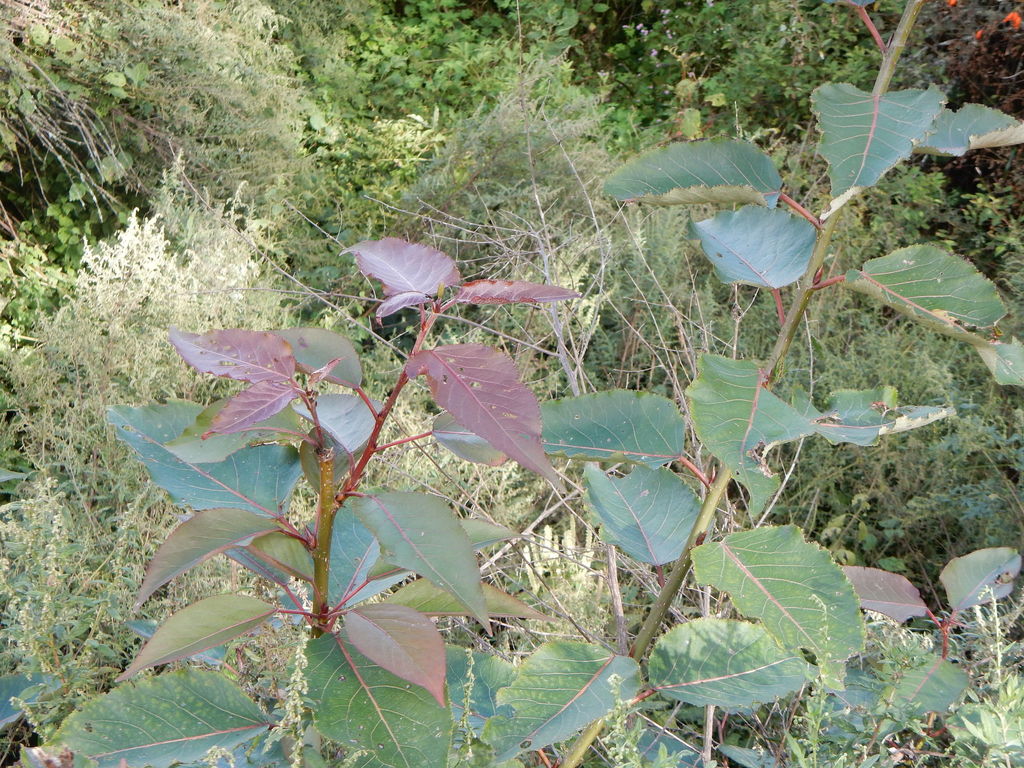
Himalayan poplar
Populus ciliata
Populus ciliata, the Himalayan poplar, is a large deciduous tree with tall clean straight trunk and wide rounded crown. The bark of the young trees is smooth and greenish-grey while the bark of the old trees is dark brown with vertical cracks. Leaves are broadly ovate with hairy serrulate-crenate margins. Flowers are drooping raceme catkins that appear before or with leaves. Populus ciliata flowers are dioecious. Male flowers have a bell-shaped perianth and female flowers are bluntly toothed. A single capsule encloses an average of 100–150 seeds, which are covered by long silky hair.
From the article Populus ciliata on Wikipedia (CC BY-SA), quoted section by section
Range & habitat
Populus ciliata is natively distributed along the Himalayas through China, Pakistan, India (Jammu and Kashmir, Himachal Pradesh, Uttarakhand, Sikkim, Arunachal Pradesh), Nepal, Bhutan, and Myanmar. Populus ciliata is exotic to Afghanistan, France, Iran, Italy, Japan, New Zealand, and the United States.
Wikipedia: “Geographical distribution”
At the table
Populus ciliata is chopped for food and stored to be fed to livestock during times of food shortage.
Wikipedia: “Food”
In medicine
The bark is used to make tonics, stimulants and blood purifiers. The paste of the bark, when mixed with the ash of cow dung, can be used to treat muscular swellings.
Wikipedia: “Medicine”
How it is grown
The seeds weigh about 15 million/kg. In spring, seeds disperse as soon as they mature due to an extremely short period of viability of a few days after maturation. Fresh seeds exhibit high viability with a germination rate of up to 75–90%.
Wikipedia: “Propagation”
Where it lives
Recorded sightings
—
geo-referenced records in GBIF, from museums, herbaria and field observers.
Drag the globe to turn it. Dots are where records exist, not a range map; darker means more records.
In the stacks
Searching the stacks…
Every page naming Populus ciliata in the Biodiversity Heritage Library →
This page is assembled live from iNaturalist, GBIF, Wikipedia, the Source Library and the Internet Archive. It is not yet part of the hand-edited codex. iNaturalist taxon 542553.