- Plants
- ›Vascular Plants
- ›flowering plants
- ›Dicots
- ›nightshades, bindweeds, gooseweeds, and allies
- ›nightshade family
- ›nightshades and allies
- ›nightshades and jaltomatas
- ›Solanum
- ›Leptostemonum
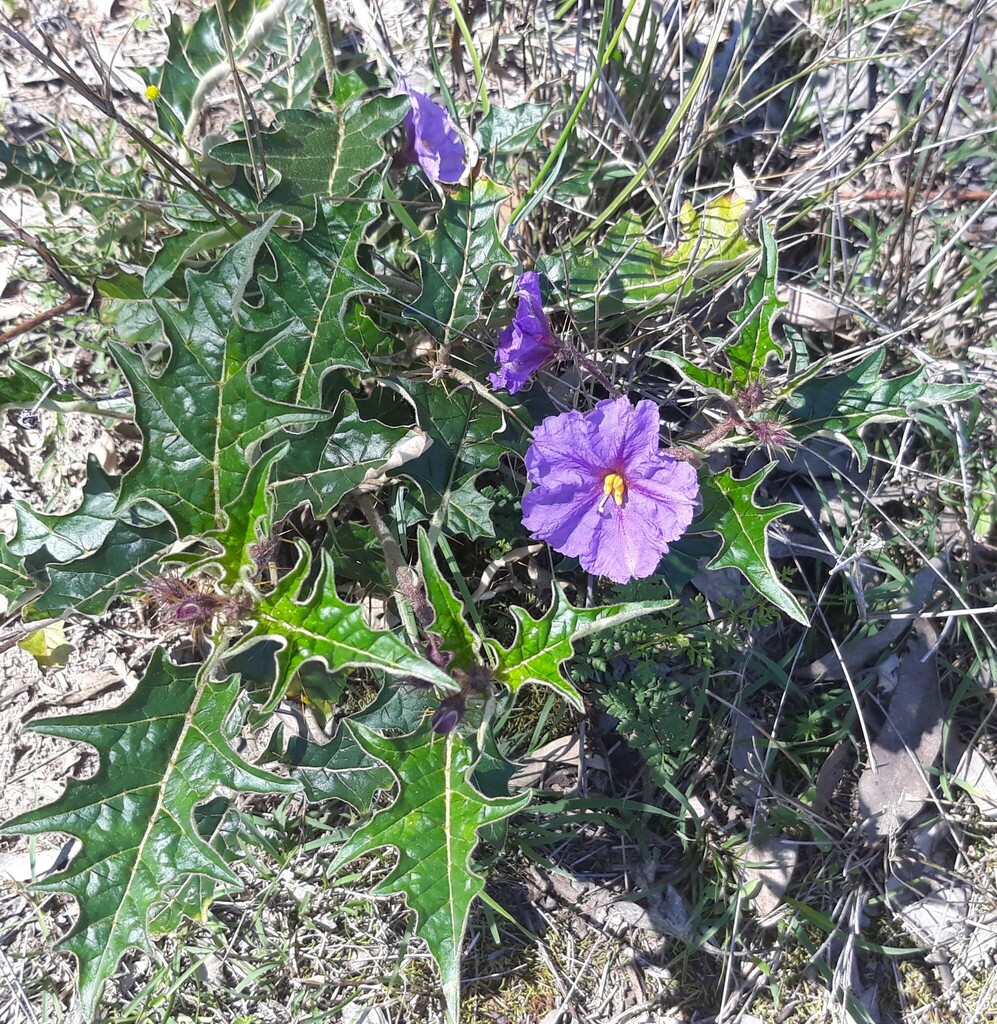
Narrawa burr
Solanum cinereum
Solanum cinereum, commonly known as Narrawa burr, is a species of flowering plant in the family Solanaceae. It has dark green, spiny leaves and purple flowers and grows in open woodland in south eastern Australia.
From the article Solanum cinereum on Wikipedia (CC BY-SA), quoted section by section
Description
Solanum cinereum is a small, upright, sparse, sprawling or bushy, perennial shrub to 1 m (3 ft 3 in) high. The leaves are oval to elliptic shaped, 6–10 cm (2.4–3.9 in) long, 3–6 cm (1.2–2.4 in) wide, heavily lobed, shiny, smooth, upper surface dark green, with conspicuous, long, spiny thorns to 15 mm (0.59 in) long, lower surface whitish to light yellow, covered densely with small star-shaped hairs and the petiole 5–15 mm (0.20–0.59 in) long. The flowers are borne singly or in small clusters with four yellow stamens, 20–30 mm (0.79–1.18 in) in diameter, mauve to purple on a peduncle usually 2–10 mm (0.079–0.394 in) long. Flowering occurs mostly from spring to autumn and the fruit is a globose-shaped berry, usually 15–20 mm (0.59–0.79 in) in diameter, pale green with darker streaks and turning brown at maturity.
Range & habitat
Narrawa burr grows in woodland, dry forests and disturbed sites in New South Wales, Victoria, Queensland and the Australian Capital Territory. It is considered a weed in farmland, because it is poisonous to sheep, cattle, and possibly horses.
== References ==
Wikipedia: “Distribution and habitat”
Where it lives
Recorded sightings
—
geo-referenced records in GBIF, from museums, herbaria and field observers.
Drag the globe to turn it. Dots are where records exist, not a range map; darker means more records.
In the stacks
Searching the stacks…
Every page naming Solanum cinereum in the Biodiversity Heritage Library →
This page is assembled live from iNaturalist, GBIF, Wikipedia, the Source Library and the Internet Archive. It is not yet part of the hand-edited codex. iNaturalist taxon 542131.