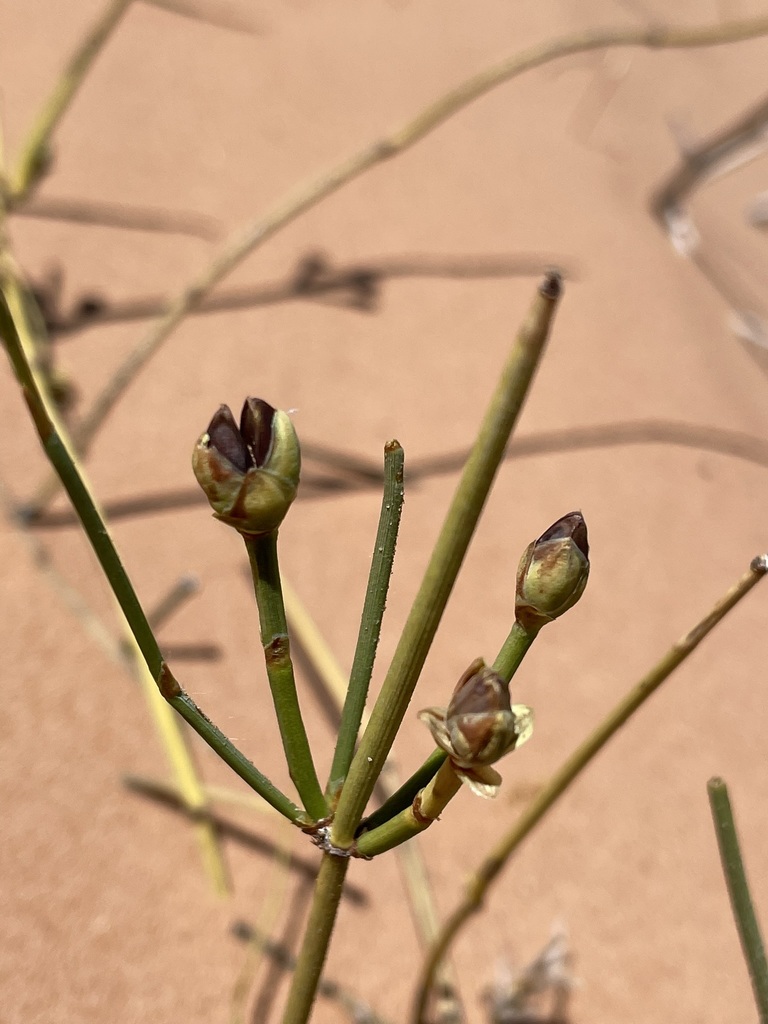
Cutler's Jointfir
Ephedra cutleri
Ephedra cutleri, the Navajo ephedra or Cutler's jointfir, is a species of Ephedra that is native to the Southwestern United States (Arizona, New Mexico, Utah, Colorado, Nevada, Wyoming).
From the article Ephedra cutleri on Wikipedia (CC BY-SA), quoted section by section
Description
The rhizomatous shrubs form erect clumps, .25–1.5 metres (0.82–4.92 ft) tall and 3–5 metres (9.8–16.4 ft) wide. It grows on flat and dry sandy areas, and occasionally on rocky slopes. Anchored by the rhizomes and an advantageous root system, Ephedra cutleri leaves grow in an opposite orientation but can not sustain all growth. Because the leaves are too small to perform photosynthesis, it is conducted in the sticky stems of the plant.
At the table
A food source for animals, there are differing views as to whether the plant has any medicinal properties for humans with the exception of brewing Mormon tea. Native Americans in the Four Corners region have made use of the plant in various ways. The seeds were sometimes roasted and ground into flour, while the plant could also be used for making light tan or reddish dyes, as well as used in the process of tanning animal hides.
Wikipedia: “Uses”
How it is grown
In one study, E. cutleri was the major plant found in Northeastern Arizona where dry, loamy, fine sand surfaced layers of Sheppard series soils dominate and form coppice dunes due their strong rhizomes. Stabilized dunes are preferred at higher elevations. Evapotranspiration of waste water studies have been performed where E. cutleri is the predominant established plant species. Their adaptation to the arid conditions of the desert landscape provide ideal functionality of evaporating the deposited water.
Wikipedia: “Cultivation”
Where it lives
Recorded sightings
—
geo-referenced records in GBIF, from museums, herbaria and field observers.
Drag the globe to turn it. Dots are where records exist, not a range map; darker means more records.
In the stacks
Searching the stacks…
Every page naming Ephedra cutleri in the Biodiversity Heritage Library →
This page is assembled live from iNaturalist, GBIF, Wikipedia, the Source Library and the Internet Archive. It is not yet part of the hand-edited codex. iNaturalist taxon 53883.