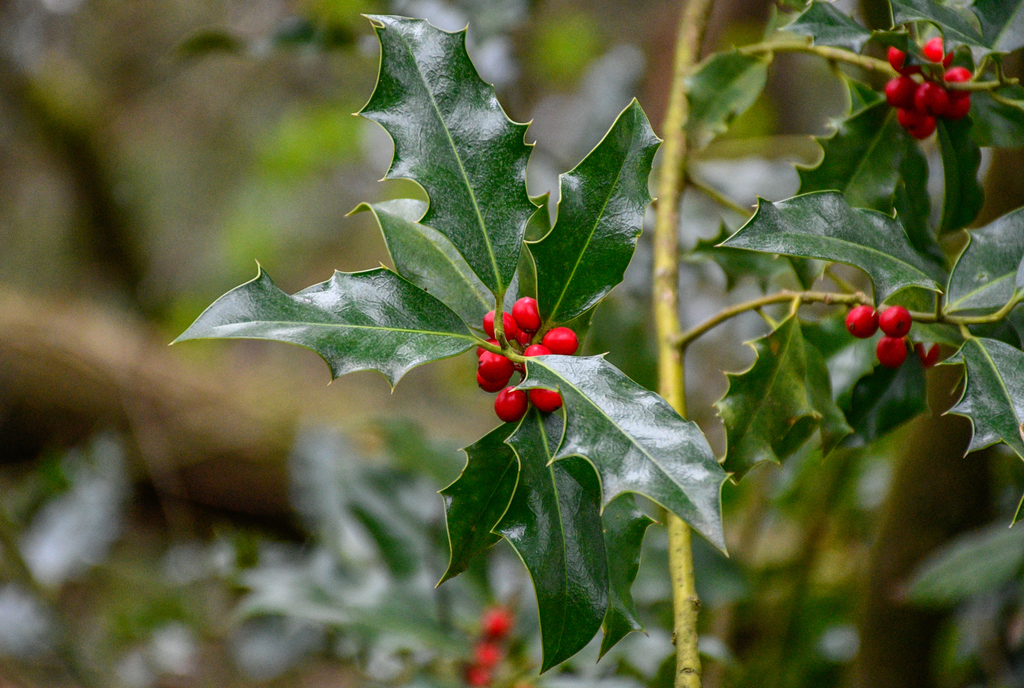
European holly
Ilex aquifolium
Ilex aquifolium, the holly, common holly, English holly, European holly, or occasionally Christmas holly, is a species of flowering plant in the family Aquifoliaceae, native to western and southern Europe, northwest Africa, and southwest Asia. It is regarded as the type species of the genus Ilex, which by association is also called holly. It is an evergreen tree or shrub found, for example, in shady areas of forests of oak and in beech hedges. In the British Isles it is one of very few native hardwood evergreen trees. It has a great capacity to adapt to different conditions and is a pioneer species that repopulates the margins of forests or clearcuts.
European holly can exceed 15 m in height, but is often found at much smaller heights, typically 2–3 m (6.6–9.8 ft) tall and broad, with a straight trunk and pyramidal crown, branching from the base. It grows slowly and does not usually fully mature due to cutting or fire. It is estimated to live as long as 300 years.
From the article Ilex aquifolium on Wikipedia (CC BY-SA), quoted section by section
Description
In exceptional cases European holly can grow to 24 m (79 ft) in height, but more typically is 3 to 15 m (10 to 49 ft) tall and often only grows into a shrub rather than reaching tree stature. It has a woody stem as wide as 40–80 cm (16–31 in), rarely 100 cm (39 in) or more, in diameter. The bark is smooth and silver-grey, but with age will develop small fissures. The root system is a fibrous mat near the surface with only a few roots that descend to greater depths. In dense stands the roots will spread only about as wide as the branches. Holly trees only rarely produce suckers, but those that do can produce a clump of stems. Lower branches that become buried in dead leaves can also sometimes root. The botanist William Dallimore estimated the maximum lifespan of the holly at 250 to 300 years. The leaves are 5–12 cm long and can be as narrow as one-third the overall length; they are evergreen, and though they can last for as much as eight years less than five is more typical. In the upper canopy of trees exposed to full sun leaves fall after just one or two years. Most leaves are shed during middle of winter, though some fall during all seasons of the year, with the oldest leaves falling first unless disturbed by drought. …
Range & habitat
Holly is native to much of the western half of Europe as well as northwestern Africa. Its native status in central and Eastern Europe is disputed. According to Plants of the World Online (POWO) it is not native or reproducing in Poland or Hungary, but is native to Bulgaria and Romania. According to the International Union for Conservation of Nature (IUCN) its status in Romania is uncertain and it is introduced and naturalized to some extant in Hungary, though they agree that it is not found in Poland or eastward in northern Europe. In response to climate change the species is shifting northwards in Norway and towards to the northeast in Denmark and Germany. By 2005 it was found as far north as Kristiansund in Norway, though still limited to a fringe of the county immediately adjacent to the North Sea. In Asia its status is disputed with POWO listing it as an introduced species in Turkey and Syria while the IUCN lists it as native and also native to Iran and Lebanon. Holly grows from sea level to elevations as high as 600 m (2,000 ft). Holly is a common species in its range and widespread. Because of this it is a species of least-concern according to the IUCN, however there is a decline in mature individuals and its population is severely fragmented. Though, local populations may face threats. …
Wikipedia: “Distribution and habitat”
What it does
Holly is a rugged pioneer species that prefers relatively moist areas, and tolerates frost as well as summer drought. With its spiny leaves it can form a dense thicket that defends other woody species from herbivores aiding the regeneration of forests. The plant is common in the garrigue and maquis and is also found in deciduous forest and oak forest. Pure stands of hollies can grow into a labyrinth of vaults in which thrushes and deer take refuge, while smaller birds are protected among their spiny leaves. After the first frost of the season, holly fruits become soft and fall to the ground serving as important food in its native regions for winter birds at a time of scarce resources. The flowers are attractive as nectar sources for insects such as bees, wasps, flies, and small butterflies. The commonly-encountered pale patches on leaves are due to the leaf-mine insect Phytomyza ilicis. It is an invasive species on the West Coast of Canada and the United States as well as in Hawaii. Holly is well known in epigenetics. Some cultivars have smooth leaf edges, or both smooth and prickly leaf edges on the same plant. In response to stress these cultivars can produce leaves with more prickles.
Wikipedia: “Ecology”
At the table
As early as the 1200s and into the first part of the 1700s Ilex aquifolium was cultivated for use as winter fodder for many domestic animals. Sheep were most frequently fed holly, but horses and cattle were also given it and branches were cut down for red deer. This practice is best documented in southern areas of the Pennines near Sheffield, but might have been more widespread in Britain and there are a few instances of it recorded in northwest France. The smooth leaves were specifically selected to be cut in at least some instances. Though the practice is much rarer, branches are still cut for sheep or cattle in Dumfries, Derbyshire, Cumbria, and in the New Forest. It was also practiced in Ireland until the middle of the twentieth century. The wood of the holly is hard and white with a slight grey or green tinge and without a noticeable heartwood. It is fine-grained and quite heavy. It is difficult to dry and is often cut into small pieces avoid problems with it warping. It is used for wood inlay, small fancy carving, or small turned pieces. It is easily stained black and is occasionally substituted for ebony. In the 1800s holly was extensively used, and considered the best material, for making driving whips for horse-drawn carriages. …
Wikipedia: “Uses”
Toxicity
Holly berries contain alkaloids, theobromine, saponins, caffeic acid, and a yellow pigment, ilixanthin. The berries are generally regarded as toxic to humans.
Wikipedia: “Chemistry and toxicity”
How it is grown
Ilex aquifolium is widely grown in parks and gardens in temperate regions. Hollies are often used for hedges; the spiny leaves make them difficult to penetrate, and they take well to pruning and shaping. Holly can grow in a wide variety of difficult soils including clay, acidic, and nutrient poor soils, but is intollerant of poor drainage. In wet conditions it is likely to have problems such as root rot, canker, or leaf blight.
AGM cultivars. Numerous cultivars have been selected, of which the following have gained the Royal Horticultural Society's Award of Garden Merit:
Ilex × altaclerensis. The hybrid Ilex × altaclerensis was developed at Highclere Castle in Hampshire, England, in 1835, a cross between I. aquifolium and the tender species I. perado. The following cultivars have gained the RHS AGM:
Wikipedia: “Cultivation”
Where it lives
Recorded sightings
—
geo-referenced records in GBIF, from museums, herbaria and field observers.
Drag the globe to turn it. Dots are where records exist, not a range map; darker means more records.
In the old herbals & bestiaries

In the stacks
Searching the stacks…
Every page naming Ilex aquifolium in the Biodiversity Heritage Library →
This page is assembled live from iNaturalist, GBIF, Wikipedia, the Source Library and the Internet Archive. It is not yet part of the hand-edited codex. iNaturalist taxon 53856.