- Plants
- ›Vascular Plants
- ›flowering plants
- ›Dicots
- ›Soapberries, Cashews, Mahoganies, and Allies
- ›mahogany family
- ›Dysoxylum
rosewood
Dysoxylum fraserianum
Didymocheton fraserianus, commonly known as rosewood or rose mahogany, is a medium-sized to large tree native to New South Wales and Queensland. It is widely used with the purpose of street design and to provide shade in the eastern suburbs of Sydney. Rosewood ranges from the rainforest around eastern Australia from Bundaberg in Queensland to Wyong in New South Wales. At maturity, it can reach a height of 57 metres (200 ft). It is generally known for its strong scent of rose from its bark.
Rosewood is a highly adaptable plant. It can grow in different site conditions, growing close to mountain ranges, basalt, and the volcanic basin. The species can also tolerate drought, frost, and salt. It is a typical long-lived but slow-growing species at the beginning. However, satisfying the growing condition of suitable temperature, humidity, and fertile soil can speed up its growth. Also, it is used commercially for the quality of its wood, in building high-end furniture and construction. Further studies have also been conducting, focusing on exploring more about its usage in essential oil.
From the article Didymocheton fraserianus on Wikipedia (CC BY-SA), quoted section by section
Description
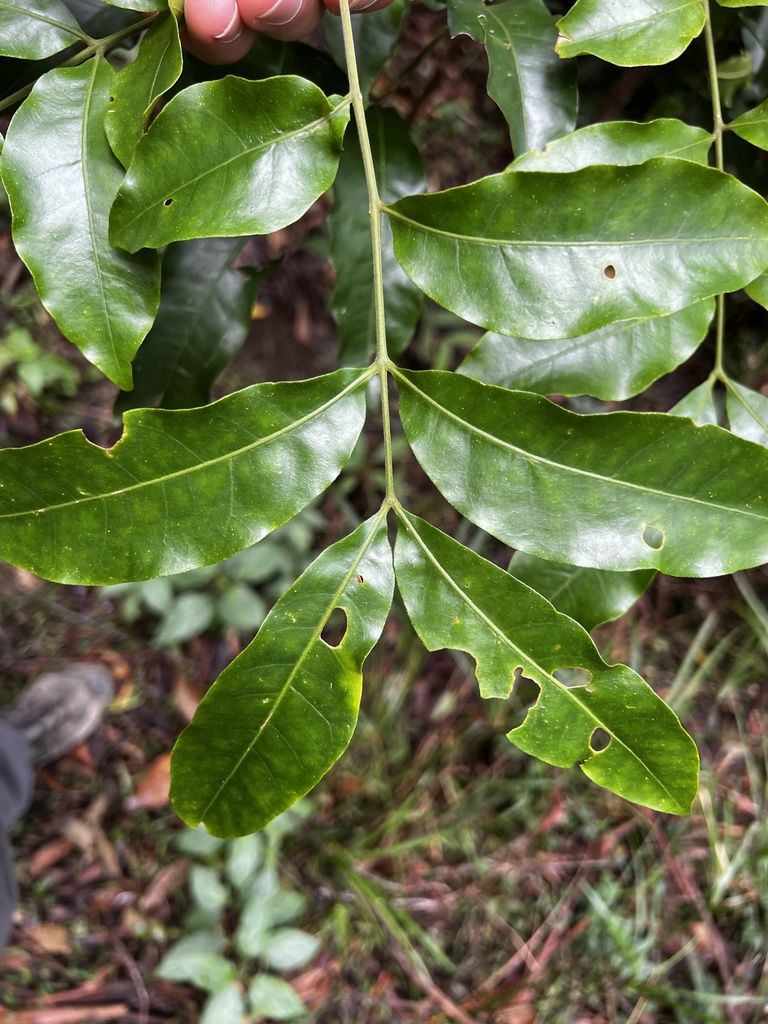
Didymocheton fraserianus is an evergreen tree that typically grows to a height of 30 m (98 ft), with a trunk up to 1.2 m (3 ft 11 in) in diameter. The largest D. fraserianus in New South Wales is 56.9 m (186.7 ft) tall and has a trunk 3.55 m (11.6 ft) in diameter. The size of the tree can vary depending on the growing conditions. Trees that grow under poor and unfavorable conditions can only grow half that height. Few specific features of D. franserianum differentiate it from the others. The stem can grow more than 1m in diameter, and it is not buttressed but flanged at the base. The bark is light brown with a scale-like outline, while the underbark is reddish-brown with non-uniform lighter colored lines. The shape of the crown is round with the standard dark green color, usually dense and shiny. The leaves are arranged in spirals along the branchlets, glossy green and 120–250 mm (4.7–9.8 in) long on a petiole 20–80 mm (0.79–3.15 in) long. The leaves are paripinnate with between four and twelve leaflets, each leaflet elliptic to egg-shaped with the narrower end towards the base, 40–110 mm (1.6–4.3 in) long and 15–40 mm (0.59–1.57 in) wide on a petiolule 1–3 mm (0.039–0.118 in) long. The flowers are arranged in thyrses 50–120 mm (2.0–4.7 in) long, more or less sessile, and sweetly scented. …
Range & habitat
Didymocheton fraserianus grows in rainforest on the coast and ranges of eastern Australia from near Bundaberg in Queensland to Wyong in New South Wales. It is one of the most common species that can be found in the subtropical rainforest of Australia. There are around 80 different species of the genus spreading from India to Australia and New Zealand. Among the 80, nine species can only be found in Australia, inhabiting sub-tropical and tropical areas and coastal ranges. The species is most commonly seen in the rainforest of Dorrigo Plateau, Richmond, and MacPherson Ranges in New South Wales. Rosewood today is very common, familiar as a street tree especially in the eastern suburbs of Sydney. The species is extensively logged due to its colour and fragrance. Didymocheton fraserianus first appeared in Queensland's suburban gardens and street in the 1970s. Didymocheton fraserianus is easy to grow under most of the conditions. Aside from the rainforest, other typical sites for habitats include flat and 10-15% gradient slope near mountain ranges. Basalt and red volcanic soils near the volcanic basin on Mt. Warning are common sites for the trees to flourish due to their deep fertile soils. The tree takes a long time to grow in the beginning, but with a suitable environment (temperature, humidity, fertility of the soil), it can turn into a fast-growing tree, offering shade.
Wikipedia: “Distribution and habitat”
Where it lives
Recorded sightings
—
geo-referenced records in GBIF, from museums, herbaria and field observers.
Drag the globe to turn it. Dots are where records exist, not a range map; darker means more records.
In the old herbals & bestiaries

In the stacks
Searching the stacks…
Every page naming Dysoxylum fraserianum in the Biodiversity Heritage Library →
This page is assembled live from iNaturalist, GBIF, Wikipedia, the Source Library and the Internet Archive. It is not yet part of the hand-edited codex. iNaturalist taxon 538023.