- Plants
- ›Vascular Plants
- ›flowering plants
- ›Dicots
- ›pinks, cactuses, and allies
- ›four o'clock family
- ›Abronia
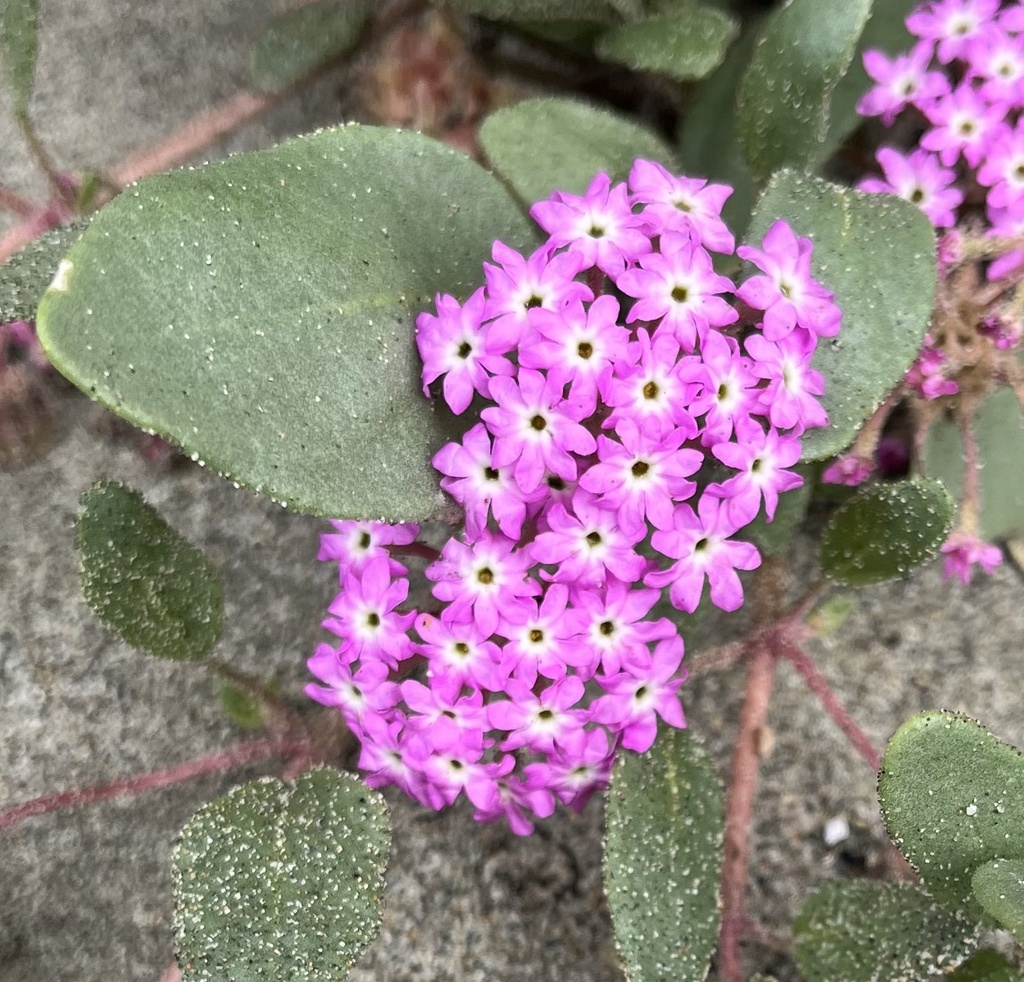
Pink Sand Verbena
Abronia umbellata
Abronia umbellata (pink sand verbena) is a flowering annual plant which is native to western North America. Other common names include beach sand verbena and purple sand verbena.
From the article Abronia umbellata on Wikipedia (CC BY-SA), quoted section by section
Description
Abronia umbellata is a prostrate annual with thick, succulent leaves (leaves occur few to many and are slender, ovate to diamond-shape with stems as long as leaf blades, stems are often hairy) and pink to purple colored flowers with white centers. Flowers occur in clusters subtended by 5-8 lanceolate bracts. The flowers do not have petals, but the calyx lobes are cleft giving the appearance of 10-16 petals. The limbs of the perianth is bright colored sometimes to purplish magenta and the tube can be green or red but always-glandular pubescent. The tube includes one pistil and three stamens. A. umbellata frequently hybridizes with other species of Abronia, including A. maritima. Its flower is fragrant at night and attracts moths. The foliage can be deciduous based on environmental stress. This plant is sometimes used in California in native plant gardening.
Range & habitat
This plant is generally found in sandy, well-drained soil in areas with low precipitation, it can become a striking carpet-like groundcover in undisturbed areas after winter rains. Pink sand verbena tolerates seaside conditions and is found on the west coast of North America from British Columbia, Canada to Baja California, Mexico. Sand verbena is typically found on beaches and sand dunes, below the coastal sage scrub, blooming throughout most of the year. It is listed as endangered by the State of Oregon.
Wikipedia: “Distribution and habitat”
In human culture
Originally described in 1793 by the French botanist Jean-Baptiste Lamarck, Abronia umbellata was collected in 1786 from Monterey, California by the gardener Jean Nicolas Collignon of the French La Pérouse expedition, which had stopped at the capital of Alta California as part of a journey of scientific exploration spanning the Pacific Ocean. While Collignon and his shipmates perished in a wreck near Vanikoro in the Solomon Islands, some of his collection had previously been shipped back to France during a stop at the Portuguese-held Macao, including the seeds of A. umbellata. They were planted at the Jardin des Plantes in Paris, and Lamarck eventually named their descendants A. umbellata, making this species the first Californian flower that does not occur outside of western North America that was described in the scientific fashion of Linnaeus.
Wikipedia: “History in Europe”
Where it lives
Recorded sightings
—
geo-referenced records in GBIF, from museums, herbaria and field observers.
Drag the globe to turn it. Dots are where records exist, not a range map; darker means more records.
In the stacks
Searching the stacks…
Every page naming Abronia umbellata in the Biodiversity Heritage Library →
This page is assembled live from iNaturalist, GBIF, Wikipedia, the Source Library and the Internet Archive. It is not yet part of the hand-edited codex. iNaturalist taxon 53801.