- Plants
- ›Vascular Plants
- ›flowering plants
- ›Dicots
- ›magnolias, nutmegs, and allies
- ›magnolia family
- ›Liriodendroideae
- ›Liriodendron
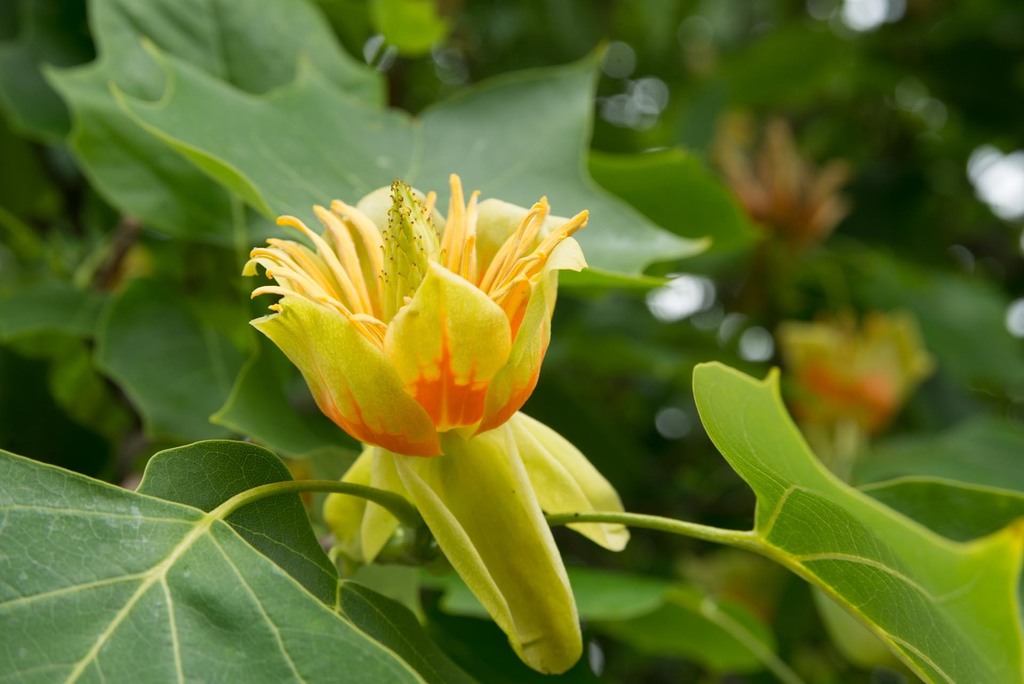
American tuliptree
Liriodendron tulipifera
Liriodendron tulipifera—known as the tulip tree, American tulip tree, tulipwood, tuliptree, tulip poplar, whitewood, fiddletree, lynn-tree, hickory-poplar, and yellow-poplar—is the North American representative of the two-species genus Liriodendron (the other member is Liriodendron chinense). It is native to eastern North America from Southern Ontario and possibly southern Quebec west to Illinois, and east to southwestern Massachusetts, then south to central Florida and Louisiana.
The tulip tree is the tallest tree of the Nearctic temperate deciduous forest. It can grow to more than 50 m (160 ft) in virgin cove forests of the Appalachian Mountains, often with no limbs until it reaches 25–30 m (80–100 ft) in height, making it a very valuable timber tree.
From the article Liriodendron tulipifera on Wikipedia (CC BY-SA), quoted section by section
Description
The tulip tree is one of the largest of the native trees of eastern North America, known in an extraordinary case to reach the height of 58.5 m (192 ft) with the next-tallest known specimens in the 52–54 m (170–177 ft) range. These heights are comparable to the very tallest known eastern white pines, another species often described as the tallest in eastern North America. The trunk on large examples is typically 1.2–1.8 m (4–6 ft) in diameter, though it can grow much broader. Its ordinary height is 24–46 m (80–150 ft) and it tends to have a pyramidal crown. It prefers deep, rich, and rather moist soil; it is common throughout the Southern United States. Growth is fairly rapid.
The bark is brown, furrowed, aromatic and bitter. The branchlets are smooth, and lustrous, initially reddish, maturing to dark gray, and finally brown. The wood is light yellow to brown, and the sapwood creamy white; light, soft, brittle, close, straight-grained. Specific gravity: 0.4230; density: 422 g/dm3 (26.36 lb/cu ft). Winter buds are dark red, covered with a bloom, obtuse; scales becoming conspicuous stipules for the unfolding leaf, and persistent until the leaf is fully grown. Flower-bud enclosed in a two-valved, caducous bract. The alternate leaves are simple, pinnately veined, measuring 125–150 mm (5–6 in) long and wide. …
Range & habitat
In the Cretaceous age the genus was represented by several species, and was widely distributed over North America and Europe. Its remains are also found in Tertiary rocks. Today the tulip tree is one of the largest and most valuable hardwoods of eastern North America, thriving in temperate deciduous forests east of the Mississippi River. Its indeterminate pattern of continued growth in the latter month of the growing season can cause this species to be more susceptible to droughts and cease shoot growth after July in drier climates. It prefers mesic to moist, well-drained soils and is generally most common at low to mid-elevations, for example usually not found above 3000 ft (900m) elevation in Virginia. It is native from southern Ontario and northern Ohio south to the Gulf of Mexico and from extreme southern New York and Connecticut south to Louisiana and northern Florida. It extends south to north Florida, and has few natural populations west of the Mississippi River, but beyond its native areas it is found occasionally as ornamentals or escapes. Its finest development is in the Southern Appalachian mountains, where trees may exceed 50 m (170 ft) in height. It was introduced into Great Britain before 1688 in Bishop Compton's garden at Fulham Palace and is now a popular ornamental in streets, parks, and large gardens. …
Wikipedia: “Distribution and habitat”
What it does
Liriodendron tulipifera is generally considered to be a shade-intolerant species that is most commonly associated with the first century of forest succession. In Appalachian forests, it is a dominant species during the 50–150 years of succession, but is absent or rare in stands of trees 500 years or older. One particular group of trees survived in the grounds of Orlagh College, Dublin for 200 years, before having to be cut down in 1990. On mesic, fertile soils, it often forms pure or nearly pure stands. It can and does persist in older forests when there is sufficient disturbance to generate large enough gaps for regeneration. Individual trees have been known to live for up to around 500 years. All young tulip trees and most mature specimens are intolerant of prolonged inundation; however, a coastal plain swamp ecotype in the southeastern United States is relatively flood-tolerant. This ecotype is recognized by its blunt-lobed leaves, which may have a red tint. Liriodendron tulipifera produces a large amount of seed, which is dispersed by wind. The seeds typically travel a distance equal to 4–5 times the height of the tree, and remain viable for 4–7 years. The seeds are not one of the most important food sources for wildlife, but they are eaten by a number of birds and mammals. Vines, especially wild grapevines, are known to be extremely damaging to young trees of this species. …
Wikipedia: “Ecology”
In human culture
In the 1819 short story, "The Legend of Sleepy Hollow," Washington Irving describes the historical tulip tree that marked the site where British Spy, John André, was captured by Revolutionary forces. Protagonist Ichabod Crane is spooked by the tree, which stood in the center of the road and "towered like a giant above all the other trees...its limbs were vast, gnarled, and fantastic, twisting down almost to the earth, and rising again into the air, and they would have formed trunks for ordinary trees.... It was universally known by the name of Major André's tree." The tree eventually succumbed to lightning strike, but a monument now stands at the site commemorating André's capture. The tulip tree is a plot element in Edgar Allan Poe's short story "The Gold-Bug" (1843). Walt Whitman observed in 1876-77 a 70-foot-tall tulip tree and how "from top to bottom, seeking the sweet juice in the blossoms, it swarms with myriads of these wild bees, whose loud and steady humming makes an undertone to the whole." He referred to the tulip tree as "the Apollo of the woods — tall and graceful, yet robust and sinewy, inimitable in hang of foliage and throwing-out of limb ; as if the beauteous, vital, leafy creature could walk, if it only would." The tulip tree has been referenced in many poems and the namesakes of other poems, such as William Stafford's "Tulip Tree" (1964).
Wikipedia: “In popular culture”
Where it lives
Recorded sightings
—
geo-referenced records in GBIF, from museums, herbaria and field observers.
Drag the globe to turn it. Dots are where records exist, not a range map; darker means more records.
In the stacks
Searching the stacks…
Every page naming Liriodendron tulipifera in the Biodiversity Heritage Library →
This page is assembled live from iNaturalist, GBIF, Wikipedia, the Source Library and the Internet Archive. It is not yet part of the hand-edited codex. iNaturalist taxon 53582.