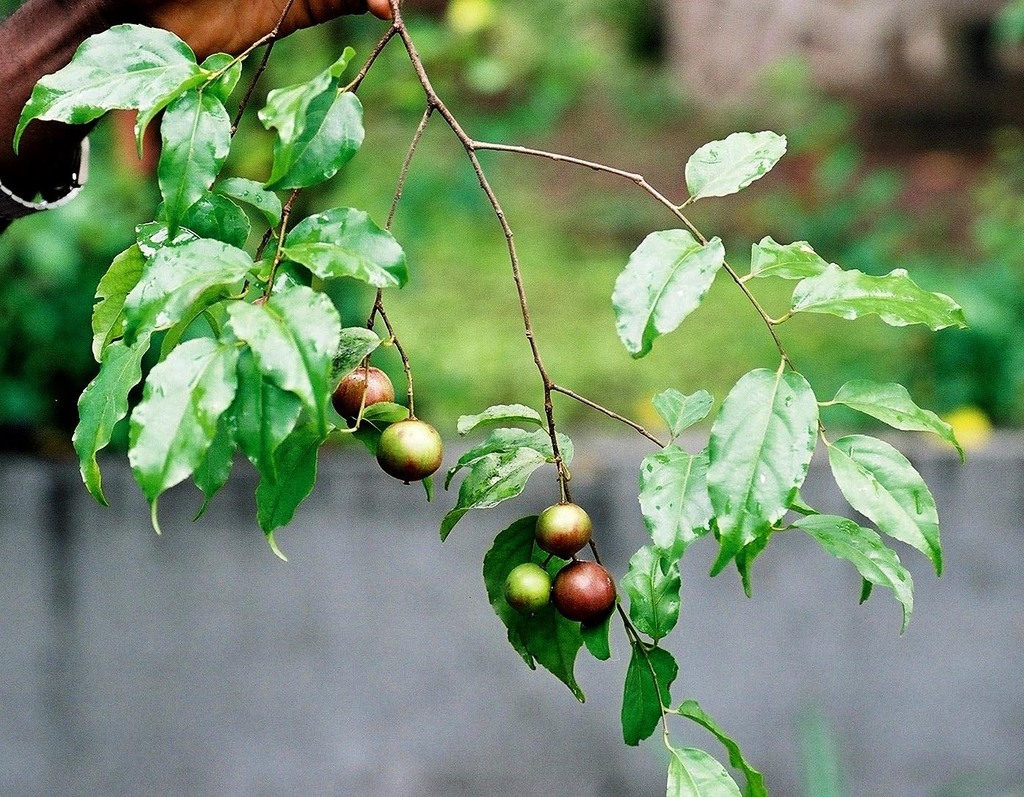
Indian coffee plum
Flacourtia jangomas
Flacourtia jangomas is a species of flowering plant in the family Salicaceae. This lowland and mountain rain forest tree is sometimes referred to by the English common names Indian coffee plum, Indian plum, or scramberry.
It was once placed in the Flacourtiaceae family. It is widely cultivated in Southeast and East Asia, and has escaped cultivation in a number of places. Its wild origin is unknown but is speculated to be tropical Asia, most likely India and Sri Lanka.
From the article Flacourtia jangomas on Wikipedia (CC BY-SA), quoted section by section
Range & habitat
It is native to Assam, Tripura, Bangladesh, South-Central and Southeast China, East Himalaya, Hainan, Myanmar, and Nepal. It is found as an introduced species in Borneo, Cambodia, the Cook Islands, Fiji, India, Java, Kenya, Laos, the Leeward Islands, Malaysia, Mauritius, New Caledonia, the Nicobar Islands, Queensland, Réunion, the Seychelles, Tanzania, Thailand, Trinidad and Tobago, Venezuela, Vietnam, and the Windward Islands.
Wikipedia: “Distribution”
What it does
The plant is considered one of the primary host plants of the Queensland fruit fly (Bactrocera tryoni).
Wikipedia: “Ecology”
At the table
Flacourtia jangomas fruits are widely eaten around South Asia, both raw and cooked. They are noted for their mild sour and tangy taste. The fruits are pickled, salt-dried or cooked in Indian curries. They can also be blended into juices or made into jams and marmalades which are immensely popular in Southern India. Commercially produced coffee plum jams and pickles are exported across the world by various companies, mainly from Kerala.
Wikipedia: “Food”
In medicine
In South Asian folkloric medicine, the fruits and leaves of Indian coffee plum are used against diarrhea. Dried leaves are reportedly effective for bronchitis and roots are said to suppress toothache. The bark of Flacourtia jangomas has various antifungal and antibacterial constituents which makes it an important ingredient for a few Ayurvedic drugs. Ground bark paste is also used for curing many common ailments in the tribal settlements of Western Ghat.
Wikipedia: “Medicine”
Where it lives
Recorded sightings
—
geo-referenced records in GBIF, from museums, herbaria and field observers.
Drag the globe to turn it. Dots are where records exist, not a range map; darker means more records.
In the old herbals & bestiaries

In the stacks
Searching the stacks…
Every page naming Flacourtia jangomas in the Biodiversity Heritage Library →
This page is assembled live from iNaturalist, GBIF, Wikipedia, the Source Library and the Internet Archive. It is not yet part of the hand-edited codex. iNaturalist taxon 53450.