- Plants
- ›Vascular Plants
- ›flowering plants
- ›Dicots
- ›Roses, Elms, Figs, and Allies
- ›rose family
- ›Amygdaloideae
- ›Exochordeae
- ›Oemleria
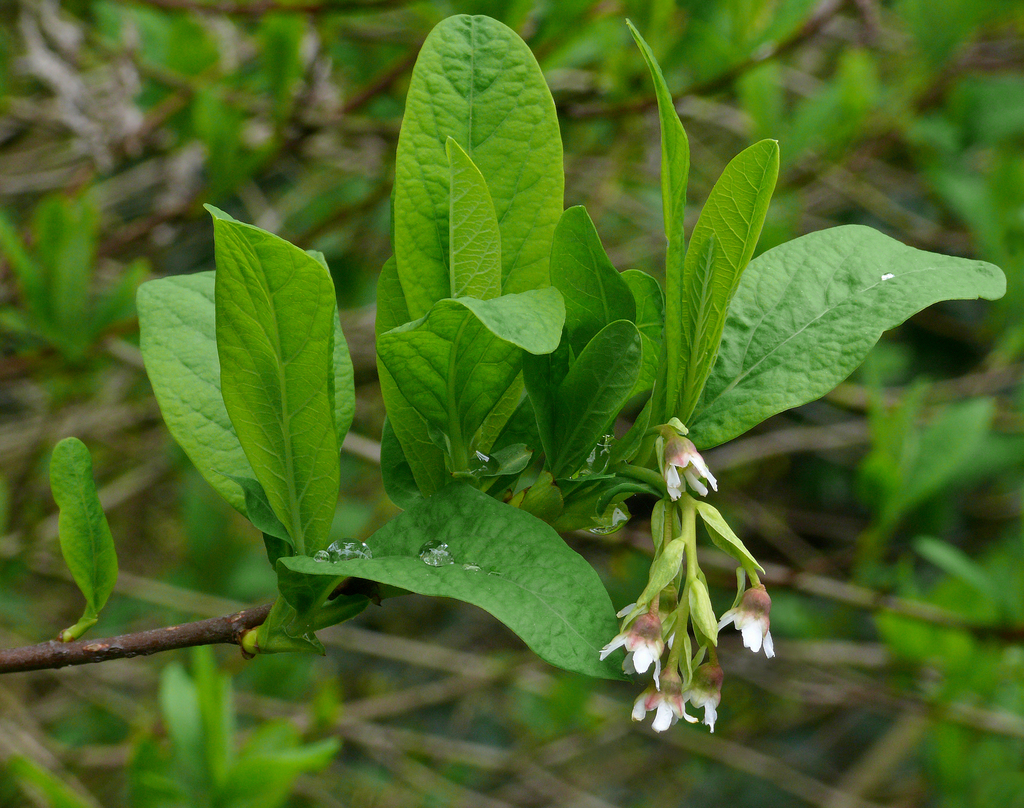
Osoberry
Oemleria cerasiformis
Oemleria cerasiformis, a shrub commonly known as osoberry, squaw plum, Indian plum, or Indian peach, is the sole extant species in the genus Oemleria. The deciduous and perennial shrub can grow up to 7 meters tall, with spreading branches that produce small white flowers and bitter fruit that only become sweet when fully ripe. Osoberry is dioecious, only female plants producing fruit, while males produce a high reproductive biomass of pollen and flowers. The flowers are insect and hummingbird-pollinated and the fruits are consumed by both birds and mammals, which later disperse the seeds in their droppings (endozoochory).
Fossil records indicate that the species had a similar range during the Eocene epoch. It is native to the Pacific coast and coast ranges of North America, from British Columbia, Canada, to Santa Barbara County, California. Its favored habitat conditions include full sun, moist soil, and low elevation. It is one of the first plants to have its flowers bloom and leaves bud in the late winter.
From the article Oemleria cerasiformis on Wikipedia (CC BY-SA), quoted section by section
Range & habitat
Osoberry are found in the Pacific Northwest, ranging from Northern California to Southwestern British Columbia. The shrubs grow in places such as second-growth forests, stream terraces, forest, or roadside margins. Osoberry grow in places with sunlight, and usually below elevations of 300 m (1,000 ft). The shrub can grow up to 1,500 m (5,000 ft) in elevation. Moist soil is preferred, but not grounds that are saturated in winter months. Osoberry flowers bloom and leaves bud in the late winter to early spring. Osoberry are relatively short compared to trees in the Pacific Northwest. The early bud timing allows the osoberry to get access to sunlight that is not as easily available in later months. When taller trees or shrubs have grown their leaves, this can block sunlight from reaching an osoberry shrub.
Wikipedia: “Distribution and habitat”
What it does
Osoberry are pollinated by native pollinators such as bees, moths, butterflies, hummingbirds, and more. The nectar in the flowers of osoberry is an important source of food for these pollinators in the early spring.
Wikipedia: “Pollination”
At the table
The Pacific coast tribes utilized its fruit, twigs, and bark, as food sources and for teas and medicine. It is one of the first tree-borne fruits to ripen in summer and as such was prized by indigenous peoples and wildlife alike.
Wood. The wood is exceptionally strong and fine-grained. But, with stems generally less than 5 cm (2 in) in diameter, this small size limits the size of products that can be made from it. The fairly common straight shoots make fine primitive arrows and the rare straight stem large enough can be fashioned into an excellent self bow. It is also suitable for small wooden tools such as spoons, combs, knitting needles, etc. The fine grain and lack of significant figure also make the wood well-suited for fine detail carving. Native Americans made use of the shrub's bark, using it to bind harpoon tips. Native tribes also used the bark of osoberry for treating tuberculosis. The bark was also used as a mild laxative, and chewing its twigs had mild anesthetic and aphrodisiac effects. Currently, osoberry is popular for restoration projects in the Pacific Northwest. Living osoberry branches can be used as live stakes in restoration projects to prevent erosion. The roots of osoberry are fibrous and are good for preventing erosion of soil.
Fruit. The fruits can be eaten raw or cooked when bitter; they tend to be somewhat astringent. …
Wikipedia: “Uses”
Where it lives
Recorded sightings
—
geo-referenced records in GBIF, from museums, herbaria and field observers.
Drag the globe to turn it. Dots are where records exist, not a range map; darker means more records.
In the stacks
Searching the stacks…
Every page naming Oemleria cerasiformis in the Biodiversity Heritage Library →
This page is assembled live from iNaturalist, GBIF, Wikipedia, the Source Library and the Internet Archive. It is not yet part of the hand-edited codex. iNaturalist taxon 53419.