- Plants
- ›Vascular Plants
- ›flowering plants
- ›Dicots
- ›Mustards, Capers, and Allies
- ›mustard family
- ›Brassicoideae
- ›Brassicodae
- ›Brassiceae
- ›Brassica
- ›Brassica
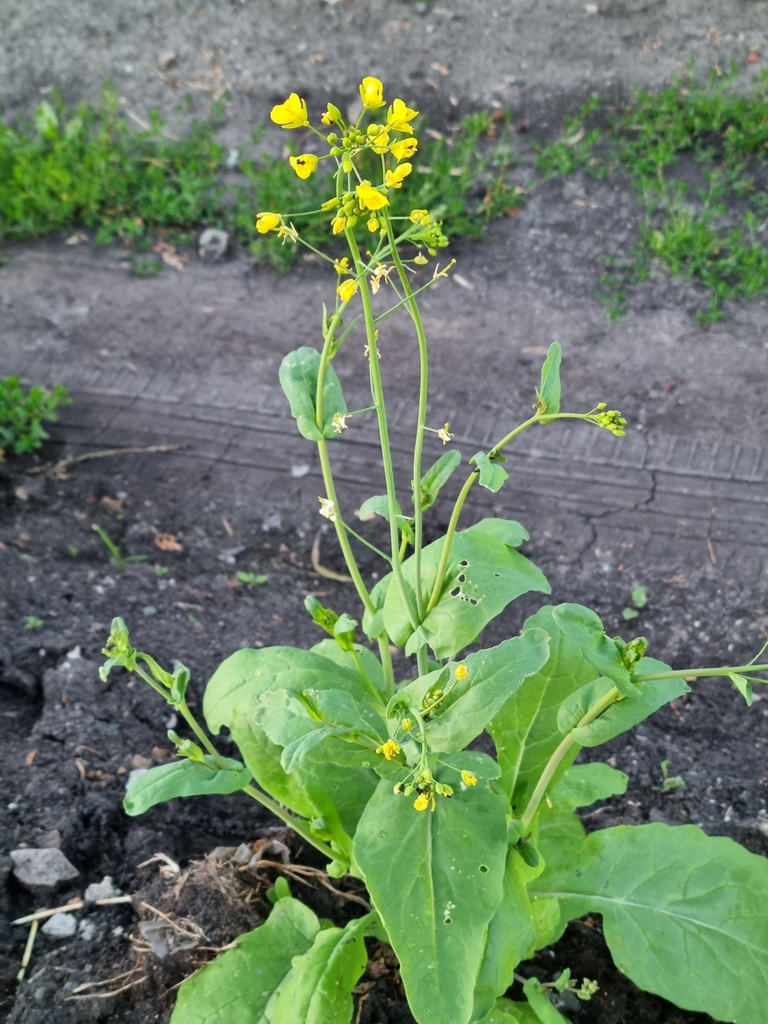
field mustard
Brassica rapa
Brassica rapa is an annual to biennial plant species native to Eurasia that is from the Brassicaceae family. The B. rapa subspecies oleifera is an oilseed commonly known as turnip rape, field mustard, bird's rape, and keblock.
It has been widely cultivated into many forms, including the turnip (a root vegetable), komatsuna, Chinese cabbage, bomdong, pak choi / bok choy, and rapini. Its domesticated forms include turnips and leafy greens, such as bok choy and napa cabbage. The oilseed types are grown for food and industrial uses. Genetic studies indicate that B. rapa was one of the earliest domesticated brassicas, with turnip-like forms arising first and additional morphotypes developing independently across Eurasia. Wild, feral, and cultivated populations are found worldwide, making the species important agriculturally, economically, and ecologically.
From the article Brassica rapa on Wikipedia (CC BY-SA), quoted section by section
What it does
Brassica rapa is an early-season nectar and pollen source for a wide range of insects. Numerous pollinators are attracted to its bright yellow flowers, including bees, flies, and butterflies. A common visitor, the small white butterfly (Pieris rapae) uses the plant both as a nectar source and as a host for larval feeding. Conversely, insect pollination is also very important to the plant; insect pollination of B. rapa leads to 30% more yield when compared to self-fertilizing controls. Furthermore, B. rapa can undergo rapid genomic adaptations when selected on by bumblebees.
Wikipedia: “Ecology and pollination”
At the table
Cultivated varieties of B. rapa are consumed commonly as vegetables, such as turnip roots, napa cabbage, komatsuna, pak choi, and other leafy greens, particularly in East Asian, South Asian, and Mediterranean cuisines. The young leaves are a leaf vegetable eaten raw, while older leaves are typically cooked. The taproot and seeds can also be eaten raw, although the seeds contain an oil that can cause irritation for some people. Rapeseed oil from the plant is also used to make canola and colza oils. B. rapa is also commonly used as a rotational cover crop for vegetables due to its ability to prevent erosion and deter disease. Because of their fast life-cycle and genetic diversity, the B. rapa cultivar Wisconsin Fast Plants is widely used in genetics and plant biology education.
Wikipedia: “Uses”
In human culture
The geographic and genetic origins of B. rapa have been difficult to identify due to its long history of human cultivation, as well as difficulty finding Brassica seeds at archaeological sites. It is found in most parts of the world, and has returned to the wild many times as a feral plant or weed. Recent genomic studies show that many “wild” populations found in Europe and the Americas are actually feral descendants of cultivated plants, while actual wild populations appear to be from regions such as the Caucasus and Central Asia. Genetic sequencing and environmental modeling have indicated that ancestral B. rapa likely originated 4000 to 6000 years ago in the Hindu Kush area of Central Asia, and had three sets of chromosomes, providing the genetic potential for a diversity of form, flavor, and growth. Domestication has produced modern vegetables and oil-seed crops, all with two sets of chromosomes. Oilseed subspecies (subsp. oleifera) of Brassica rapa may have been domesticated several times from the Mediterranean to India, starting as early as 2000 BC. There are descriptions of B. rapa vegetables in Indian and Chinese documents from around 1000 BC. Edible turnips were possibly first cultivated in northern Europe, and were an important food in ancient Rome. The turnip then spread east to China, and reached Japan by 700 AD. …
Wikipedia: “History”
Where it lives
Recorded sightings
—
geo-referenced records in GBIF, from museums, herbaria and field observers.
Drag the globe to turn it. Dots are where records exist, not a range map; darker means more records.
In the old herbals & bestiaries


In the stacks
Searching the stacks…
Every page naming Brassica rapa in the Biodiversity Heritage Library →
This page is assembled live from iNaturalist, GBIF, Wikipedia, the Source Library and the Internet Archive. It is not yet part of the hand-edited codex. iNaturalist taxon 53271.