- Plants
- ›Vascular Plants
- ›flowering plants
- ›Dicots
- ›proteas, lotuses, planes, and allies
- ›Protea family
- ›Singlet Proteas
- ›Nutseed Proteoid Clade
- ›Cape Nutseed Proteoids
- ›Mimetes
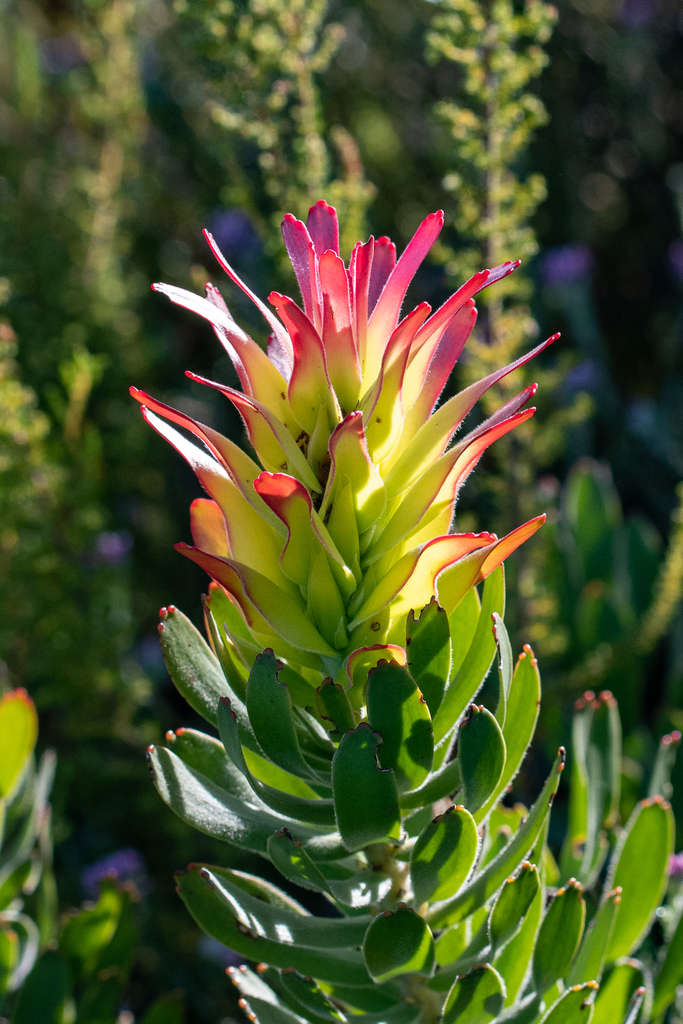
Common Pagoda
Mimetes cucullatus
Mimetes cucullatus is an evergreen shrub with several, mostly not branching, upright stems of 1–2 m (3–7 ft) high, that has been assigned to the family Proteaceae. It is the most widespread and most common pagoda species that can cope with a relatively large range of environmental circumstances. It is known under several names including common pagoda in English and rooistompie in Afrikaans.
From the article Mimetes cucullatus on Wikipedia (CC BY-SA), quoted section by section
Description
Mimetes cucullatus is an evergreen, upright shrub of 1–2 m (3–7 ft) high, that has a firm woody tuber in the ground, from which several stems rise. These stems are upright, 3–8 mm (0.12–0.32 in) thick, mostly not branching but occasionally forking, initially covered in grey felty hair, but this tends to wear off with age. The leaves are alternately set along the stems, very narrow to broad elliptic or inverted egg-shaped, 2½–5½ cm (1–2¼ in) long and ½–2 cm (0.2–0.8 in) wide. Young growth is scarlet coloured, turning green lower down the stem. The leaves that subtend the flower heads are inverted fiddle-shaped in outline, folded backwards from the midline out, and during flowering are scarlet in the upper parts, gradually turning through yellowish to green at the base or entirely yellowish with a green base or softly orange. The inflorescence that consists of many flower heads in the axils of the highest leaves on the stem is cylindric in shape and 6–10 cm (2½–4 in) long and 4–7 cm (1⅔–2 in) in diameter, topped by a tuft of smallish, more or less upright, narrowly egg-shaped, scarlet coloured leaves. Each flower head contains four to seven flowers and is subtended by a leaf that is fiddle-shaped in outline and the side bent away from the stem as to cowl over the lower flower head. …
Range & habitat
Mimetes cucullatus is the most widely distributed pagoda species, found from west of the Olifants River valley near Porterville in the north and the Cape Peninsula in the southwest, to the Langeberg range in the east. It is particularly common along the coast between Hangklip near Pringle Bay in the Kogelberg area to Bredasdorp. There are three isolated inland populations of M. cucullatus in the Kouga Mountains, Klein Swartberg and Rooiberg, an isolated mountain in the middle of the Little Karoo. Another isolated population occurs on the Potberg. This makes it likely that its distribution used to be larger than today but, with increasing drought, it became limited to areas that are wet enough today.
Wikipedia: “Distribution”
What it does
This species, along with other members of the genus Mimetes, is adapted to bird pollination. Mimetes cucullatus has special glands on the tips of its leaves called extrafloral nectaries, which attract ants. Ants may defend the plants against insect herbivores. In addition, ants are the main dispersers of M. cucullatus seeds.
Wikipedia: “Reproduction”
How it is grown
Mimetes cucullatus is an unusual and beautiful plant. It is popular with people who have interest in indigenous plants and wildlife gardens. Since M. cucullatus is a resprouter, it responds well to severe pruning, which makes it well suited as a cut-flower.
Wikipedia: “Cultivation”
Where it lives
Recorded sightings
—
geo-referenced records in GBIF, from museums, herbaria and field observers.
Drag the globe to turn it. Dots are where records exist, not a range map; darker means more records.
In the stacks
Searching the stacks…
Every page naming Mimetes cucullatus in the Biodiversity Heritage Library →
This page is assembled live from iNaturalist, GBIF, Wikipedia, the Source Library and the Internet Archive. It is not yet part of the hand-edited codex. iNaturalist taxon 532040.