- Plants
- ›Vascular Plants
- ›flowering plants
- ›monocots
- ›grasses, sedges, cattails, and allies
- ›grasses
- ›Panicums, Bluestems, Paspalums, and Allies
- ›bristle, rosette, and barnyard grasses, and allies
- ›Anthephorinae
- ›Digitaria
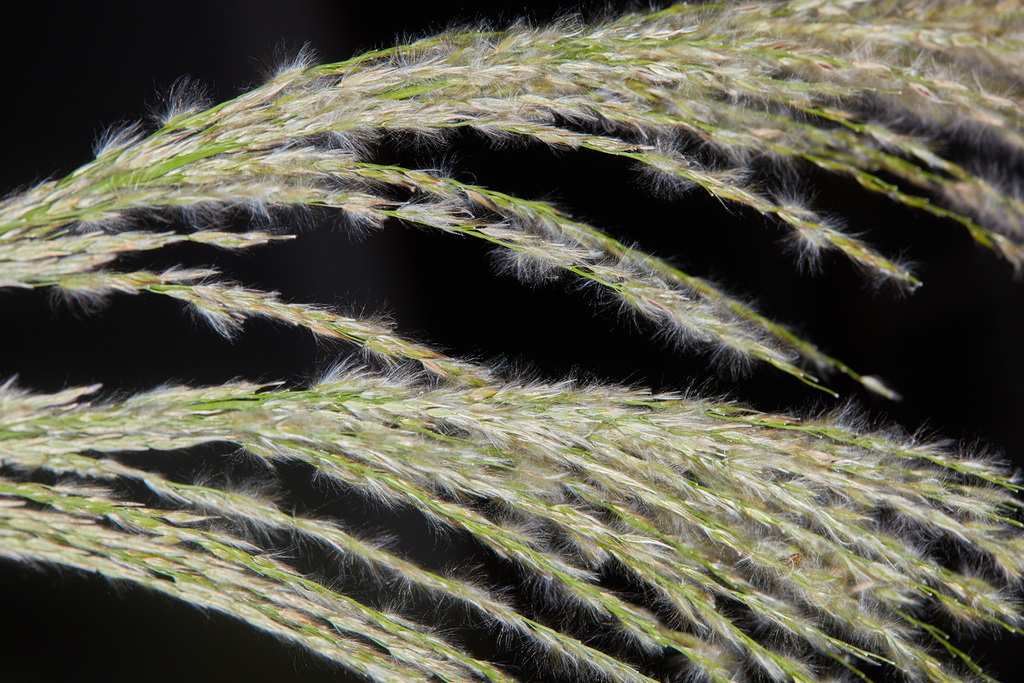
Sourgrass
Digitaria insularis
Digitaria insularis is a species of grass commonly known as sourgrass. It is native to Central and South America and the southern parts of the United States and has been introduced into other parts of the world. It was first described by the German botanist Friedrich Karl Georg Fedde in 1904.
From the article Digitaria insularis on Wikipedia (CC BY-SA), quoted section by section
Description
Digitaria insularis is a tufted perennial bunchgrass with very short, swollen rhizomes. The stems reach a height of 80–130 cm and are erect, branched from the lower and middle nodes, swollen bases, with woolly bracts, glabrous internodes and nodes. Sheaths papillose - pilose in their majority, ligule 4–6 mm long, blades linear, 20–50 cm long and 10–20 mm wide. Inflorescence 20–35 cm long, numerous clusters, 10–15 cm long, solitary triquetrous rachis of clusters, 0.4-0.7 mm wide, scabrous; spikelets lanceolate, 4.2-4.6 mm long, paired, caudate, densely covered with trichomes up to 6 mm long, brown or whitish, ranging up to 5 mm from the apex of the spikelet; lower glume triangular to ovate, to 0.6 mm long, enervate, membranous; upper glume 3.5-4.5 mm long, acute, 3-5 nerved, ciliated; inferior lemma as long as spikelet, acuminate, 7-nerved, covered with silky hairs, upper lemma 3.2-3.6 mm long, acuminate, dark brown; anthers 1-1.2 mm long.
Range & habitat
Digitaria insularis is native to the tropical and sub-tropical Americas. It is a common species found in disturbed areas and on beaches, at an altitude of up to 1,400 m (4,593 ft) above sea level. In its native Brazil, Paraguay, Bolivia and Venezuela it is a pervasive weed out of its natural habitats. It has been introduced in tropical Asia and some Pacific islands and elsewhere. In some countries into which it has been introduced such as Hawaii and Papua New Guinea, it is considered an invasive species.
Wikipedia: “Distribution and habitat”
Where it lives
Recorded sightings
—
geo-referenced records in GBIF, from museums, herbaria and field observers.
Drag the globe to turn it. Dots are where records exist, not a range map; darker means more records.
In the stacks
Searching the stacks…
Every page naming Digitaria insularis in the Biodiversity Heritage Library →
This page is assembled live from iNaturalist, GBIF, Wikipedia, the Source Library and the Internet Archive. It is not yet part of the hand-edited codex. iNaturalist taxon 53184.