- Plants
- ›Vascular Plants
- ›flowering plants
- ›Dicots
- ›carrots, ivies, and allies
- ›carrot family
- ›Apioideae
- ›Chervils, Carrots, Hedgeparsleys and Allies
- ›Scandicinae
- ›Osmorhiza
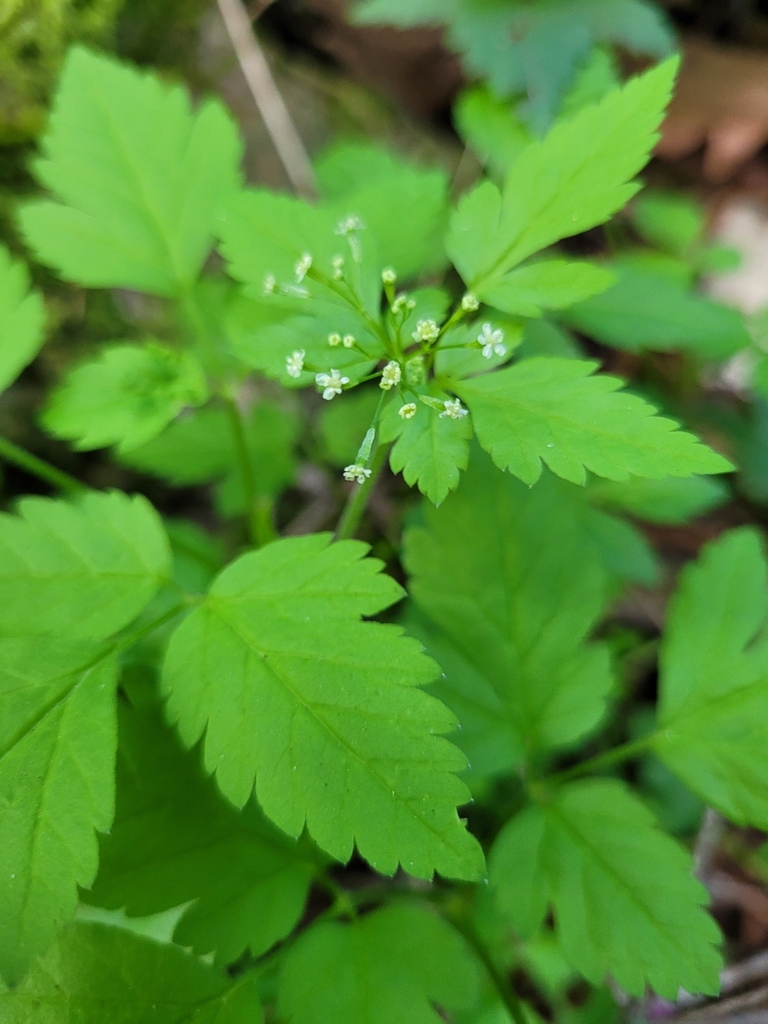
mountain sweet cicely
Osmorhiza berteroi
Osmorhiza berteroi is a species of flowering plant in the family Apiaceae known by the common name mountain sweet cicely.
From the article Osmorhiza berteroi on Wikipedia (CC BY-SA), quoted section by section
Description
It is an aromatic perennial herb producing a branching stem which may exceed a meter tall. The plentiful green leaves have blades up to 20 centimeters long which are divided into three leaflets (trifoliate), which are toothed or lobed. The blade is borne on a long petiole. The inflorescence is a compound umbel of many tiny white flowers at the tip of a stemlike peduncle. There are 4–10 florets on each umbellule with the central florets only possessing anthers. The narrow, elongated fruit is ribbed and bristly, measuring up to 2.5 centimeters long.
Similar species. Osmorhiza berteroi occurs alongside several other species of Osmorhiza throughout its range, but is most likely to be confused with O. depaurerata. The two species are very similar and most easily separated by examining the seeds
Range & habitat
It has an amphitropical distribution being native to both temperate parts of North and South America. In the Northern Hemisphere it is found boreal zones from Alaska to Newfoundland, extending south to South Dakota, and in mountain ranges adjacent to the Pacific coast from the Alaska panhandle to California and Arizona. In South America it occurs in Magellanic forests in Argentina and Chile. The amphitropical distribution is believed to have arisen recently (in the past 1 million years), probably by seeds attached to the feathers of migratory birds. In contrast, the east–west disjunct distribution are most likely relict populations of a once continuous range.
Wikipedia: “Distribution”
At the table
Osmorhiza berteroi was used as a source of food by several groups of Native Americans in all parts of its native range. These included the Selkʼnam people in what is now Chile, and tribes of the Great Plains, such as the Cheyenne and Blackfoot. The root was eaten, and also used as a medicinal treatment for coughs and colds.
Wikipedia: “Use for food and medicine”
Where it lives
Recorded sightings
—
geo-referenced records in GBIF, from museums, herbaria and field observers.
Drag the globe to turn it. Dots are where records exist, not a range map; darker means more records.
In the stacks
Searching the stacks…
Every page naming Osmorhiza berteroi in the Biodiversity Heritage Library →
This page is assembled live from iNaturalist, GBIF, Wikipedia, the Source Library and the Internet Archive. It is not yet part of the hand-edited codex. iNaturalist taxon 53166.