- Plants
- ›Vascular Plants
- ›flowering plants
- ›Dicots
- ›myrtles, evening primroses, and allies
- ›myrtle family
- ›Myrtoideae
- ›gum trees
- ›Angophora
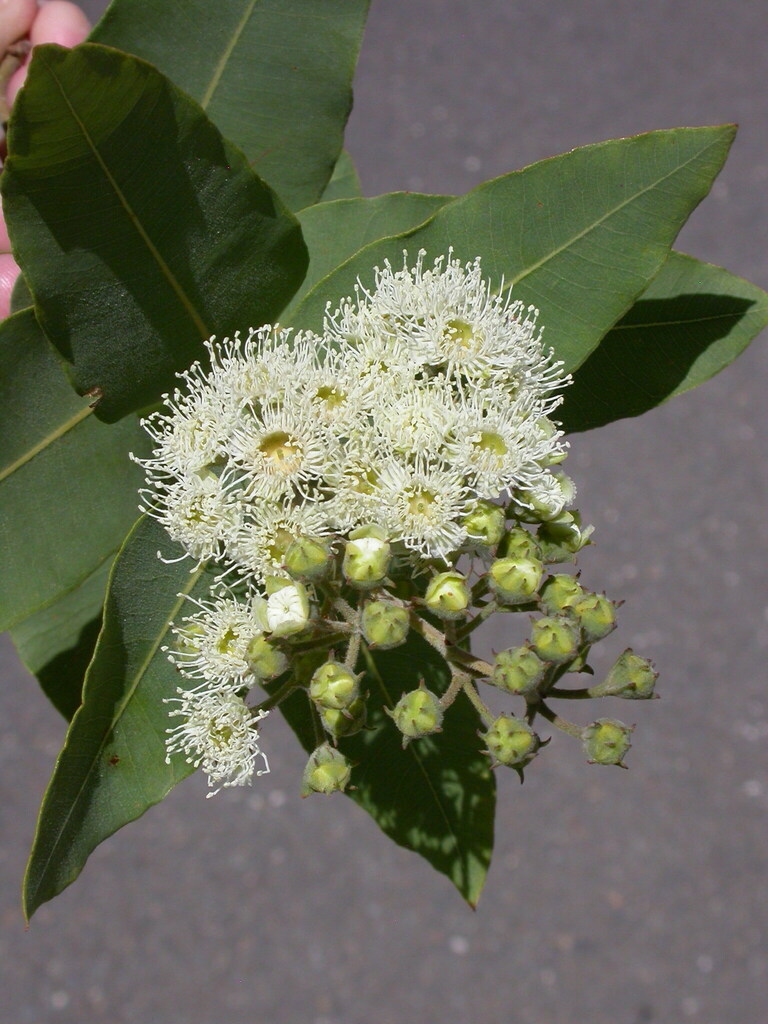
broad-leaved apple
Angophora subvelutina
Angophora subvelutina, known as the broad-leaved apple, is a common woodland and forest tree of eastern Australia. Usually seen on river flats between 12 and 20 metres tall, though exceptional specimens exceed 35 metres tall. One of the habitats west of Sydney is on poorly drained alluvial flats near the Hawkesbury/Nepean river system. The explorer Allan Cunningham remarked that presence of these trees indicated fertile areas for agriculture. Adult leaves are similar in shape to eucalyptus...
From the article Angophora subvelutina on Wikipedia (CC BY-SA), quoted section by section
Description
Angophora subvelutina is a tree that typically grows to a height of 17–25 m (56–82 ft) and forms a lignotuber. It has rough, fibrous or flaky, greyish bark on the trunk and branches. Young plants and coppice regrowth have sessile, egg-shaped to elliptical or lance-shaped leaves that are 50–110 mm (2.0–4.3 in) long and 25–50 mm (1.0–2.0 in) wide arranged in opposite pairs with a stem-clasping base. Adult leaves are also arranged in opposite pairs, paler on the lower surface, lance-shaped to egg-shaped or elliptical, 60–120 mm (2.4–4.7 in) long and 20–50 mm (0.8–2.0 in) wide with a stem-clasping base. The flower buds are arranged on the ends of branchlets on a branched peduncle 9–30 mm (0.4–1.2 in) long, each branch of the peduncle with three or seven buds on pedicels 4–10 mm (0.2–0.4 in) long. Mature buds are globe-shaped, 4–6 mm (0.16–0.24 in) long and wide with a ribbed floral cup. The petals are white or creamy white with a green keel, about 3 mm (0.12 in) long and 3–4 mm (0.12–0.16 in) wide. Flowering occurs from November to January and the fruit is a cup-shaped capsule 8–11 mm (0.3–0.4 in) long and 6–11 mm (0.2–0.4 in) wide with ribbed sides and the valves enclosed in the fruit.
Range & habitat
Broad-leaved apple grows in open forest in alluvial soil and gravelly clay. It is found mainly in near-coastal areas from near Bundaberg in Queensland and south to near Taree and disjunctly to near Araluen in New South Wales.
Wikipedia: “Distribution and habitat”
At the table
The 1889 book The Useful Native Plants of Australia records that "The Rev. Dr. Wolls states that these 'apple trees' are sometimes cut down to keep cattle alive in dry seasons, as the leaves are relished by them."
== References ==
Wikipedia: “Uses”
Where it lives
Recorded sightings
—
geo-referenced records in GBIF, from museums, herbaria and field observers.
Drag the globe to turn it. Dots are where records exist, not a range map; darker means more records.
In the stacks
Searching the stacks…
Every page naming Angophora subvelutina in the Biodiversity Heritage Library →
This page is assembled live from iNaturalist, GBIF, Wikipedia, the Source Library and the Internet Archive. It is not yet part of the hand-edited codex. iNaturalist taxon 531489.