- Plants
- ›Vascular Plants
- ›flowering plants
- ›Dicots
- ›nightshades, bindweeds, gooseweeds, and allies
- ›bindweed family
- ›Bindweeds, Morning-glories and Allies
- ›Bindweed Tribe
- ›Convolvulus
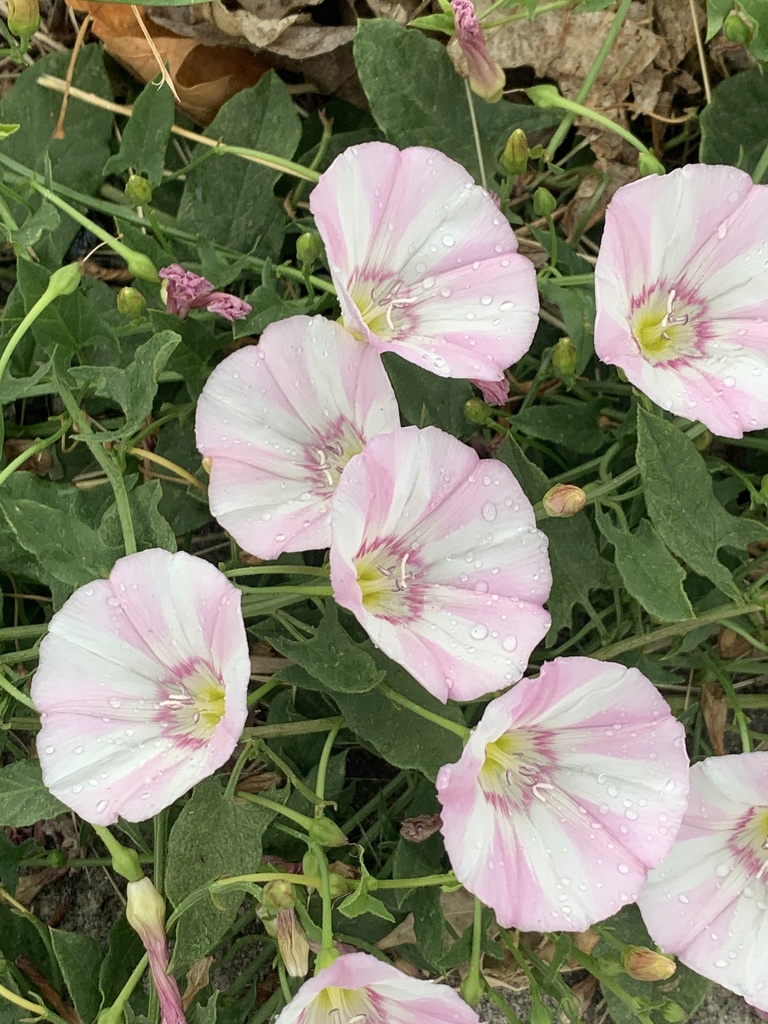
field bindweed
Convolvulus arvensis
Convolvulus arvensis, or field bindweed, is a species of bindweed in the Convolvulaceae native to Europe and Asia. It is a rhizomatous and climbing or creeping herbaceous perennial plant with stems growing to 0.5–2 metres (1.6–6.6 ft) in length. It is usually found at ground level with small white and pink flowers.
Other common names, mostly obsolete, include lesser bindweed, European bindweed, withy wind (in basket willow crops), perennial morning glory, small-flowered morning glory, creeping Jenny, and possession vine.
From the article Convolvulus arvensis on Wikipedia (CC BY-SA), quoted section by section
Description
Convolvulus arvensis is a perennial vine that typically climbs to 1 metre (3.3 ft). The vine produces woody rhizomes from which it resprouts in the spring, or when the aboveground vines are removed. The leaves are spirally arranged, linear to arrowhead-shaped, 2–5 cm (0.79–1.97 in) long and alternate, with a 1–3 cm (0.39–1.18 in) petiole. The flowers are trumpet-shaped, 1–2.5 cm (0.39–0.98 in) diameter, white or pale pink, with five slightly darker pink radial stripes. Flowering occurs in mid summer (in the UK, between June and September) when white to pale pink, funnel-shaped flowers develop. Flowers are approximately 1.9–2.5 cm (0.75–0.98 in) across and are subtended by small bracts. The fruit are light brown, rounded and 3–4 mm (0.12–0.16 in) wide. Each fruit contains 2 or 4 seeds that are eaten by birds and can remain viable in the soil for decades. The stems climb by twisting around other plant stems in a counter-clockwise direction.
Similar species. Convolvulus arvensis can be confused with a number of similar species. Key traits of C. arvensis are the small flowers often crowded together, and two sharp, backwards-pointed lobes at the base of the usually arrow-shaped leaf ending in a sharp apex. Juvenile stems exude a milky sap when broken. Similar species include:
Calystegia sepium - Large white flowers. Squarish or rounded lobes at the base of the leaf. C. …
What it does
Plants are typically found inhabiting farmland, waste places, along roads, in pastures, grassy slopes, and also along streams in North America. It is able to colonise hot asphalt surfaces by covering it from the sides of roads, and worm its way between pavement stones. It grows from 600 to 4,500 metres (2,000 to 14,800 ft) in altitude in China, and is absent from the warmer southern provinces. It prefers dry areas with humus-poor, nutrient-rich and alkaline soils. It is a characteristic species in the phytosociological vegetation association Convolvulo-Agropyretum, belonging to the couch grass dry grasslands alliance (called Convolvulo-Agropyrion repentis in syntaxonomy). Like the other Convolvulus bindweeds of Eurasia, it is specifically pollinated by sweat bees in the genus Systropha. These are specialists (oligolectic) feeding upon the flowers of these plants, possessing unusual modifications of the scopa, such that almost the entire abdomen (including the dorsal surface) is used for carrying pollen, rather than the legs, as in most bees. Species of Systropha in central Europe (such as S. curvicornis and S. planidens, both uncommon bees) are essentially entirely dependent upon C. arvensis. Although both species specialise on the same plant species, S. curvicornis is a habitat generalist while S. …
Wikipedia: “Ecology”
At the table
Bindweed contains several alkaloids which are toxic for mice, including pseudotropine, and lesser amounts of tropine, tropinone, and meso-cuscohygrine. The alkaloids are also reported to give the plant psychoactive properties. Its leaves contain glycosides and have been traditionally used to treat hypertension and as a laxative and diuretic.
Wikipedia: “Chemistry and uses”
In human culture
In one of the tales collected by Jacob and Wilhelm Grimm, Our Lady's Little Glass, this flower is used by Mary, mother of Jesus, to drink wine with when she helps free a wagoner's cart. The story goes on to say that "the little flower is still always called Our Lady's Little Glass".
Wikipedia: “In culture”
Where it lives
Recorded sightings
—
geo-referenced records in GBIF, from museums, herbaria and field observers.
Drag the globe to turn it. Dots are where records exist, not a range map; darker means more records.
In the old herbals & bestiaries


In the stacks
Searching the stacks…
Every page naming Convolvulus arvensis in the Biodiversity Heritage Library →
This page is assembled live from iNaturalist, GBIF, Wikipedia, the Source Library and the Internet Archive. It is not yet part of the hand-edited codex. iNaturalist taxon 53021.