- Plants
- ›Vascular Plants
- ›flowering plants
- ›monocots
- ›Spiderworts and Allies
- ›Spiderworts
- ›Commelinoideae
- ›Commelineae
- ›Dayflowers and relatives
- ›Commelina
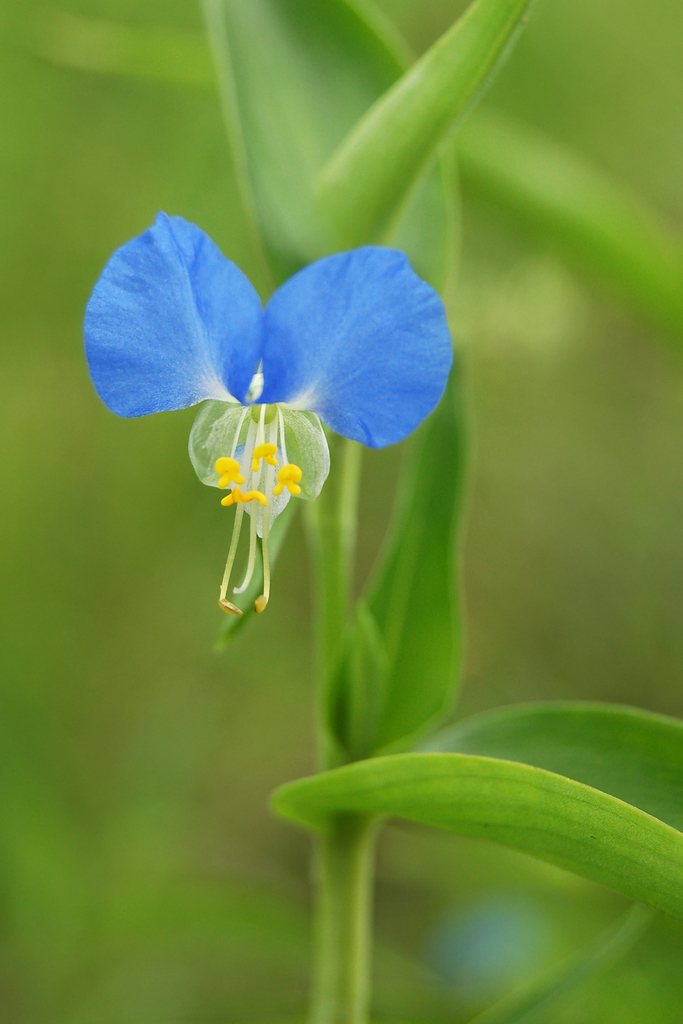
Asiatic dayflower
Commelina communis
Commelina communis the Asiatic dayflower, is an herbaceous annual plant in the dayflower family. It gets its name because the blooms last for only one day. It is native throughout much of East Asia and northern parts of Southeast Asia. In China, the plant is known as yazhicao (simplified Chinese: 鸭 跖 草; traditional Chinese: 鴨跖草; pinyin: yāzhīcǎo), roughly translating to "duckfoot herb", while in Japan it is known as tsuyukusa (露 草, tsuyukusa), meaning "dew herb". It has also been introduced to parts of central and southeastern Europe and much of eastern North America, where it has spread to become a noxious weed. It is common in disturbed sites and in moist soil. The flowers emerge from summer through fall and are distinctive with two relatively large blue petals and one very small white petal.
The Asiatic dayflower plant serves as the type species for its large genus. Linnaeus picked the name Commelina in honour of the two Dutch botanists of the Commelijn family, using the two large showy petals of Commelina communis to symbolise them. Linnaeus described the species in the first edition of his landmark work, Species Plantarum, in 1753. Long before the plant was studied in Europe, however, it had been used for generations in traditional Chinese medicine. The flowers have also been used in Japan to produce a dye and a pigment that was used in many world-renowned Ukiyo-e woodcuts from the 18th and early 19th centuries.
From the article Commelina communis on Wikipedia (CC BY-SA), quoted section by section
Description
The Asiatic dayflower is an annual herb with stems that are typically decumbent, meaning that they are prostrate at the base but become erect towards the tips, but some individuals may be simply erect. The diffusely branched stems tend to root at the basal nodes. The pubescence on the stems is variable, but common patterns include a line of hair continuous with the leaf sheath, or they may be glabrous basally, meaning hairless, and puberulent towards the extremities, that is covered with fine hairs. The leaves are sessile: they lack a leaf stalk, also known as a petiole; or they may be subpetiolate, meaning they have very small petioles. The leaf sheaths are cylindrical, sometimes striped with red, and typically glabrous, but usually have margins that are puberulent or pilose, meaning lined with fine, soft hairs. The leaf blades range from narrowly lanceolate, or lance-shaped, to ovate–elliptic, between egg-shaped and ellipse-shaped. They measure 3–12 cm (1+1⁄4–4+3⁄4 in) by 1–4 cm (1⁄2–1+1⁄2 in) wide. The blades range from glabrous to puberulent and have scabrescent, or slightly rough, margins. Their tips are acute, meaning they come to a point quickly, to acuminate, meaning the point develops gradually. The leaf bases are oblique, or uneven. The flowers are arranged on inflorescences called cincinni (singular: cincinnus), which are also called scorpioid cymes. …
Range & habitat
The plant's native distribution includes much of East Asia and Southeast Asia. Country by country, it is found in China, Taiwan, Japan, Korea, the Russian Far East, Cambodia, Laos, Malaysia, Thailand, India, Iran and Vietnam. Within China it is found in all provinces except Qinghai, Hainan, Xinjiang, and Tibet. In Japan the plant is found throughout the bulk of the country from Hokkaido south to Kyūshū. In Russia the Asiatic dayflower is found naturally on Sakhalin as well as in the Far East in areas surrounding the Ussuri River. The species has been introduced to much of Europe and eastern North America. On the former continent it is now found from Central Europe well into western Russia. Specifically it is known from Italy north to Switzerland, east through the region encompassing the former Yugoslavia, east into the regions around the Black Sea including Romania, the Moldavia Region, and Ukraine but excluding Crimea, north through the Dnieper Basin into Belarus and Russia, continuing east into the regions surrounding the Don River and the Volga River south to their intersection at the Volga–Don Canal and north to the regions around Lake Ladoga and Lake Ilmen, and farther east to the regions of the Ural River and the Kama River. It is also found in the Czech Republic and Slovakia. …
Wikipedia: “Distribution and habitat”
What it does
The Asiatic dayflower is considered an invasive weed in many areas where it has been introduced. In the United States, the Virginia Department of Conservation and Recreation, for example, categorises the species as "occasionally invasive" in its Invasive Plant Species of Virginia. This means that the plant will "not affect ecosystem processes, but may alter plant community composition by outcompeting one or more native plant species". The species is typically limited to disturbed sites, whence it spreads relatively slowly. Within its native range in China it is also sometimes considered a pest, especially in the northeast of the country where it has caused economically significant agricultural damage in orchards. The Asiatic dayflower has been used in pollination studies concerning the behaviour of plants in relation to their pollinators. One important experiment tested the hypotheses that floral guides (i.e. various patterns and colours on anthers and petals) simultaneously promote pollinator visitation and prevent visits where the pollinator fails to come into contact with the stigma or anthers, termed pollen theft. As the flowers of the Asiatic dayflower lack nectar, they offer only pollen as a reward to their visitors. …
Wikipedia: “Ecology”
At the table
In China it is used as a medicinal herb with febrifugal, antipyretic, anti-inflammatory, and diuretic effects. Additionally, it is also used for treating sore throats and tonsillitis. Recent pharmacological investigations have revealed that the Asiatic dayflower contains at least five active compounds. One of these, p-hydroxycinnamic acid, shows antibacterial activity, while another, D-mannitol, has an antitussive effect. In China and India the plant is also used as a vegetable and fodder crop.
Wikipedia: “Medicine and food”
Where it lives
Recorded sightings
—
geo-referenced records in GBIF, from museums, herbaria and field observers.
Drag the globe to turn it. Dots are where records exist, not a range map; darker means more records.
In the old herbals & bestiaries


In the stacks
Searching the stacks…
Every page naming Commelina communis in the Biodiversity Heritage Library →
This page is assembled live from iNaturalist, GBIF, Wikipedia, the Source Library and the Internet Archive. It is not yet part of the hand-edited codex. iNaturalist taxon 52927.