- Plants
- ›Vascular Plants
- ›flowering plants
- ›Dicots
- ›nightshades, bindweeds, gooseweeds, and allies
- ›nightshade family
- ›nightshades and allies
- ›nightshades and jaltomatas
- ›Solanum
- ›Leptostemonum
Carolina horsenettle
Solanum carolinense
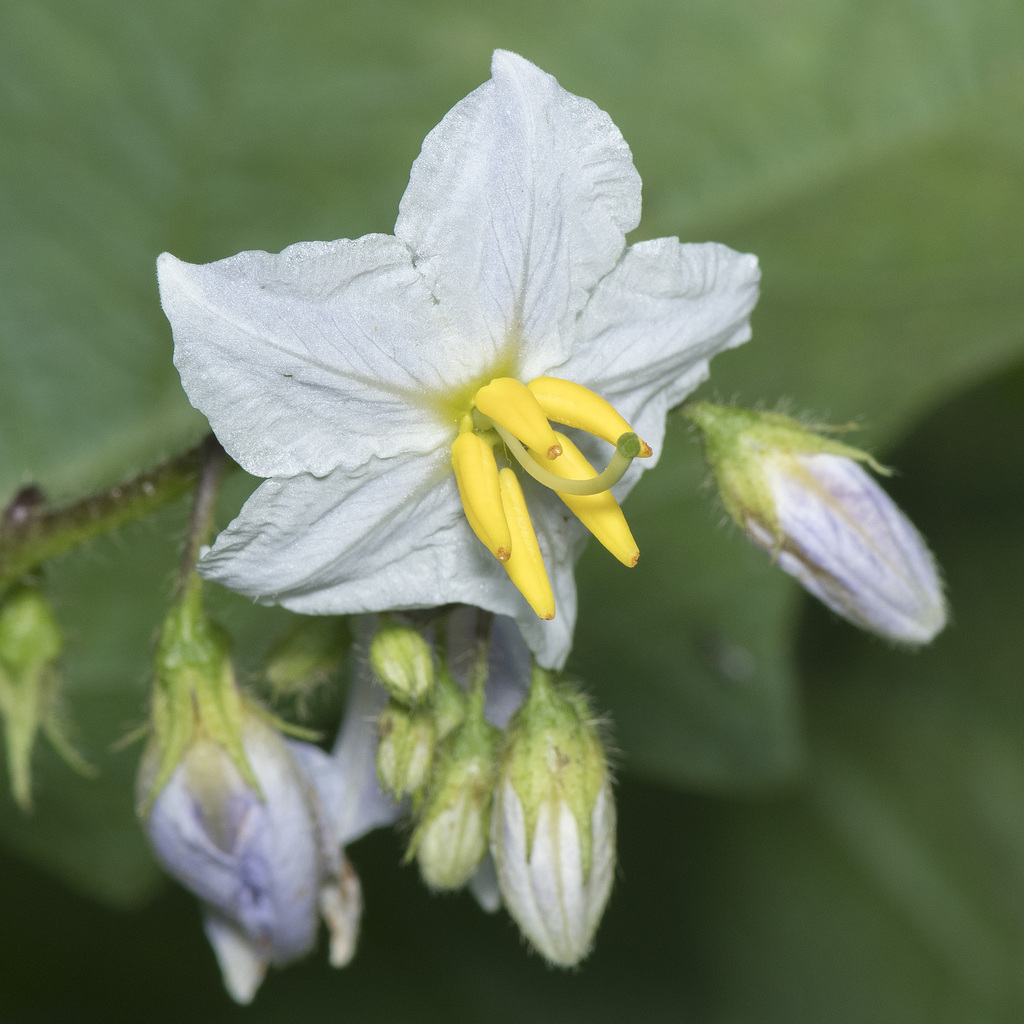
Solanum carolinense, the Carolina horsenettle, is not a true nettle, but a member of the Solanaceae, or nightshade family. It is a perennial herbaceous plant, native to the southeastern United States, though its range has expanded throughout much of temperate North America. The plant is considered to be invasive in parts of Europe, Asia, Africa and Australia. The stem and undersides of larger leaf veins are covered with prickles.
"Horsenettle" is also written "horse nettle" or "horse-nettle", though USDA publications usually use the one-word form. Though there are other horsenettle nightshades, S. carolinense is the species most commonly called "the horsenettle". Other common names include radical weed, sand brier or briar, bull nettle, tread-softly, Solanum mammosum ("apple of Sodom"), devil's tomato and wild tomato.
From the article Solanum carolinense on Wikipedia (CC BY-SA), quoted section by section
Description
The leaves are alternate, elliptic-oblong to oval, 6 to 11 centimetres (2+1⁄2 to 4+1⁄2 inches) long, and each is irregularly lobed or coarsely toothed. Both surfaces are covered with fine hairs. The leaves smell like potatoes when crushed. The flowers have five petals and are usually white or purple with yellow centers, though there is a blue variant that resembles the tomato flower. The fruits are berries that resemble tomatoes. The immature fruit is dark green with light green stripes, turning yellow and wrinkled as it matures. Each fruit contains around 60 seeds. It flowers throughout the summer, from April to October (in the northern hemisphere). The plant grows to 90 cm (3 ft) tall, is perennial, and spreads by both seeds and underground rhizome. Stems of older plants are woody.
Range & habitat
Solanum carolinense can be found growing in pastures, roadsides, railroad margins, and in disturbed areas and waste ground. They can grow to about 1 m (3 ft 3 in) tall, but are typically shorter, existing as subshrubs. They prefer full sun, and can tolerate both wet or dry conditions. They grow readily in sandy or loamy soils, and may also tolerate a wide range of soil types. They are most vigorous and most likely to become weedy or aggressive on disturbed sites, but can also be found in less disturbed habitats.
Wikipedia: “Habitat”
Toxicity
Many parts of the plant have historically been used to create medicines to treat various conditions. It was listed in the United States National Formulary from 1916 to 1936 for use by pharmacists. However all parts of the plant, including its tomato-like fruit, contain toxins in varying degrees due to the presence of solanine glycoalkaloids which is a toxic alkaloid and one of the plant's natural defenses. While ingesting any part of the plant can cause fever, headache, scratchy throat, nausea, vomiting, and diarrhea, ingesting the fruit can cause abdominal pain, circulatory and respiratory depression, or even death.
Where it lives
Recorded sightings
—
geo-referenced records in GBIF, from museums, herbaria and field observers.
Drag the globe to turn it. Dots are where records exist, not a range map; darker means more records.
In the stacks
Searching the stacks…
Every page naming Solanum carolinense in the Biodiversity Heritage Library →
This page is assembled live from iNaturalist, GBIF, Wikipedia, the Source Library and the Internet Archive. It is not yet part of the hand-edited codex. iNaturalist taxon 52899.