- Plants
- ›Vascular Plants
- ›flowering plants
- ›Dicots
- ›pepper plants, birthworts, and allies
- ›birthwort family
- ›Asaroideae
- ›Asarum
- ›Asarum
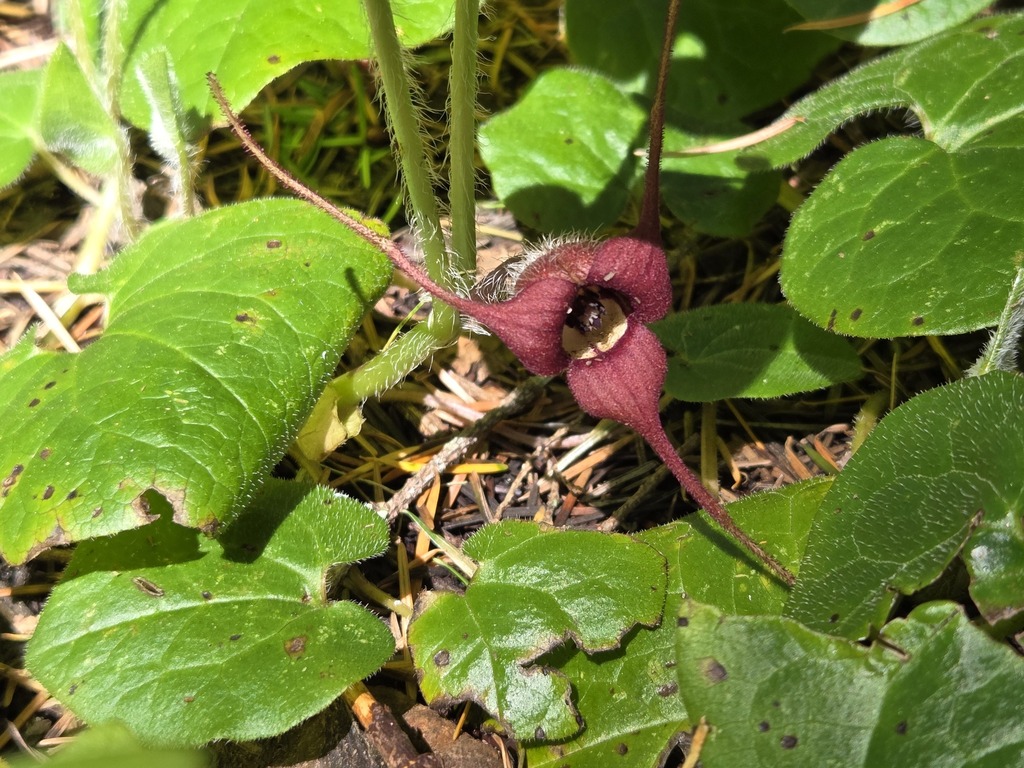
Western Wild Ginger
Asarum caudatum
Asarum caudatum (British Columbia wild ginger, western wild ginger, or long-tailed wild ginger) is native to rich moist forests of western North America from British Columbia to California and as far east as western Montana. It is an evergreen with flowers that develop from March to August. The flowers are distinct, hirsute (hairy), cup-shaped, and brown-purple to green-yellow which terminate in three, long, gracefully curved lobes, often concealed by leaves. The long rhizomes give rise to...
From the article Asarum caudatum on Wikipedia (CC BY-SA), quoted section by section
Description
Growing from a long rhizome, the reniform (kidney/heart-shaped) leaves range from 2–10 centimetres (3⁄4–4 inches) in length. The leaves are found in colonies or clusters as the rhizome spreads, forming mats. The leaves emit a ginger aroma when rubbed.
Blooming from April to July (about a month earlier in British Columbia), the flower sits at the end of a 15 cm (6 in) leafstalk, often on the ground, hidden by the leaves. The flowers are hirsute (hairy), cup-shaped, and brown-purple to green-yellow, terminating in three, long, gracefully curved lobes.
Similar species. Similar species include A. hartwegii, A. lemmonii, and A. marmoratum.
Range & habitat
Asarum caudatum is found in British Columbia, Washington, Oregon, Northern California, Idaho, and Montana in moist, shaded environments. Its northernmost populations occur near Meziadin Lake. It is a typical herb found in the understory of mixed conifer forests under 670 metres (2,200 ft) in elevation, and is often a dominant plant.
Wikipedia: “Distribution and habitat”
What it does
A. caudatum reproduces rhizomatously, meaning many mats are formed by one clonal plant connected by a rhizome. It can also reproduce sexually, with its seeds dispersed by ants. The flowers are pollinated by flies. However, cross-pollination is rare. Ants are attracted by a fatty appendage attached to the seed. The ants carry the entire package back to their colonies. The seed is often dropped outside the nest once the ant realizes only the appendage is edible. Due to the costs of producing seeds with an appendage to attract ants, it is more energetically favorable for the plant to reproduce rhizomatously.
Wikipedia: “Ecology”
At the table
The root is edible in small amounts. Native Americans used the plant for various medicinal purposes. Some describe using A. caudatum as a ginger substitute and as a tea with medicinal properties. In a study on its effects on fungus, A. caudatum had antifungal properties when tested against nine fungal species.
Wikipedia: “Uses”
Toxicity
Members of the family Aristolochiaceae contain aristolochic acid, which has been recognized as a carcinogen.
In human culture
Caudatum comes from the Latin cauda, meaning tail. This refers to the tail-like shape of the flower's calyx.
Wikipedia: “Etymology”
Where it lives
Recorded sightings
—
geo-referenced records in GBIF, from museums, herbaria and field observers.
Drag the globe to turn it. Dots are where records exist, not a range map; darker means more records.
In the stacks
Searching the stacks…
Every page naming Asarum caudatum in the Biodiversity Heritage Library →
This page is assembled live from iNaturalist, GBIF, Wikipedia, the Source Library and the Internet Archive. It is not yet part of the hand-edited codex. iNaturalist taxon 52858.