- Plants
- ›Vascular Plants
- ›flowering plants
- ›Dicots
- ›Gentians, Dogbanes, Madders, and Allies
- ›madder family
- ›Cinchonoideae
- ›Naucleeae
- ›Cephalanthus
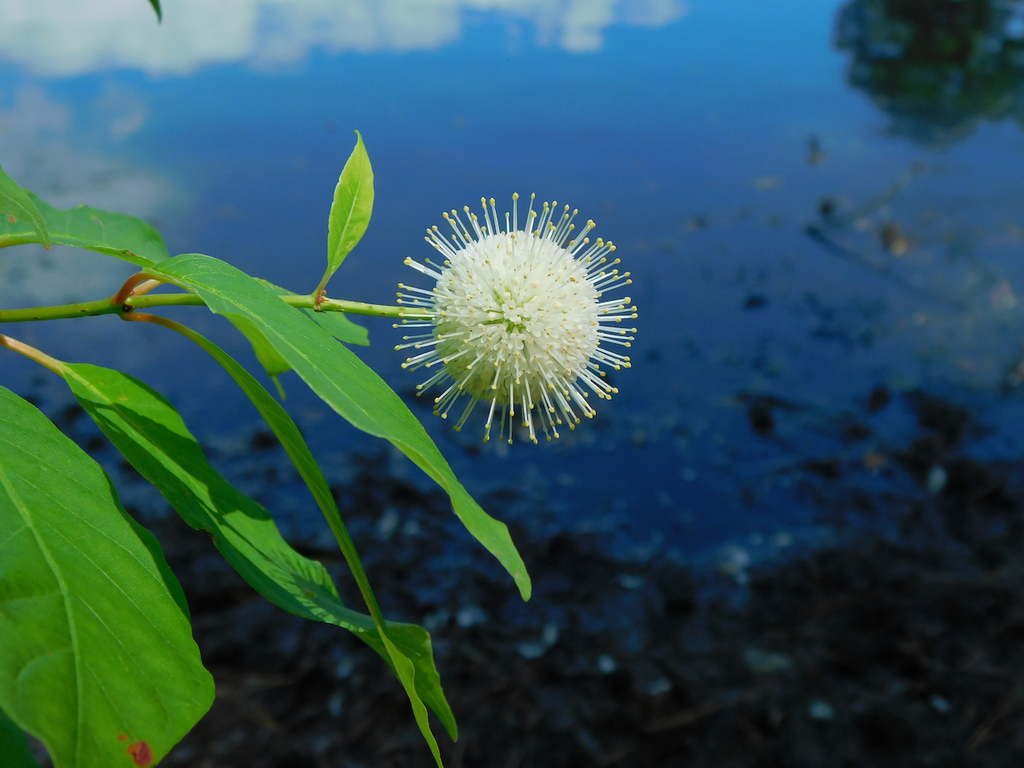
buttonbush
Cephalanthus occidentalis
Cephalanthus occidentalis is a species of flowering plant in the family Rubiaceae that is native to eastern and southern North America. Common names include buttonbush, common buttonbush, button-willow, buck brush, and honey-bells.
From the article Cephalanthus occidentalis on Wikipedia (CC BY-SA), quoted section by section
Description
Cephalanthus occidentalis is a deciduous shrub or small tree that averages 1–3 m (3.3–9.8 ft) in height, but can reach 6 m (20 ft). The leaves are opposite or in whorls of three, elliptic to ovate, 7–18 cm (2.8–7.1 in) long and 4–10 cm (1.6–3.9 in) broad, with a smooth edge and a short petiole. The flowers are arranged in a dense spherical inflorescence 2–3.5 cm (0.79–1.38 in) in diameter on a short peduncle. Each flower has a fused white to pale yellow four-lobed corolla forming a long slender tube connecting to the sepals. The stigma protrudes slightly from the corolla. The fruit is a spherical cluster of achenes (nutlets).
Range & habitat
Buttonbush is a common shrub of many wetland habitats in its range, including swamps, floodplains, mangrove, pocosin, riparian zones, and moist forest understory. It is a member of the flora in the Everglades.
Wikipedia: “Habitat”
What it does
Waterfowl and other birds eat the seeds. Wood ducks utilize the plant as nest protection, and mallards eat the fruit. Deer browse the foliage, which is poisonous to livestock. Insects and hummingbirds take the nectar, with bees using it to make honey. It is a larval host to the hydrangea sphinx, the royal walnut moth, and the titan sphinx.
Wikipedia: “Ecology”
In medicine
Cephalanthus occidentalis has a number of historical medicinal uses, but it is also toxic due to the presence of cephalanthin.
Wikipedia: “Medicinal”
How it is grown
Buttonbush is cultivated as an ornamental plant for a nectar source or 'honey plant' and for aesthetics in gardens and native plant landscapes, and is planted on slopes to help control erosion. Buttonbush is a suitable shrub for butterfly gardens.
Wikipedia: “Cultivation”
Where it lives
Recorded sightings
—
geo-referenced records in GBIF, from museums, herbaria and field observers.
Drag the globe to turn it. Dots are where records exist, not a range map; darker means more records.
In the stacks
Searching the stacks…
Every page naming Cephalanthus occidentalis in the Biodiversity Heritage Library →
This page is assembled live from iNaturalist, GBIF, Wikipedia, the Source Library and the Internet Archive. It is not yet part of the hand-edited codex. iNaturalist taxon 52763.