- Plants
- ›Vascular Plants
- ›flowering plants
- ›monocots
- ›grasses, sedges, cattails, and allies
- ›grasses
- ›Pooideae
- ›Bromeae
- ›Bromus
- ›Bromus
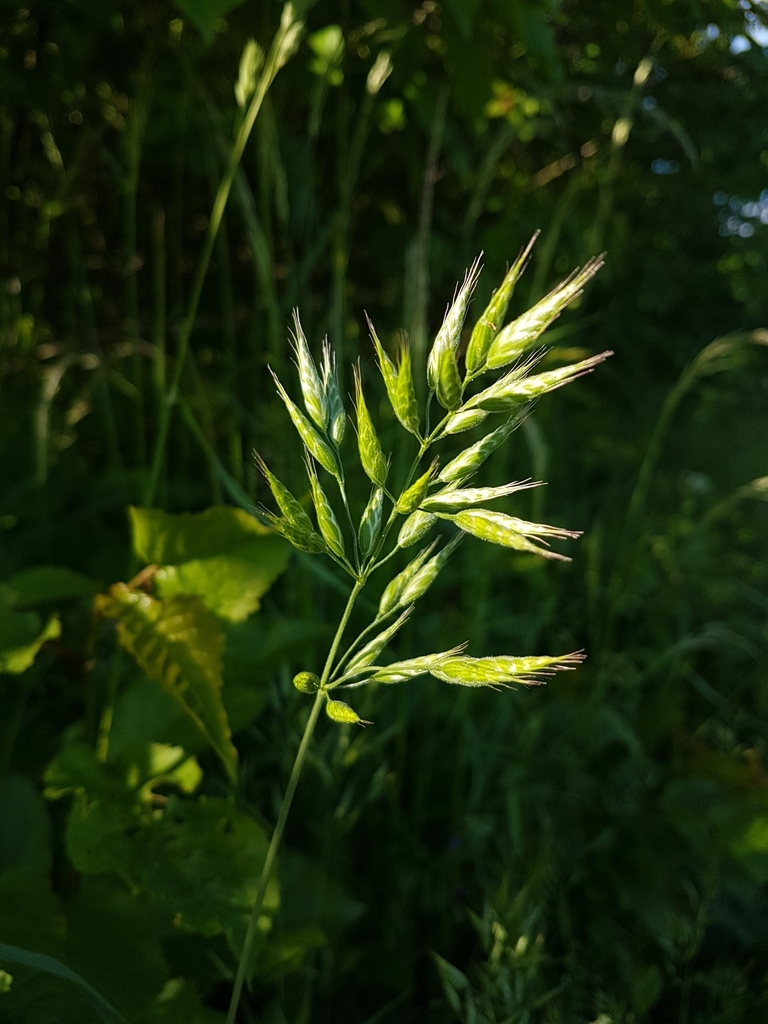
common soft brome
Bromus hordeaceus
Bromus hordeaceus, the soft brome, is an annual or biennial species of grass in the grass family (Poaceae). It is also known in North America as bull grass, soft cheat, and soft chess.
It is the most common species of Bromus in Britain, where it can be found on roadsides, waste ground, meadows, and cultivated land. It is found throughout Europe and western Asia, and was introduced into North and South America and Australia.
From the article Bromus hordeaceus on Wikipedia (CC BY-SA), quoted section by section
Description
The plant is pubescent entirely and lacks rhizomes. It can grow 7–110 cm (3–43 in) high, sometimes in tufts, sometimes singly. The smooth, yellowish brown culms measure 0.5–5 mm (0.02–0.20 in) wide at their base, and are minutely to densely pubescent, with hairs measuring up to 0.6 mm (0.02 in) long. The moderately to densely pilose leaf sheaths are mostly closed, with hairs 1.2 mm (0.047 in) long. The plant lacks auricles. The membraneous and erose ligules are 1–2.6 mm (0.04–0.10 in) long and are glabrous or pubescent. The grey-green leaf blades are 2.2–18 cm (0.9–7.1 in) long and 1–5.3 mm (0.04–0.21 in) wide, with a pubescent adaxial surface and an abaxial surface pubescent with hairs about one quarter the length of those on the adaxial surface. The leaf margins are smooth or serrated. The grey-green to purple panicles are 2.5–14 cm (1.0–5.5 in) long and 1–4 cm (0.39–1.57 in) wide. The panicles can be dense or reduced to just one spikelet. The erect to ascending or lax branches of the panicle are scabrous or pubescent, each branch bearing one spikelet. The ovate-lanceolate spikelets are 1.7–3 cm (0.67–1.18 in), including the awns 3–8 mm (0.12–0.31 in) long. The rachillae can be visible when the spikelet is mature and the spikelet has six to eleven florets. The subequal glumes are minutely to densely pubescent and the keels are serrated. …
Range & habitat
Bromus hordeaceus is native to the Mediterranean basin, and is now widely distributed across North America, Europe, Africa, and Australia. It grows in waste areas, road verges, fields, grassy plains, and sandy beaches. The grass prefers drained or dry soils consisting of clay loam or sand, especially areas tending to be less fertile. The plant is resistant to drought and temperature variations.
Wikipedia: “Distribution and habitat”
Where it lives
Recorded sightings
—
geo-referenced records in GBIF, from museums, herbaria and field observers.
Drag the globe to turn it. Dots are where records exist, not a range map; darker means more records.
In the stacks
Searching the stacks…
Every page naming Bromus hordeaceus in the Biodiversity Heritage Library →
This page is assembled live from iNaturalist, GBIF, Wikipedia, the Source Library and the Internet Archive. It is not yet part of the hand-edited codex. iNaturalist taxon 52703.